Meal planning for college students has unusual constraints: a dining hall, mini-fridge, microwave, limited budget, and a changing class schedule. Cornell Health’s student nutrition guidance recommends consistent meals that combine protein or dairy, grains or starchy foods, and fruits or vegetables whether food comes from campus, home, restaurants, or takeout. This guide applies that flexible approach to dining-hall planning, dorm-friendly ingredients, a sample $30 grocery add-on list, and no-stove meal ideas.
⚠️ Disclaimer: This meal plan is for general informational purposes only. Always consult your doctor before starting any new diet, especially if you have a medical condition, are pregnant, or nursing.
Why College Meal Planning Is Its Own Thing 🧭
You’re not cooking dinner for a family of 4. You’re not on a keto reset. You’re a college student, and your meal reality is different:
Don’t Want to Plan Every Dinner Yourself?
28 Days of Dinners Planned for You gives you 28 days of dinners, grocery lists and prep guidance already organized for you.
Plan My Next 28 Dinners →- 🥘 Meal plan is your foundation — dining hall is 60–70% of your calories
- 🥶 Mini-fridge only — 3 shelves, no real freezer
- 🍞 Microwave + kettle = your entire kitchen
- 💸 Grocery budget = $20–50/week if you’re lucky
- ⏰ Chaotic schedule — 8 am labs, 10 pm study groups, weekend fluctuations
- 🌙 Late-night hunger is real and needs a plan (or Domino’s wins every time)
The good news: with a structured college meal planning framework, you can eat well, save money, hit protein goals, and stop feeling like your diet is destroying you.
The 4 Rules of College Meal Planning 🎯
Before the weekly plan, these four rules are your foundation:
🎯 Rule 1: Maximize Your Meal Plan Before Anything Else
You’re already paying for the dining hall. Use it — strategically. Every meal plan swipe is a chance to hit protein, fiber, and vegetables for zero extra cost.
Dining hall priorities: – Load up on eggs, grilled chicken, tofu, beans, or fish — protein first – Salad bar is your best friend — fill half your plate – Take extras when allowed (a boiled egg, fruit, a container of yogurt for later) – Skip the endless pasta + pizza + dessert loop — you know why
🎯 Rule 2: Build 3 “No-Cook” Meals for Dorm Days
For days you skip the dining hall (sleeping through breakfast, late study nights, weekends), have 3 no-cook meals ready.
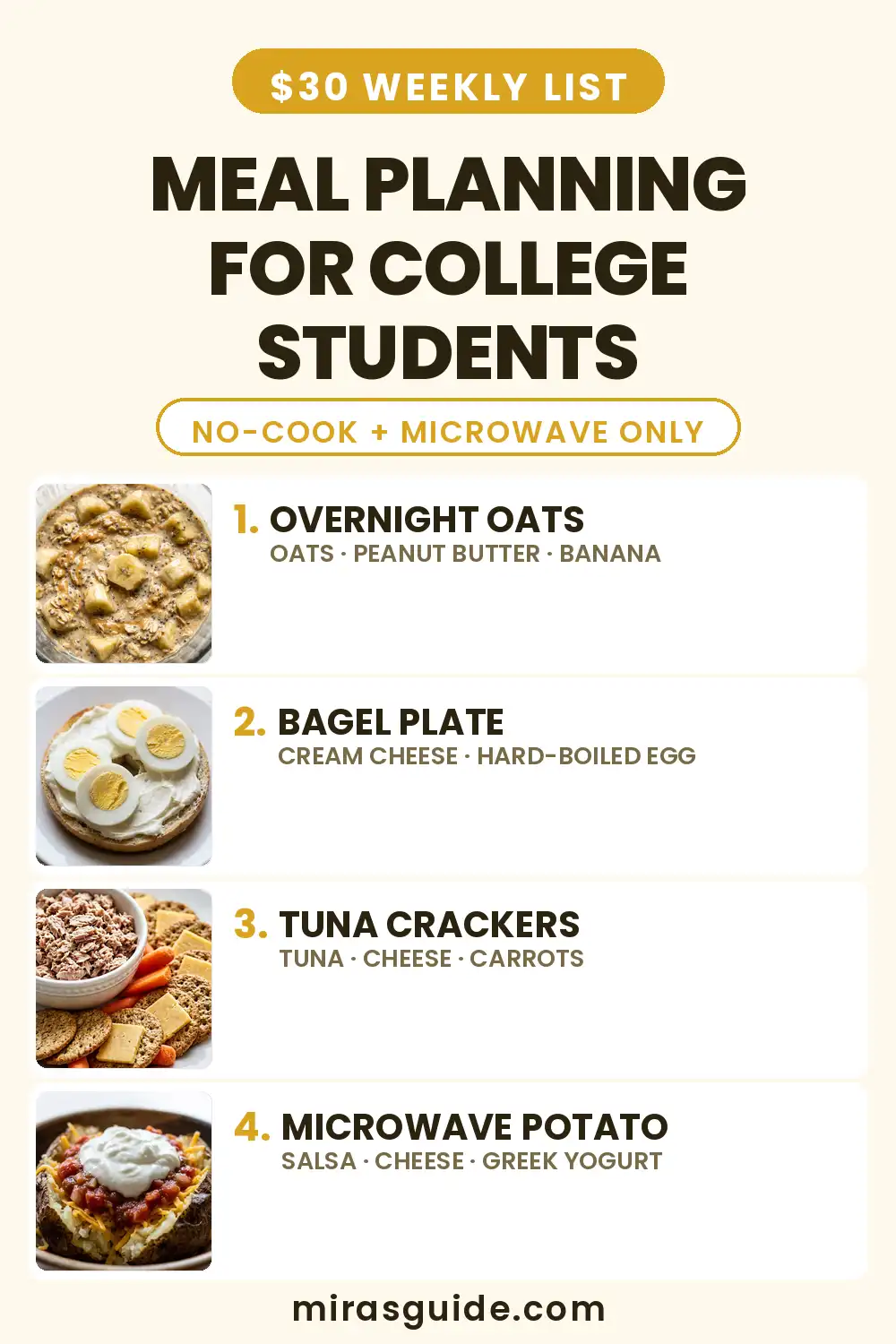
Dorm-friendly no-cook meals: – 🥯 Bagel + cream cheese + hard-boiled eggs (from dining hall) – 🥣 Overnight oats + peanut butter + banana – 🥪 Tuna packet + whole-grain crackers + cheese slices + carrots – 🍎 Apple + almond butter + Greek yogurt cup + granola – 🌯 Tortilla + hummus + turkey slices + spinach + cheese
🎯 Rule 3: Microwave Meals Are Not the Enemy
A microwave can do more than reheat packaged food. Harvard Health’s microwave cooking overview explains that short microwave cooking can preserve nutrients well. Build quick dorm meals from a protein, produce, and a starch:
- 🥔 Baked potato (microwave 5 min) + salsa + cheese + Greek yogurt
- 🥚 Scrambled eggs in a mug (2 eggs, 1 min)
- 🍚 Microwave rice pouch + canned chicken + salsa
- 🍜 Ramen upgraded with an egg + frozen peas + hot sauce
- 🥣 Microwave oatmeal + peanut butter + banana + protein powder
Frozen microwave meals also don’t have to be junk. Amy’s, Kevin’s, Trader Joe’s, or Healthy Choice have real protein + veg options for $3–5 each.
🎯 Rule 4: Weekly Grocery = $30 for 15 Add-On Items
You don’t need to buy a full week of groceries. Your dining hall handles the bulk. Your weekly $30 shop covers add-ons:
- Protein: Greek yogurt cups (5-pack), tuna packets, string cheese, deli turkey
- Carbs: bagels, whole-grain wraps, instant oatmeal, microwave rice
- Fruit/Veg: bananas, apples, baby carrots, cherry tomatoes
- Snacks: hummus, peanut butter, protein bars, popcorn
- Beverage: shelf-stable protein shakes (12-pack lasts 2 weeks)
The 5-Step College Meal Planning System 🗓️
Here’s your weekly framework — actually doable between classes.
Step 1: Print Your Dining Hall Menu on Sunday 📅
Most colleges post the weekly menu online. Print it or screenshot it. Circle the protein-heavy options (grilled chicken night, taco bar, breakfast-for-dinner). Those are your “definite dining hall” meals.
Step 2: Identify Your “Dorm Gap Days” 🕳️
Look at your class schedule for the week. When are you skipping the dining hall? – Early morning classes (breakfast in dorm) – Late study nights (dinner in dorm) – Weekends (dining hall may have shorter hours)
Those are your gap days — you need a dorm meal ready.
Step 3: Buy One Round of Groceries for the Gaps 🛒
$25–35, once a week. Aisle-by-aisle list:
- Produce: 5 bananas, 5 apples, bag of carrots, cherry tomatoes
- Dairy: Greek yogurt 5-pack, string cheese, cottage cheese cup
- Bread/carbs: whole-grain wraps, instant oatmeal packets, microwave rice pouch
- Protein: 2 tuna packets, deli turkey, hard-boiled egg 6-pack (or make yourself)
- Snacks: peanut butter, hummus, protein bars, popcorn
- Freezer: 2 healthy frozen microwave meals for emergency dinners
Step 4: Pre-Portion Snack Zip-Bags on Sunday 🥜
Sunday night, portion out snacks for the week:
- 5 zip bags of nuts + dark chocolate (afternoon snack)
- 5 zip bags of carrots + hummus in a small container (crunchy snack)
- Reusable water bottle by your bed
Grab-and-go for backpack + late-night study sessions.
Step 5: Have a “Study Snack Strategy” 🌙
The late-night 10 pm–2 am study snack is where diets die. Plan for it:
- 🥜 Handful of almonds + apple slices
- 🥛 Greek yogurt + granola
- 🍿 Air-popped popcorn (huge volume, low calories)
- 🥚 Hard-boiled egg + whole-grain crackers
- 🍫 One square dark chocolate + peppermint tea
That way when hunger hits at 11 pm, you have real food ready — not vending machine chips.
A Sample Week: College Student Meal Plan 📋
Here’s a realistic 5-day snapshot for a student with a meal plan.
Monday (dining hall 3x)
- Breakfast (dorm, no time for dining hall): Overnight oats + peanut butter + banana
- Lunch (dining hall): Salad bar with chicken, chickpeas, egg, cheese, olive oil
- Snack: Greek yogurt + almonds
- Dinner (dining hall): Grilled chicken + rice + broccoli + salad
- Late night: Apple + peanut butter
Tuesday (dining hall 2x)
- Breakfast (dining hall): Scrambled eggs + turkey sausage + fruit + oatmeal
- Lunch (dorm, class runs late): Tuna packet + whole-grain crackers + cheese + carrots
- Snack: Protein bar
- Dinner (dining hall): Taco bar loaded with meat + beans + veggies + salsa
- Late night: Cottage cheese + berries
Wednesday (dining hall 3x)
- Breakfast (dining hall): Yogurt parfait + hard-boiled eggs + fruit
- Lunch (dining hall): Grain bowl with chicken + veggies + hummus
- Snack: String cheese + apple
- Dinner (dining hall): Stir-fry night — tofu or chicken + veggies + rice
- Late night: Popcorn + water bottle
Thursday (dorm-heavy day)
- Breakfast (dorm): Microwave scrambled eggs in a mug + toast
- Lunch (dining hall): Salad bar loaded up
- Snack: Greek yogurt + granola
- Dinner (dorm): Microwave rice + tuna packet + salsa + shredded cheese
- Late night: Hummus + carrots
Friday
- Breakfast (dining hall): Full breakfast — protein + carb + fruit
- Lunch (dorm): Wrap with deli turkey + hummus + spinach + cheese
- Snack: Cottage cheese + berries
- Dinner (dining hall or takeout): Whatever’s happening socially — pizza night is fine occasionally
- Late night: Water + fruit
Total daily protein: 80–120 g. Total daily cost outside dining hall: ~$4–6.
Managing Common College Meal Planning Challenges 🎯
Freshman 15 pressure
The “freshman 15” is real but not inevitable. Culprits: liquid calories (alcohol, sugary drinks, lattes), late-night pizza, and skipping meals then binge-eating. Fix: hit protein at every meal, drink water first, and stop skipping breakfast.
Broke — like, actually broke
- Rice + beans + eggs = complete protein for pennies
- Frozen vegetables are cheaper than fresh + last for weeks
- Bulk oatmeal = 30 breakfasts for $5
- Peanut butter jar = protein for the whole month
- Split a $50 Costco run with roommates for staples
No time to eat between classes
- Batch-make 5 overnight oats on Sunday
- Pre-portion snack bags every Sunday night
- Keep a shelf-stable protein shake in your backpack
- 5 minutes of eating > skipping the meal entirely
Dining hall food fatigue
Every dining hall gets old by week 6. Solutions: – Rotate through the salad bar, breakfast-for-dinner, and stir-fry stations – Bring your own hot sauce, spices, or nut butter to add – Take one meal out per week for variety
Alcohol wrecking nutrition
Alcohol is empty calories, worse sleep, and next-day snack chaos. If you drink, eat a protein-rich meal first, hydrate between drinks, and have Greek yogurt + banana ready for the morning.
The College Dorm Pantry Base 📦
Stock these — your foundation:
Mini-fridge: – Greek yogurt 5-pack – String cheese – Deli turkey slices – Hummus tub – Baby carrots + cherry tomatoes – Hard-boiled eggs (6-pack or make yourself) – Cottage cheese cup
Freezer (mini): – 2 healthy frozen entrées (Amy’s, Kevin’s, Trader Joe’s) – Frozen fruit for smoothies (if you have a blender)
Pantry/Desk: – Peanut butter jar – Instant oatmeal packets – Whole-grain wraps (last 2 weeks) – Tuna packets (shelf-stable) – Microwave rice pouches – Whole-grain crackers – Almonds, walnuts, dark chocolate – Popcorn (microwave or air-pop) – Shelf-stable protein shakes (12-pack) – Reusable water bottle – Hot sauce, everything bagel seasoning
FAQ
How do I meal plan if I don’t have a stove?
Microwave + kettle + mini-fridge = enough. Overnight oats, microwave scrambled eggs, microwave rice pouches, no-cook wraps, and frozen microwave meals cover 90% of dorm eating. Add one hard-boiled egg 6-pack, and you have protein without any cooking.
How much money do I actually need for groceries with a meal plan?
$25–50 per week if you have a meal plan. Your dining hall covers the bulk. Grocery is for gap-day meals, snacks, and drinks. Without a meal plan, budget $50–75/week (still very doable with rice, beans, eggs, oats, and frozen vegetables).
What if I’m gluten-free, vegan, or have food allergies?
Most college dining halls have accommodations — ask the dining services office. They’ll show you the labeled options, the allergen-free station, or work with you on modifications. Our gluten-free meal planning guide covers the specific weekly framework for gluten-free eaters.
How do I hit protein goals in a dorm?
Protein sources that don’t need cooking: Greek yogurt (17g), cottage cheese (14g), tuna packet (20g), deli turkey slices (12g/2 slices), string cheese (7g), hard-boiled egg (6g), shelf-stable protein shake (20–30g). Two of these per meal easily hits 30g of protein.
How does this fit with your other meal plans?
College meal planning is a compressed version of our beginner framework. Our beginner meal planning guide covers the full foundation for once you’re in an apartment with a real kitchen. Our meal planning for one picks up after graduation for solo cooking. And our cheap high-protein meal prep works well for broke college years.
Your Next Step 👉
Pick ONE thing this week. My honest suggestion:
- Print your dining hall menu Sunday night. Circle the protein-heavy meals.
- Buy Greek yogurt + tuna packets + oatmeal + peanut butter. That’s your dorm gap kit — one Target run.
- Pre-portion 5 snack bags Sunday. Grab-and-go for the week.
- Set a rule: protein at every meal. Even at the dining hall. Even at 2 am.
That’s your first college meal planning week.
Once these habits stick, you’ll notice you have more energy in class, spend way less on random food, and stop the “I ate garbage all week” spiral. Our cheap high-protein meal prep becomes useful once you graduate to an apartment kitchen. And if you’re eventually cooking for one, our meal planning for one walks through the whole framework.
Meal planning for college students isn’t about being a chef in a dorm. It’s about leveraging what you already have — the meal plan, the microwave, the $30 grocery budget — and adding just enough structure to eat well through 4 years of chaos. Do that, and you’ll graduate with energy, savings, and a real skill you carry into every apartment after.

Stop wondering what’s for dinner
This article covers tonight. 28 Days of Dinners Planned for You covers the next 27—decided, shopped and prepped.
- ✓ 28 dinner recipes for real weeknights
- ✓ 4 weekly grocery lists, done for you
- ✓ Simple prep guidance for smoother evenings
- ✓ Leftover strategy & emergency dinners