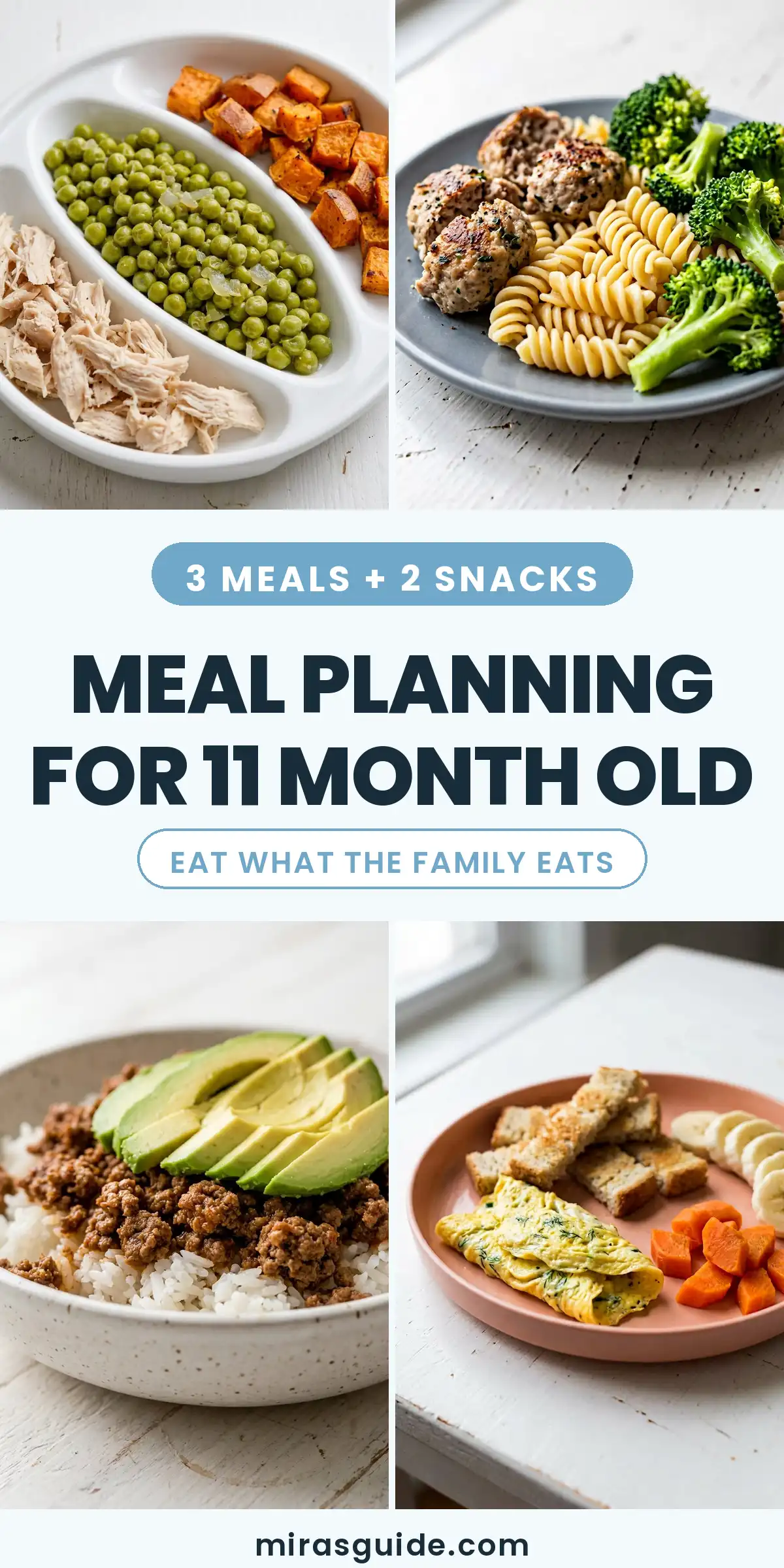
Meal planning for an 11 month old is a wildly different beast than planning for a 6 month old. Purees are (mostly) behind you. Your baby is grabbing food off your plate. They want texture, variety, and independence — and they want it now.
And in just a few weeks they’ll be one year old, transitioning off formula (or continuing breastfeeding) and eating whatever the family eats.
Don’t Want to Plan Every Dinner Yourself?
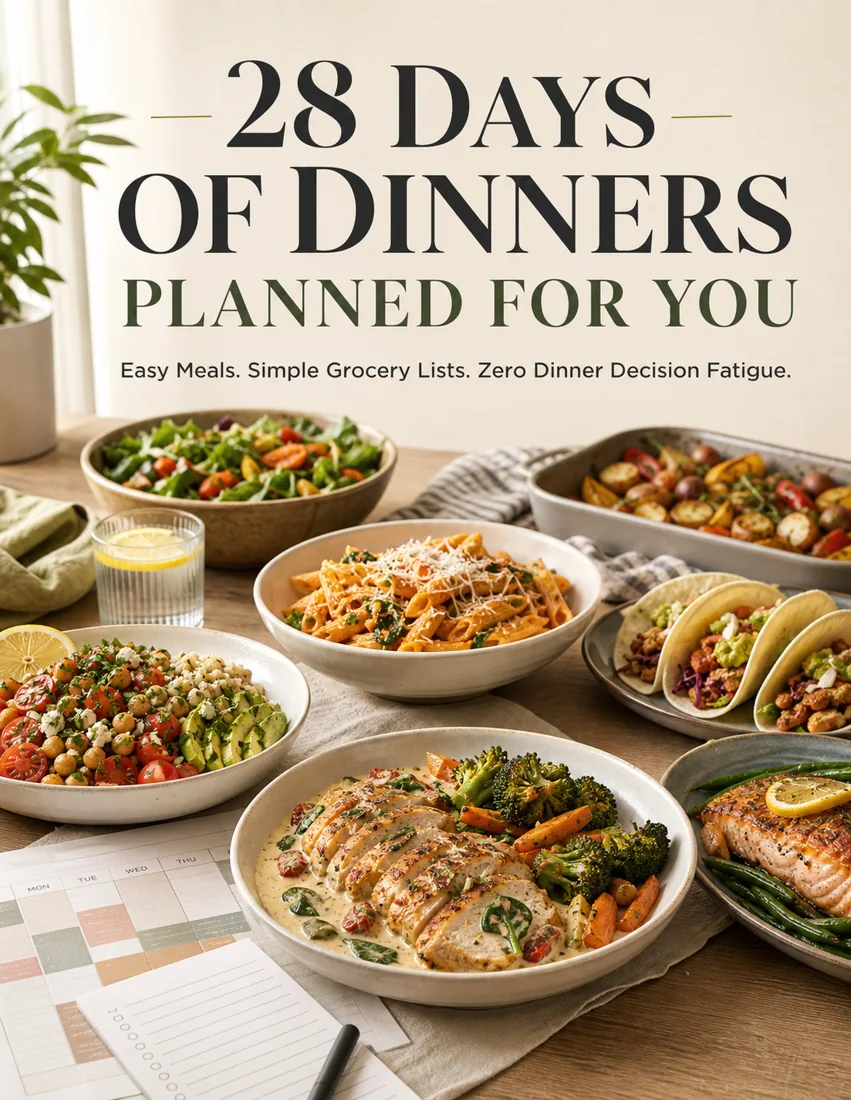
28 Days of Dinners Planned for You gives you 28 days of dinners, grocery lists and prep guidance already organized for you.
This guide is the practical weekly meal planning framework for an 11-month-old: 3 real meals, 2 snacks, mostly finger foods, iron-rich staples, and a smooth glide path toward the toddler year. No pressure to make everything from scratch. No baby-food-jar guilt.
Just a real system for a real pre-toddler who’s ready to eat like the rest of the family — with a few age-appropriate tweaks.
👶 Pediatric Disclaimer: Every baby and child develops differently. Always consult your pediatrician before introducing new foods, changing your child’s diet, or starting a new feeding routine. This article is for informational purposes only and does not replace professional medical guidance.
Why 11 Months Is Its Own Meal Planning Stage 🧭
Your 11-month-old is not the same eater they were 3 months ago. Big shifts happening right now:
- 🥄 Self-feeding is a driving force — they want the spoon, the food, the cup, all of it
- 🍗 Finger foods dominate — most meals are soft, cut-up versions of family foods
- 🥛 Milk feeds are dropping — usually 3–4 milk feeds/day instead of 6+
- 🍽️ 3 meals + 2 snacks is the standard rhythm
- 🩸 Iron still critical — sarcopenia isn’t a thing yet, but iron deficiency in toddlers is common
- 🥜 Allergen continued exposure — once you’ve introduced peanut, egg, dairy, keep offering 2–3x/week
The good news: at 11 months, your baby can eat 80–90% of what the family eats — with minor tweaks (no added salt, no honey, no whole nuts, cut small). Meal planning gets much simpler at this stage.
The 4 Rules of Meal Planning for an 11-Month-Old 🎯
Before the weekly plan, these four rules run everything:
🎯 Rule 1: 3 Meals + 2 Snacks + 3–4 Milk Feeds
This is the standard 11-month rhythm:
- 🌅 Morning: milk on wake, breakfast 30 min later
- ☕ Mid-morning snack: small finger food
- ☀️ Lunch: 3-part plate (protein + carb + veg/fruit)
- 🕐 Afternoon snack: milk feed + small finger food
- 🌆 Dinner: family-adapted meal
- 🌙 Bedtime: milk feed
Predictable rhythm = happy baby + easier planning.
🎯 Rule 2: Every Meal = Protein + Carb + Veg/Fruit
You’re now feeding a mini-adult. Every meal should have all three:
- 🥩 Protein: shredded chicken, ground beef, mashed beans, egg, cheese, yogurt, tofu, flaked fish
- 🍚 Carb: rice, pasta, soft toast, roasted potato, oatmeal
- 🥦 Veg or fruit: steamed broccoli florets, roasted sweet potato, berries, banana coins
Three little piles on the tray. That’s a meal.
🎯 Rule 3: Family Meals Are the Goal
At 11 months, aim to serve baby a modified version of what the adults eat. This saves you cooking two meals AND builds early “eat what the family eats” habits.
Simple modifications: – Salt: cook family meal unsalted, add salt to adult plates after – Honey: skip entirely until 12 months (botulism risk) – Choking hazards: cut grapes, cherry tomatoes, hot dog rounds into quarters lengthwise – Whole nuts: never — use nut butter thinly spread – Sugar: minimize; save sweet foods for occasional treats – Texture: everything soft enough to smoosh between your fingers
🎯 Rule 4: Milk Volume Comes Down, Water Goes Up
At 11 months, baby needs about 20–24 oz of breast milk or formula daily (down from 30+ oz earlier). Water becomes a real meal companion — offer 4–8 oz per day with meals in an open cup or straw cup. No juice needed.
The 5-Step 11-Month Meal Planning System 🗓️
Here’s how to build a week without losing your mind.
Step 1: Choose 5 Family-Friendly Dinners 🍽️
Sunday, pick 5 dinners that are inherently baby-friendly. Winners:
- 🍝 Ground turkey pasta with hidden vegetables (no salt in sauce)
- 🍚 Sheet pan chicken + roasted veggies + rice
- 🌮 Deconstructed taco bowls (baby gets soft-cooked beef + avocado + rice)
- 🥘 Slow cooker chicken thighs with sweet potatoes
- 🍲 Turkey meatball soup with soft-cooked pasta + vegetables
Baby eats a modified plate. Adults eat the full plate. Same base ingredients.
Step 2: Pick 5 Rotating Breakfasts 🍳
Rotate the same 5 breakfasts each week — 11-month-olds love repetition:
- Full-fat plain yogurt + berries + tiny drizzle of nut butter
- Whole-grain oatmeal + banana + ground flax
- Scrambled egg + soft-cooked veggie + toast strips
- Cottage cheese + soft-diced peach or pear
- Small pancake (unsweetened) + almond butter + strawberry slices
Step 3: Prep 5 Snack Boxes 🥕
Pack 5 clear containers on Sunday, one for each weekday. Each contains:
- 3 cubes of cheese
- Small handful of soft fruit (blueberries, banana pieces, watermelon)
- Small handful of soft, well-cooked vegetables
- A handful of whole-grain O’s or soft crackers
Grab-and-go for morning + afternoon snacks. Zero decision fatigue.
Step 4: Batch-Cook Protein Sources on Sunday 🥩
Same as adult meal prep, just adapted:
- Baked chicken thighs (shred fine, portion into small containers)
- Turkey meatballs (baked, halved for baby)
- Hard-boiled eggs (quarter for choking safety)
- Cooked lentils or beans (in the fridge, mashed slightly)
That’s a week of protein done in 90 minutes.
Step 5: Keep a “Yes Foods” List on the Fridge 📝
Write out 15 foods your baby reliably eats. Refer to it when you blank on ideas. Update weekly. Example list:
- Yogurt, cottage cheese, cheese cubes
- Chicken, meatballs, salmon, tofu
- Sweet potato, broccoli, peas, carrots
- Berries, banana, avocado, mango
- Oatmeal, rice, pasta, whole-grain bread
A Sample Week: 11-Month-Old Meal Plan 📋
Here’s a realistic 5-day snapshot:
Monday
- 7 am: Nurse or 6 oz formula
- 8 am: Oatmeal + banana + ½ tsp peanut butter mixed in
- 10 am snack: Cheese cubes + blueberries
- 12 pm lunch: Shredded chicken + roasted sweet potato + soft peas
- 3 pm: Nurse or 6 oz formula + small handful of Cheerios
- 6 pm dinner: Turkey meatball halves + soft-cooked pasta + steamed broccoli florets
- 7 pm: Bedtime nurse or 6 oz formula
Tuesday
- 7 am: Milk feed
- 8 am: Scrambled egg + toast strips + banana coins
- 10 am snack: Yogurt pouch + soft pear pieces
- 12 pm lunch: Leftover meatballs + rice + steamed carrots
- 3 pm: Milk feed + rice cake with a thin smear of avocado
- 6 pm dinner: Ground turkey taco bowl (soft-cooked meat + avocado + rice + shredded cheese)
- 7 pm: Bedtime milk feed
Wednesday
- 8 am: Cottage cheese + soft peach + whole-grain toast squares
- 10 am snack: Roasted sweet potato cubes + blueberries
- 12 pm lunch: Deconstructed taco bowl leftovers
- 3 pm snack: Milk feed + soft banana pancake
- 6 pm dinner: Baked chicken thigh (shredded) + roasted potatoes + steamed broccoli
Thursday
- 8 am: Yogurt + berries + a drizzle of nut butter
- 10 am snack: Cheese + whole-grain crackers
- 12 pm lunch: Chicken + potato + broccoli leftovers
- 3 pm snack: Milk feed + soft roasted apple slices
- 6 pm dinner: Salmon (flaked, deboned) + soft rice + peas
Friday
- 8 am: Oatmeal + mashed berries + ground flax
- 10 am snack: Banana + cottage cheese
- 12 pm lunch: Salmon + rice + peas leftovers
- 3 pm snack: Milk feed + soft avocado on toast
- 6 pm dinner: Slow cooker chicken + sweet potatoes + steamed carrots
Total daily food: ~ ¼ to ½ adult portion sizes. Total daily milk: 20–24 oz. Water with each meal.
Managing Common 11-Month Meal Planning Challenges 🎯
Baby refuses vegetables suddenly
Totally normal at 11 months — food preferences fluctuate. Keep offering (research shows kids need 10–15 exposures before accepting a new food). Don’t turn meals into a battle. Rotate cooking methods (roasted vs steamed vs mashed).
Only wants to feed themselves — makes a mess
Let them. Self-feeding is a critical developmental skill. Cover the floor with a splat mat, offer a preloaded spoon alongside finger foods, and accept that this stage is messy. It passes.
Suddenly refusing bottle or breast
Could be teething, distraction, or a natural drop in milk needs at this age. Try offering milk in a cup. If baby is still hitting weight-gain milestones and eating solids well, some milk drop is normal.
Constipation from too much dairy
Constipation can happen as solid foods change. Continue your baby’s usual breast milk or infant formula, and offer age-appropriate fiber-rich foods such as pears, prunes, oatmeal, or beans plus water with meals. HealthyChildren.org’s infant constipation guidance recommends contacting your pediatrician if constipation lasts more than a week or if you see blood in the stool.
Ready for cow’s milk?
American Academy of Pediatrics guidance on cow’s milk recommends waiting until about 12 months before using cow’s milk as a drink. Until then, breast milk or iron-fortified infant formula should remain the main milk source; yogurt or cheese offered as solids is different from replacing breast milk or formula with cow’s milk.
The 11-Month Baby Food Pantry Base 📦
Stock these — the foundation of a week:
Refrigerator: – Full-fat plain yogurt (whole milk, unsweetened) – Cottage cheese – Shredded cheese, cheese cubes (whole milk mozzarella, mild cheddar) – Eggs (18-count) – Ripe avocados, berries, ripe pears, bananas
Freezer: – Frozen fruit (blueberries, mango, peaches) – Frozen vegetables (peas, broccoli, cauliflower) – Frozen salmon fillets – Batch-cooked turkey meatballs, chicken thighs
Pantry: – Whole-grain oatmeal (unsweetened) – Whole-grain bread, crackers, pasta – Rice, quinoa – Canned wild salmon (rinsed, deboned) – Canned beans (low sodium) – Natural peanut butter – Whole-grain O’s cereal (unsweetened) – Baby-safe open cup or straw cup
FAQ
How much should an 11-month-old eat?
Roughly ¼ to ½ of an adult portion per meal. That’s usually ½ cup of food total across 3 small piles on the tray. Add 2 snacks per day and 3–4 milk feeds. Every baby is different — follow their cues. If they turn away, meal is over. If they’re still eating, offer more.
Can my 11-month-old have salt and sugar?
Minimize both. Baby’s kidneys can’t handle a lot of added salt (aim for less than 1 g/day). Sugar isn’t harmful in small amounts but sets up sweet-preference habits that last for years. Cook family meals unsalted and add salt to adult plates. Save sweet foods for occasional treats.
What about honey?
Never before 12 months. Honey can carry spores of Clostridium botulinum, which cause infant botulism. Wait until baby’s first birthday.
Is my baby getting enough iron?
Aim for 1–2 iron-rich foods per day. Best sources: red meat, iron-fortified cereal, beans, tofu, egg yolk, and dark leafy greens paired with a vitamin-C food (berries, citrus, tomato) to boost absorption. Talk to your pediatrician if you’re worried — they can order a hemoglobin check at the 12-month visit.
How does this fit with the rest of the family?
By 11 months, baby is eating a modified version of family meals. Our healthy kids lunchbox ideas covers meal planning for older kids using the same batch-prep principles. Our beginner meal planning guide helps you plan family meals baby can share. If you started earlier, our 6-month first-foods framework covers the puree-to-finger-food transition.
Your Next Step 👉
Pick ONE thing this week. My honest suggestion:
- Write out a “Yes Foods” list of 15 things baby reliably eats. Post it on the fridge.
- Batch-cook one protein on Sunday. Chicken thighs or turkey meatballs.
- Set the 3-meals + 2-snacks + 3–4 milk feeds rhythm this week. Same times every day.
- Serve one family meal (modified) this week. Notice how much easier that dinner felt.
That’s your first 11-month meal planning week.
Once baby is confidently eating family meals (usually by 12–14 months), meal planning becomes normal family meal planning with a couple of texture tweaks. Our beginner meal planning guide covers the full foundation for the toddler + family stage. And our healthy kids lunchbox ideas becomes relevant surprisingly fast — daycare + school lunches sneak up on you.
Meal planning for an 11-month-old isn’t about creating separate baby meals. It’s about modifying family meals so baby joins the table. Do that, and the transition to the toddler year is a small step, not a leap.
Stop wondering what’s for dinner
This article covers tonight. 28 Days of Dinners Planned for You covers the next 27—decided, shopped and prepped.
- ✓ 28 dinner recipes for real weeknights
- ✓ 4 weekly grocery lists, done for you
- ✓ Simple prep guidance for smoother evenings
- ✓ Leftover strategy & emergency dinners