

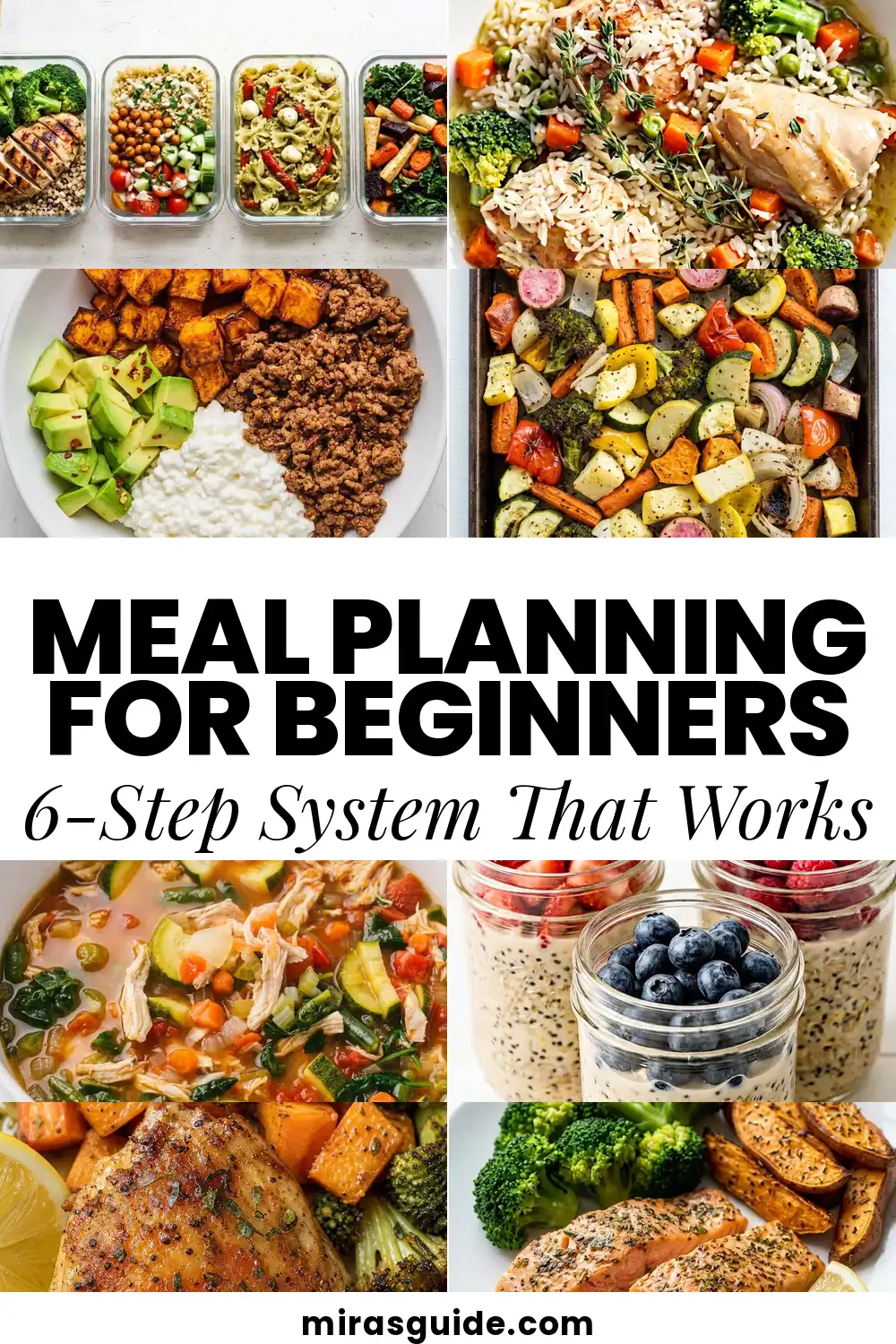
Meal planning for beginners doesn’t have to be complicated. Here’s the simple 6-step system that works when Pinterest-perfect plans fall apart.
Meal planning for beginners doesn’t have to be a color-coded spreadsheet or a Sunday that eats your whole afternoon. It’s a simple system for deciding what you’ll eat and what you’ll buy before the week starts — so you’re not standing in front of the fridge at 6pm making it up as you go. This guide walks you through the exact 6-step process, the four mistakes that make people quit in week two, and a plug-and-play sample plan you can copy this week. No apps, no printables you’ll never use, no perfection required.
⚠️ Disclaimer: This meal plan is for general informational purposes only. Always consult your doctor before starting any new diet, especially if you have a medical condition, are pregnant, or nursing.
Why You’ll Actually Stick With This ❤️
- 6 clear steps — no scrolling recipes for an hour before you start
- Built for real life — assumes your week will get disrupted, because it will
- Under 30 minutes to plan — the whole system takes less time than one takeout order
- Works whether you’re feeding 1 person or 5 — the framework scales
- Zero perfectionism — designed to survive the first week you “fail”
What Meal Planning Actually Is (And What It Isn’t) 🧭
Meal planning is deciding, in advance, what meals you’ll eat this week and what groceries you need to make them happen. That’s it. (For the nutrition side of things, dietitians recommend anchoring meals with the Harvard’s Healthy Eating Plate — half vegetables, a quarter protein, a quarter whole grains.)
It is not meal prep. Meal prep is the cooking part — batch-roasting chicken on Sunday, portioning containers. Meal planning is the thinking part that comes first. You can absolutely meal plan without meal prepping (many people just plan and cook fresh each night). But you cannot meal prep well without planning first.
It is also not what Pinterest sells you. Pinterest shows you 21 perfectly plated meals for the week, matching containers, and a color-coded printable. That version fails for almost everyone because it’s designed for a life that doesn’t get disrupted. Real meal planning is quieter — a short list on your phone, three or four go-to dinners, and a grocery list that doesn’t require a spreadsheet.
The Real Reason Meal Plans Fall Apart 🚫
Before we get into the steps, here’s what actually kills meal planning for beginners. According to research summarized by the Academy of Nutrition and Dietetics, nearly 9 in 10 Americans have tried meal planning — but only about 44% keep it up. The dropouts aren’t lazy. They hit one of four walls:
- They planned too many meals. Mapping out breakfast, lunch, dinner, and snacks for seven straight days is 21+ decisions. When Wednesday’s plan slips, the whole thing feels ruined.
- They built zero flexibility in. A late meeting, a sick kid, or just not being in the mood for salmon on Tuesday — and the plan breaks.
- They picked recipes that shared nothing. Five completely different meals means a long shopping list, higher costs, and half-used ingredients rotting in the crisper drawer.
- They skipped the prep step. Planning what to eat is only half the job. If you didn’t wash, chop, or pre-cook anything, you’re still starting from scratch every night — and after work, that’s when takeout wins.
Every step below is designed to avoid these four walls.
The 6-Step Meal Planning System (For Beginners) 🗓️
Step 1 — Pick One Honest Goal
Before you open a single recipe, decide what you’re actually trying to fix. Trying to solve everything at once — cheaper groceries, perfect macros, zero waste, and five new recipes a week — is how beginners burn out.
Pick one:
- 💰 Save money on groceries
- ⏰ Save time in the evenings
- 🥗 Eat healthier (weight loss, more protein, less takeout)
- 👨👩👧 Feed a family without the daily “what’s for dinner” argument
Your goal shapes everything else. Someone saving money will build a plan around sale items. Someone saving time will lean on the crockpot. Don’t skip this step.
Step 2 — Check Your Calendar First (Not Pinterest)
Open your calendar for the next 7 days. Before you look at a single recipe, mark:
- ❌ Days you’ll eat out or have plans
- ⚡ Days you’ll be home late or exhausted (these need 15-minute meals)
- 🛌 Days you’ll be home earlier (these can handle a longer recipe)
- 🎉 Any birthdays, events, or nights someone else is cooking
You are not planning 21 meals. You’re planning around real life. Most weeks, you’ll cook 3-5 dinners at home. Anything more is a fantasy.
Step 3 — Shop Your Kitchen Before Your List
This is the step almost every beginner skips, and it’s the one that saves the most money. Before you write a grocery list, look at:
- 🥶 Freezer first — thaw anything that’s been in there too long
- 🧊 Fridge — what’s about to go bad?
- 🥫 Pantry — what half-used bag of rice, can of beans, or jar of sauce is sitting there?
Write down what you have. Those items become the anchor for at least one or two meals this week. This one habit cuts most people’s grocery bill by 15-25%.
Step 4 — Pick 3-5 Dinners That Share Ingredients
Do not pick 5 completely unrelated meals. This is the #1 reason plans fail — a mile-long grocery list of things you’ll only use once.
Instead, use
Don’t Want to Plan Every Dinner Yourself?
28 Days of Dinners Planned for You gives you 28 days of dinners, grocery lists and prep guidance already organized for you.
Plan My Next 28 Dinners →- Roast 3 lbs of chicken breast Sunday → use in Monday’s rice bowls, Tuesday’s tacos, Wednesday’s salad
- Cook 2 lbs of ground beef Sunday → becomes Monday’s firecracker beef bowls, Tuesday’s tacos, Thursday’s egg roll in a bowl
- Batch-cook rice + roast a tray of vegetables → the base of 4 different dinners
You still eat variety. You just don’t buy for it.
Step 5 — Add Breakfast and Lunch on Autopilot
Do not — and I mean do not — try to plan 3 different breakfasts and 5 different lunches your first week. Put them on repeat.
- Breakfast (pick 2, alternate): High-protein overnight oats, cottage cheese egg bites, Greek yogurt with berries, or eggs and toast.
- Lunch (pick 2, alternate): Leftovers from last night’s dinner (safe for 3-4 days per USDA food safety guidance), a big salad with grilled chicken, or a wrap.
Repetition is the whole trick. You can add variety later — once the habit sticks.
Step 6 — Write The Grocery List Once, Sorted By Store Section
Take your dinner list, breakfast picks, and lunch picks. Write down every ingredient. Cross off anything you already have from Step 3.
Then — this matters — reorganize the list by section of the store:
- 🥬 Produce
- 🥩 Meat / seafood
- 🧀 Dairy
- 🥫 Pantry / canned
- 🧊 Frozen
- 🍞 Bread / bakery
You’ll shop faster, forget less, and stop wandering aisles hoping something inspires you.
That’s the whole system. Six steps, about 20-30 minutes total once you get the rhythm.
A Sample Beginner Meal Plan (Copy This Week) 📋
Here’s exactly what a first-week beginner plan looks like — deliberately simple, ingredient-stacked, built around 3 dinners cooked at home.
| Day | Breakfast | Lunch | Dinner |
|---|---|---|---|
| Mon | Overnight oats | Chicken + rice bowl (from Sun prep) | 🍗 Roast chicken + veggies |
| Tue | Greek yogurt + berries | Leftover roast chicken salad | 🌮 Chicken tacos (using Sun’s chicken) |
| Wed | Overnight oats | Leftover tacos | 🍝 Pasta night (quick + easy) |
| Thu | Greek yogurt + berries | Big salad + rotisserie chicken | 🍕 Frozen pizza + salad (planned “easy” night) |
| Fri | Overnight oats | Leftover pasta | 🥡 Eat out or takeout (planned) |
| Sat | Eggs + toast | Whatever’s left in the fridge | 👨🍳 Try one new recipe |
| Sun | Eggs + toast | Leftover Sat dinner | 🥣 Meal prep for the week |
Grocery list for this week (approx): 3 lb chicken breast, 1 rotisserie chicken, 1 lb ground beef, greens, cucumber, tomatoes, onions, garlic, lemons, 1 dozen eggs, Greek yogurt, cottage cheese, cheese, tortillas, rice, oats, pasta, marinara, olive oil, salt/pepper/seasonings you already have.
That’s roughly 3 cooked-from-scratch dinners, 2 leftover nights, 1 easy night, 1 planned takeout. Realistic. Sustainable. Not Instagram-worthy — but you’ll actually do it.
Common Beginner Mistakes (And How to Avoid Them) ⚠️
Almost everyone who quits meal planning quits for one of these five reasons. None of them are about willpower.
- Planning 21 meals your first week. You will burn out by Wednesday. Start with 3-5 dinners, put breakfast and lunch on repeat. Add complexity later.
- Picking 5 unrelated meals. Long shopping list, high cost, half-used ingredients rotting. Fix: share at least one ingredient across three meals (chicken, ground beef, rice, etc.).
- No flexibility built in. Life will disrupt Tuesday’s plan. That’s not failure — it’s real life. Fix: plan 3-4 nights, leave 2-3 flex nights (leftovers, easy night, planned takeout).
- Skipping the prep step. A perfect plan on paper still requires cooking after a 10-hour day. Fix: spend 60-90 minutes on Sunday doing at least one of: cook a protein, roast a tray of vegetables, batch a grain. See our beginner Sunday meal prep plan for exactly how.
- Forgetting about snacks. 3pm hits, willpower is gone, you grab whatever’s closest. Fix: plan 1-2 snacks per day and put them on the grocery list. Greek yogurt, fruit + almonds, carrots + hummus. Boring on purpose.
Meal Planning Templates That Actually Help 📝
You don’t need an app. What works for most beginners:
- 📱 Notes app on your phone — free, always with you, no learning curve
- 📓 A cheap magnetic notepad on the fridge — write meals for the week + running grocery list
- 📋 A shared Google Sheet or Notion page — if you and a partner both cook
If you want a printable, keep it simple: 7 days, 3 meal slots each, a spot for the grocery list. Overengineered templates with color-coded macro breakdowns are usually the reason people quit.
How to Build Your “Rotation” Over Time 🔄
Real meal planning stops being work the moment you build a rotation — a short list of go-to meals you know by heart, that you can pull from without thinking.
Aim for:
- 🍳 5-7 breakfast options you rotate through
- 🥗 5-7 lunch options (many can be dinner leftovers)
- 🍽️ 15-20 dinner recipes you know cold, split across categories: fast weeknight, one-pot, slow cooker, sheet pan, freezer-friendly
Once you have this list, meal planning becomes: “Which 4 dinners from my list this week? Anything special going on? What do I already have?” Twenty minutes. Done.
Add one new recipe per week, max. Not five. Not “let’s try three Pinterest recipes this week.” One. That’s how the rotation grows without burning you out.
Frequently Asked Questions
How much time does meal planning take for beginners?
About 20-30 minutes to plan + write the grocery list, once you get the rhythm. Your first couple of weeks will take longer (maybe an hour) because you’re building the habit. Add another 45-60 minutes for grocery shopping, and 60-90 minutes if you’re doing Sunday prep. Total upfront: 2-3 hours a week for a system that saves you 5+ hours of “what’s for dinner?” chaos.
What if my schedule changes every week?
Plan by theme instead of assigning specific meals to specific days. Example: “This week I’m cooking a stir-fry night, a soup night, a grain bowl night, and one new recipe.” You know what you’ll cook — you just pick which one to make based on how the day goes. Structure without rigidity.
Should I meal plan if I live alone?
Yes — and it’s often easier for one person than a family. The main trap for solo meal planning is waste, not effort. Plan 3-4 days at a time instead of 7, buy smaller quantities of fresh produce, and lean on the freezer. A separate solo-cooking guide is on the way — for now, use the 3-4 dinner framework above and cut recipe portions in half.
How do I meal plan on a budget?
Build the whole plan around what’s on sale + what you already have. Check your grocery store’s weekly ad before picking recipes, not after. Cheap protein anchors (chicken thighs, ground turkey, canned beans, eggs) plus pantry staples (rice, oats, pasta) can carry an entire week. The USDA MyPlate guidelines are a solid free framework if you want to balance meals without tracking macros for under $50 for one person or under $100 for a family of four. See our cheap high-protein meal prep under $50/week for the exact grocery list.
Do I need to prep everything on Sunday?
No. Sunday prep is powerful but not required. If Sundays don’t work, pick any day you have 60-90 minutes free — Saturday morning, Monday evening, whatever fits. Some people even split it: 30 minutes Sunday for proteins, 30 minutes Wednesday for a top-up. Do what fits your life, not what Pinterest shows you.
What’s the difference between meal planning and meal prep?
Meal planning = deciding what you’ll eat and buy this week. Meal prep = actually cooking some or all of it in advance. You can meal plan without meal prepping. Most beginners should start with meal planning first, then add prep once the planning habit sticks. Trying to do both from day one is why 56% of people quit within a month.
Your Next Step 👉
Pick one thing to do today — not five. My honest suggestion:
- Open the notes app on your phone right now.
- Write down 3 dinners you’ll cook this week using ingredients you already have.
- Add anything missing to a short grocery list.
That’s it. That’s your first meal plan.
Once that feels easy — usually week two or three — add Sunday prep. My beginner Sunday meal prep plan walks you through five simple meals and one grocery trip that handles the whole week. Solo cooks — cut recipe portions in half, prep 3-4 days at a time instead of 7, and lean on the freezer for anything you buy in bulk.
The habit is what matters. Not the aesthetic. Start small.

Stop wondering what’s for dinner
This article covers tonight. 28 Days of Dinners Planned for You covers the next 27—decided, shopped and prepped.
- ✓ 28 dinner recipes for real weeknights
- ✓ 4 weekly grocery lists, done for you
- ✓ Simple prep guidance for smoother evenings
- ✓ Leftover strategy & emergency dinners



Pingback: Meal Planning Breakfast: A Full Week That Works
Pingback: Meal Planning Lunches for Work: 5-Day Weekly Guide
Pingback: Zero Waste Meal Planning: The Weekly System That Works
Pingback: Clean Eating Meal Plan: The Honest Whole-Food System
Pingback: Meal Planning Theme Nights: The Weekly Rotation That Works
Pingback: Aldi Meal Plan: The Honest Weekly System That Works
Pingback: Meal Planning Rotation: The 4-Week System That Lasts
Pingback: Meal Planning Hacks for Busy Working Moms: Real Weeknights
Pingback: Keto Meal Plan for Beginners: The Honest First-Week Guide
Pingback: Lazy Girl Meal Plan: The Actually-Sustainable System
Pingback: Pregnancy Meal Plan: Trimester-by-Trimester Guide
Pingback: 1800 Calorie Meal Plan: Maintenance & Active Framework
Pingback: Intermittent Fasting Meal Plan 16:8: Honest Weekly Guide
Pingback: Costco Meal Plan Shopping List: The Bulk Buying Framework
Pingback: Walmart Dinner Meal Plan: The Weekly Weeknight Framework
Pingback: 1400 Calorie Meal Plan: The Honest Weekly Framework
Pingback: Meal Planning Gluten Free: The 7-Day System That Works
Pingback: Meal Planning for 11 Month Old: Pre-Toddler Weekly Guide