

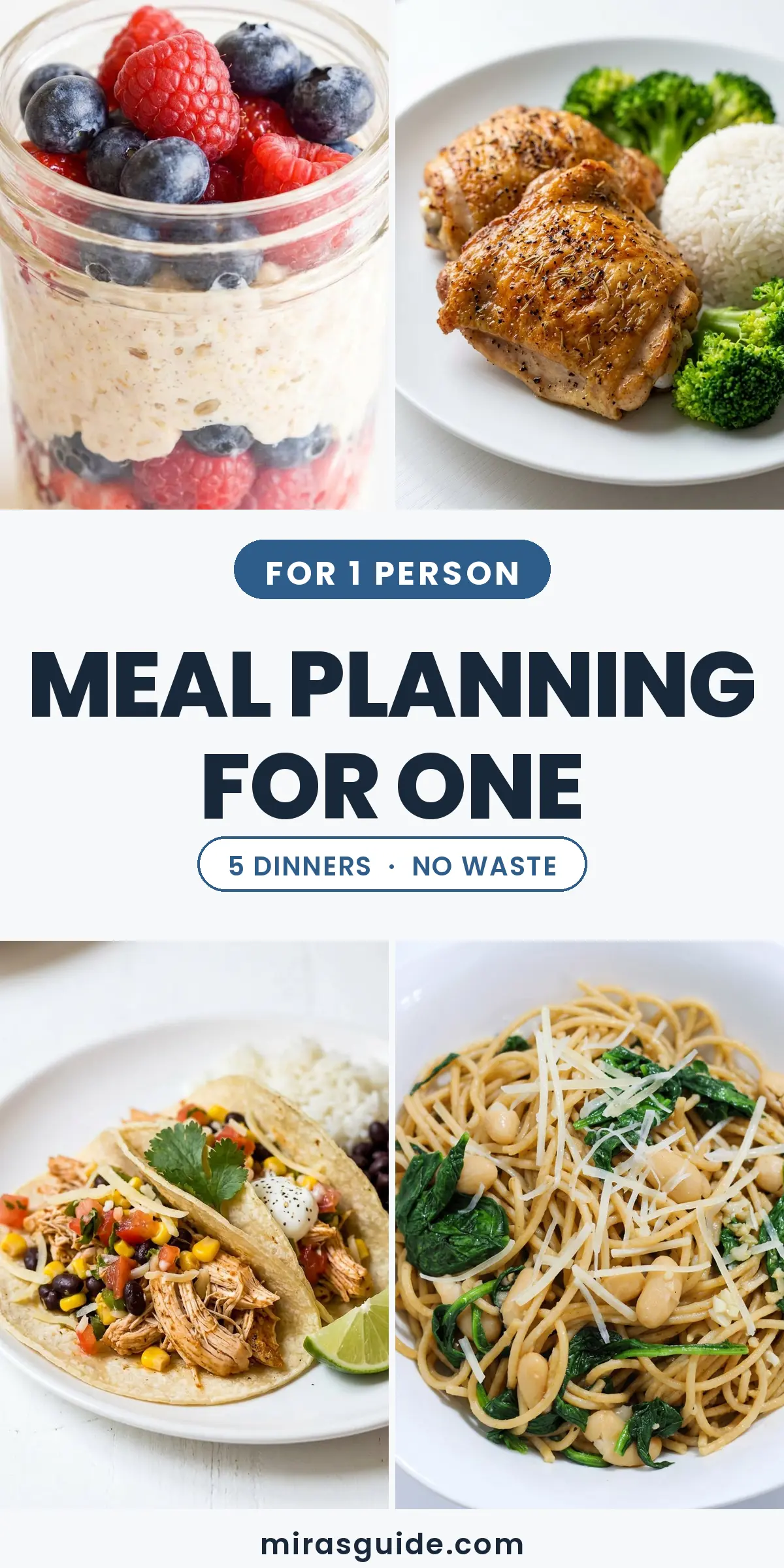
Meal planning for one is nothing like meal planning for a family — and that’s exactly why most guides fail solo cooks. Family systems assume you’ll finish a bag of spinach in three days, use a whole onion in one recipe, and cook enough of everything for four people.
When you’re the only one eating, those same habits leave you with a fridge full of half-used produce and four containers of the same stir-fry by Wednesday.
Want Dinner Decisions Handled for the Whole Household?
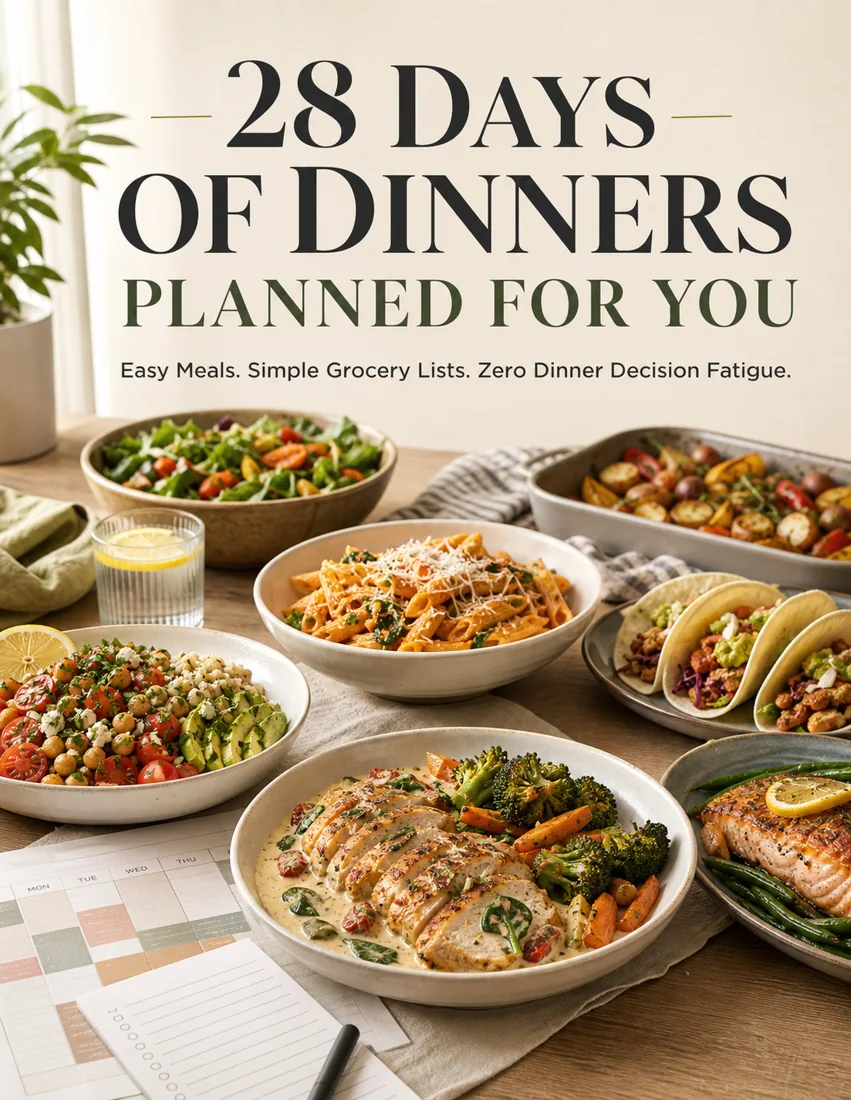
28 Days of Dinners Planned for You gives you 28 days of family-friendly dinners, already planned and portioned.
This guide walks you through the exact 5-step system built for cooking for one — how to shop small without paying more, how to use your freezer as a second pantry, and how to plan meals that don’t turn into leftover fatigue.
⚠️ Disclaimer: This meal plan is for general informational purposes only. Always consult your doctor before starting any new diet, especially if you have a medical condition, are pregnant, or nursing.
Why Meal Planning for One Fails (And What To Do Instead) 🧭
The single biggest mistake solo cooks make is trying to shrink a family meal plan into a one-person version. Standard nutrition frameworks like the Harvard Healthy Eating Plate still apply — roughly half vegetables and fruits, a quarter healthy protein, and a quarter whole grains — but the shopping logistics change completely. That’s how you end up with:
- 🥬 Half a bag of spinach turning to slime by day four
- 🍗 A pack of chicken breasts that’s too much for one but too little to freeze usefully
- 🥫 Half an onion, a quarter of a bell pepper, and two mystery containers in the back of the fridge
- 🍝 The same pasta bake staring at you Monday, Tuesday, Wednesday, Thursday
The problem is that grocery stores are sized for families. A “small” carton of eggs is 6 or 12 — plenty for a family, way too many for you alone. Fresh herbs come in bundles that can flavor 15 meals. Meat is packed in family-of-four portions.
A meal plan built for one has to work with that reality, not against it. Which means three big rule changes:
- Buy loose or small quantities — even when the per-pound price is higher, per-meal cost is lower once waste is accounted for
- Treat your freezer as a second pantry — not a storage graveyard
- Plan 4-5 meals with overlapping ingredients — not 7 unique dinners
Get those three right and cooking for one becomes cheaper, easier, and less lonely.
The Real Cost of Cooking for One 💸
Solo cooks pay a real “singles tax” at the grocery store — EPA estimates food waste costs each U.S. consumer about $728 per year. Shopping and portioning carefully can make that loss easier to avoid when cooking for one.
That’s not because solo cooks are careless. It’s structural:
- 🛒 Package sizes built for families
- ⏳ Fresh produce shelf life shorter than one person’s eating pace
- 🍽️ Recipes written for 4 servings that don’t scale cleanly to 1
- 🕐 Cooking time barely changes whether you’re feeding 1 or 4
The fix isn’t willpower. It’s a system designed from the ground up for one person. (For deeper background on solo nutrition, Colorado State University Extension’s healthy eating guide for one or two offers practical advice on shopping, portions, leftovers, and balanced meals.)
The 5-Step Meal Planning System for One 🗓️
Step 1 — Plan 5 Meals, Not 7
The single most freeing change: stop trying to plan every dinner of the week. Aim for 5 home dinners plus 2 flex slots for eating out, ordering in, or scrambling eggs at 9pm.
Why 5 instead of 7? Because most solo cooks: – 🍴 Eat out or with friends 1-2 nights a week anyway – 😴 Have at least one night where cooking feels like too much – ❄️ Can pull from the freezer on the 7th night if plans change
Plan 5, and the plan survives real life. Plan 7, and you either overshop or feel like a failure by Thursday.
Step 2 — Shop Your Freezer and Fridge First
Before you touch a recipe or a grocery list, open your freezer and fridge. Write down what you already have. That container of soup from three weeks ago, the frozen chicken thighs, the half jar of pasta sauce, the wilted-but-still-good spinach.
Now build one meal around each thing that needs using up. This is the single habit that separates solo cooks who waste food from solo cooks who don’t.
Bonus points if you keep a “use it or lose it” shelf in the fridge — one visible spot where anything nearing its end goes. Impossible to forget.
Step 3 — Pick 5 Recipes With Overlapping Ingredients
Here’s the trick — don’t pick 5 recipes that share nothing. That’s how you end up with 15 half-used ingredients. Pick recipes that share a core protein or vegetable so one grocery item does double duty.
Example week:
- 🍗 Roast a small chicken (or 2-3 chicken thighs) Sunday
- 🥗 Monday: chicken salad wrap for lunch
- 🌮 Tuesday: chicken tacos for dinner
- 🍜 Wednesday: chicken fried rice using leftover rice
- 🥘 Thursday: pull the frozen soup from last week
Same protein, four different flavors. Zero boredom. If you want a proper high-protein rotation, my high-protein chicken rice bowls with 5 variations is exactly this system in action.
Step 4 — Cook Once, Eat Twice (On Purpose)
Batch cooking as a family means big pans. Batch cooking for one means making 2 servings instead of 1. That’s it.
Cook dinner tonight → eat one → refrigerate one for tomorrow’s lunch. You cooked once but eat twice. This one habit alone cuts your cooking nights in half.
Some meals do this better than others:
| ✅ Great for cook-once-eat-twice | ❌ Bad for cook-once-eat-twice |
|---|---|
| Soups, stews, chili, curries | Fried anything (loses crispness) |
| Grain bowls, taco filling, rice pilaf | Delicate fish (dries out) |
| Roasted proteins (chicken, salmon) | Sushi or salads with dressing on |
| Casseroles, pasta bakes | Anything with wilted lettuce |
If you already know you hate leftovers, alternate the format: eat as a bowl tonight, wrap it in a tortilla tomorrow, top with a fried egg the third day. Same base, different meal.
Step 5 — Freeze Half Immediately (Not Later)
Here’s the rule that separates a working solo system from a chaotic one: freeze the second half BEFORE you eat the first, not after you’re tired of it.
The moment food comes off the stove, portion it into single-serving containers. Two go in the fridge, the rest go straight in the freezer. Label with the name + date using masking tape and a Sharpie.
Why now, not later? Because “I’ll freeze it if I don’t eat it by day 3” always becomes “I forgot and it’s now day 6, into the trash it goes.” Freezing now is the difference between a freezer full of ready meals and a fridge full of guilt.
Best tools for solo freezing: – 🧊 Silicone freezer molds (Souper Cubes or generic) — perfect single-serving portions of soups, sauces, cooked grains – 📦 Small glass containers with locking lids — freezer + microwave + dishwasher safe – 🏷️ Masking tape + Sharpie — name + date on every single container
The Solo Grocery Shopping Rules 🛒
Nothing kills a meal plan faster than a grocery trip built for a family. Three rules that fix 90% of solo waste:
🥕 Rule 1: Buy Loose, Not Bagged
Two carrots from the loose bin, not a 2-lb bag. Three tomatoes, not a clamshell of six. One bell pepper, not the shrink-wrapped 3-pack. Yes, the per-pound price is higher. But your per-meal cost is lower because nothing goes bad.
Bulk bins are your friend for dry goods too — measure out exactly the rice, oats, or nuts you’ll actually use in the next 2 weeks. Most grocery stores have them.
🧊 Rule 2: Frozen Vegetables Are Not a Compromise
Frozen spinach, broccoli, peas, corn, stir-fry mixes — these are often more nutritious than fresh because they’re frozen at peak ripeness, and they let you use only what you need. The bag stays in the freezer indefinitely.
Solo cooks who shift to 50% frozen vegetables cut their produce waste by roughly half. That’s a bigger impact than any recipe change.
🥩 Rule 3: Ask The Butcher / Deli Counter
Butchers and deli counters will sell you exactly what you need — 1 chicken breast, ¼ lb of ground turkey, 2 slices of cheese. You avoid the “family pack for $12” trap and get exactly one meal’s worth.
If your grocery store doesn’t have a real butcher, buy the family pack and portion + freeze it the same day. Never let raw meat sit in the fridge past day 2.
A Sample Week: Meal Planning for One 📋
Here’s a real 5-dinner, one-person week using ingredient stacking. Everything below fits in a small handheld basket at the grocery store.
| Day | Breakfast | Lunch | Dinner |
|---|---|---|---|
| Mon | Overnight oats jar | Leftover roast chicken salad | 🍗 Roast chicken thighs + rice + broccoli |
| Tue | Greek yogurt + berries | Chicken wrap with pickled onions | 🌮 Chicken tacos (fresh, using Mon’s chicken) |
| Wed | Overnight oats jar | Leftover taco filling on greens | 🍝 Pasta with garlic, spinach, white beans |
| Thu | Greek yogurt + berries | Leftover pasta | 🥚 Eggs + toast + veggie |
| Fri | Overnight oats jar | Big salad with canned tuna | 🍕 Frozen pizza + salad (planned easy night) |
| Sat | Whatever’s around | Fridge cleanout | 🥡 Eat out or takeout (planned) |
| Sun | Yogurt or eggs | Whatever’s left | ❄️ Freezer meal from a previous week |
Grocery list (fits in a handheld basket): 3-4 chicken thighs, 1 doz eggs, small tub Greek yogurt, 1 pack overnight oats, 1 loaf bread (freeze half), 1 small bag rice, 1 pasta, 1 can tuna, 1 can white beans, small tortillas pack, 1 head broccoli, 1 bag spinach, 2 onions, 3 tomatoes, small cheese wedge, olive oil, seasonings you already have. Total: ~$35-45.
Common Solo Cooking Mistakes ⚠️
Almost every solo cook who quits meal planning quits for one of these reasons. None of them are about being disorganized.
- Buying a family-sized meal plan and dividing by 4. The math never works. Some ingredients don’t scale down (you can’t buy 0.5 of an onion). Build the plan for one from the start.
- Buying fresh produce optimistically. “I’ll eat all this kale this week.” Then Wednesday arrives and the kale looks sad. Fix: buy half of what you think you need, or go frozen.
- Skipping the freezer step. Cook Sunday, eat 4 identical dinners Monday-Thursday, get sick of it by Wednesday and throw the rest out. Fix: freeze half immediately so it becomes a different meal on a different week.
- Trying to make cooking “worth it” every night. For one person, cooking + cleaning for a fancy meal feels disproportionate. Fix: lower the bar. An omelet with whatever’s in the fridge is a meal. Toast with avocado and a fried egg is a meal.
- Ignoring “backup meal” nights. Every solo cook needs 3-4 embarrassingly easy meals in the back pocket. Cereal with fruit, tuna melt, scrambled eggs on toast, a bowl of soup. These aren’t failure — they’re built into a working system.
The Solo Cook’s Pantry & Freezer Starter Kit 📦
You don’t need everything on day one. But over 2-3 grocery trips, build up a base that lets you throw together a meal without shopping.
🥫 Solo Pantry Essentials
- Rice (small bag), oats, pasta
- Canned beans (black, chickpeas, cannellini)
- Canned tomatoes, canned tuna, canned salmon
- Olive oil, soy sauce, vinegar (small bottles)
- Onions, garlic (long shelf life)
- Salt, pepper, 3-4 spices you actually use
❄️ Solo Freezer Essentials
- Bread (freeze the day you buy it — thaw slices as you need them)
- Individually portioned raw chicken thighs / ground turkey
- Frozen vegetables (spinach, peas, broccoli, stir-fry mix)
- Frozen berries (for smoothies + oats)
- 2-3 pre-made freezer meals from previous batch cooking
🧊 Solo Fridge Essentials (Rotate Weekly)
- Eggs (small carton if available)
- Greek yogurt (small tub)
- Cheese (small block, not shredded — lasts longer)
- One protein for this week
- Salad greens (small clamshell) OR frozen alternative
Build this over 3 grocery trips and you’ll have “throw-together” meal capability for any night you can’t be bothered to plan.
FAQ
How do I meal plan for one without wasting food?
Three habits handle 90% of it: cook every meal to yield two servings (eat one, freeze one), buy fresh produce loose in small quantities rather than pre-bagged, and treat your freezer as a working pantry — not a place food goes to die. That’s it. Everything else is optimization. For practical portion and shopping guidance designed for a small household, use Colorado State University Extension’s guide for one or two people.
Is it cheaper to meal plan for one or just buy prepared food?
For a single person, meal planning saves money mostly through waste reduction, not bulk buying. A rough rule: solo cooks who portion and freeze consistently spend about $40-60/week on groceries and eat well. Prepared meals or takeout for the same eating quality run $150+/week. The savings compound fast.
How much should one person spend on groceries per week?
A realistic range for one person cooking mostly at home is $40-70/week in the US (higher in expensive cities, lower in the Midwest/South). Set a weekly target, then build the plan backwards from that number. Budget-conscious solo cooks can eat well on $30/week using the cheap high-protein meal prep approach — pantry staples + one intentional protein.
What are the best backup meals when I don’t feel like cooking?
Every solo cook needs a short list. Mine: tuna melt wrap, creamy avocado egg salad on toast, cereal + fruit, scrambled eggs + veggie, quesadilla with whatever cheese is around, a bowl from the mason jar noodle soup rotation. None require a recipe. All take under 10 minutes.
How do I stop getting bored of leftovers?
Change the format, not the food. Same roast chicken becomes: bowl on Monday, wrap on Tuesday, fried rice on Wednesday, soup on Thursday. Different sauces do the heaviest lifting — a spoonful of pesto, salsa, sriracha mayo, or lemon vinaigrette makes the same protein feel like a new meal.
Should I use a meal delivery service instead?
Meal delivery (HelloFresh, Blue Apron, etc.) solves the portion-control problem instantly — every ingredient is measured. Downsides: 2-3x more expensive per meal, less flexibility, more packaging waste. A hybrid works well: cook 3 nights from your own plan + use delivery 2 nights in busy weeks. Cheaper than delivery-only, less stressful than cooking every night.
How is meal planning for one different from meal planning for two?
The biggest difference: portion math and package sizes. Cooking for two means most family recipes work as-is (divide by 2). Cooking for one means most recipes need to be quartered or scaled, and package sizes rarely cooperate. The freezer becomes even more critical when it’s just you. If this is your first attempt, start with our complete beginner’s meal planning guide — the fundamentals apply, then layer the solo-specific rules on top.
Your Next Step 👉
Pick one habit to try this week — not five. My honest suggestion:
- On your next grocery trip, buy loose produce wherever possible. Two carrots, not a bag.
- When you cook dinner tonight, make two servings. Eat one, put one in the fridge for tomorrow’s lunch.
- That’s it. Repeat next week.
Once those two habits feel automatic — usually 2-3 weeks — layer on the freezer step. Cook Sunday for 4 portions, eat 2 fresh, freeze 2 for future weeks. Within a month, you’ll have a rotating stash of ready meals and your grocery bill will drop by 20-30%.
If you want a fuller kitchen system, my beginner Sunday meal prep plan is a good next step — 5 meals from one grocery trip, in about 2 hours. Scale everything down by 60% for one person.
Solo cooking gets so much easier once you accept it’s a different game than family cooking — not a lesser version of it. Build the system for one from the ground up, and it works.
Stop wondering what’s for dinner
This article covers tonight. 28 Days of Dinners Planned for You covers the next 27—decided, shopped and prepped.
- ✓ 28 dinner recipes for real weeknights
- ✓ 4 weekly grocery lists, done for you
- ✓ Simple prep guidance for smoother evenings
- ✓ Leftover strategy & emergency dinners


Pingback: Meal Planning for Two: The Honest Guide for Couples
Pingback: Meal Planning for College Students: Dorm-Room Guide
Pingback: Lazy Girl Meal Plan: The Actually-Sustainable System
Pingback: Costco Meal Plan for One: Solo Bulk-Buying Framework