

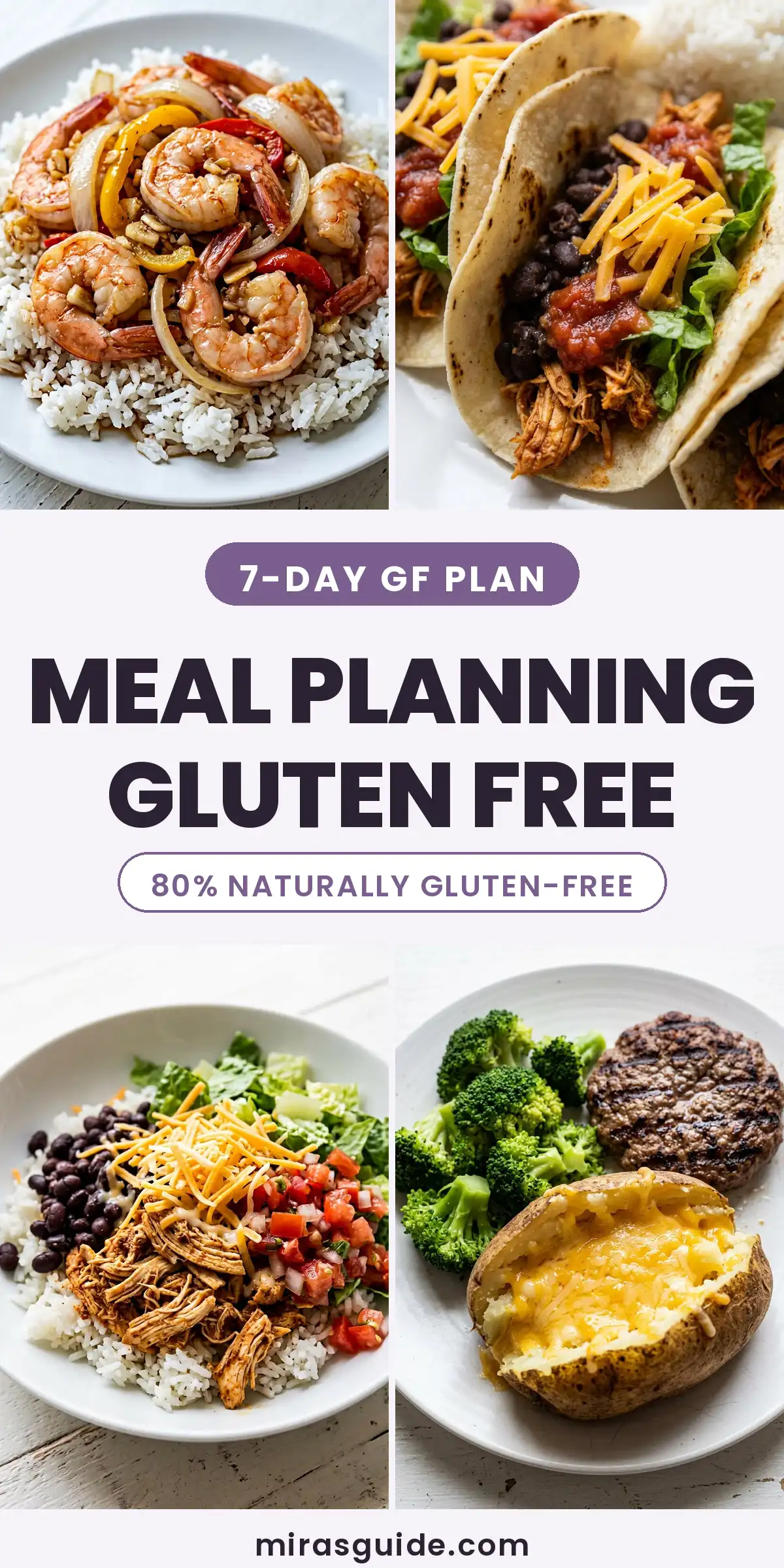
Meal planning gluten free is genuinely harder than regular meal planning — hidden gluten shows up in soy sauce, salad dressings, canned soups, and “healthy” cereals you’d never suspect.
One accidental sandwich or wheat-thickened sauce can trigger days of symptoms for people with celiac disease or serious sensitivity.
Don’t Want to Plan Every Dinner Yourself?
28 Days of Dinners Planned for You gives you 28 days of dinners, grocery lists and prep guidance already organized for you.
This guide walks you through the exact 7-day gluten-free meal planning system — a safe grocery list, cross-contamination-free cooking rules, and a full week of naturally gluten-free meals (no expensive specialty products required).
No aspirational “gluten-free lifestyle” — just a practical system for people who need to eat gluten-free, whether from celiac disease, sensitivity, or family accommodation.
⚠️ Disclaimer: This meal plan is for general informational purposes only. Always consult your doctor before starting any new diet, especially if you have a medical condition, are pregnant, or nursing.
Why Gluten-Free Meal Planning Is Its Own Skill 🧭
If you’re new to gluten-free eating (or feeding a family member with celiac disease), you’ll quickly discover that regular meal planning advice doesn’t cut it. Here’s what makes gluten-free different:
- 🚫 Hidden gluten in unexpected places — soy sauce, canned soups, salad dressings, seasonings, “wheat-free” ≠ gluten-free
- 💰 Specialty products are expensive — GF bread runs $6-8/loaf, GF pasta $4-6/box
- ⚠️ Cross-contamination is real — shared cutting boards, toasters, oil can cause reactions
- 🍽️ Restaurant meals are risky — even “gluten-free” menu items get contaminated
- 🥺 Meal repetition burnout hits fast — the “safe” foods can feel monotonous
The good news: the best gluten-free meal planning strategy uses naturally gluten-free whole foods — rice, potatoes, eggs, fresh meats, vegetables, beans, corn tortillas — that most families already eat. You don’t need specialty products to build a full week of safe, satisfying meals.
The 3 Rules of Safe Gluten-Free Meal Planning 🛡️
Before we get to the 7-day plan, master these 3 rules — they prevent 90% of accidental gluten exposure:
🛡️ Rule 1: Build Your Plan Around Naturally Gluten-Free Foods
Rather than trying to replace every wheat product with an expensive GF version, base your meals on foods that were never gluten in the first place:
- 🍚 Rice (all varieties — brown, white, jasmine, basmati, wild)
- 🥔 Potatoes (all varieties + sweet potatoes)
- 🌽 Corn products (corn tortillas, cornmeal, polenta)
- 🍳 Eggs, meat, poultry, fish, seafood (all naturally GF)
- 🥕 All fresh fruits + vegetables
- 🥫 Beans + lentils (canned or dried — but check labels)
- 🥛 Plain dairy (milk, cheese, plain yogurt, butter)
- 🌾 Certified GF oats + quinoa
Build 80% of your meals from this list. Add specialty GF products only when you specifically need them (bread, pasta on occasion).
🛡️ Rule 2: Read Every Single Label
Gluten hides in surprising places. Every package needs a label check, especially:
⚠️ Common gluten hiding spots: – Soy sauce (use tamari or coconut aminos instead) – Canned soups (many use wheat thickeners) – Salad dressings + marinades – Deli meats (some brands use wheat as filler) – Seasoning blends (taco seasoning, spice mixes) – Broths + stocks – Sauces (Worcestershire, some BBQ sauces, gravies) – “Wheat-free” oats (must be certified gluten-free to be safe) – Chocolate + candy bars – Some medications + supplements
✅ The safe rule: Only buy items labeled “Certified Gluten-Free” or with a clear “Gluten-Free” designation on packaging. “May contain wheat” or “produced in a facility with wheat” = skip it.
🛡️ Rule 3: Prevent Cross-Contamination in Your Kitchen
Even a crumb of wheat bread can trigger a celiac reaction. If someone in your household eats gluten, follow these rules:
- 🔪 Separate cutting boards (or wash thoroughly between uses)
- 🍞 Dedicated GF toaster (or use toaster bags)
- 🧈 Separate butter/condiments (double-dipping with a wheat-crumb knife = contamination)
- 🍽️ Clean surfaces + hands between prepping gluten and GF foods
- 🥘 Cook gluten-free items first in a shared kitchen
- 🥄 No shared utensils for cooking (a wheat spoon in your GF pot = problem)
For strict celiac households, most people find it easier to make the whole kitchen gluten-free rather than manage two systems.
The 5-Step Gluten-Free Meal Planning System 🗓️
Step 1 — Build Your Safe Ingredient List First
Before picking recipes, write down every naturally gluten-free food your household eats + tolerates well. This becomes your “safe ingredient bank” for meal planning.
Example safe ingredient bank: – Proteins: chicken, ground beef, eggs, canned tuna, salmon, beans – Starches: rice (any variety), potatoes, corn tortillas, certified GF oats, quinoa – Vegetables: all fresh vegetables + plain frozen vegetables – Fruits: all fresh + frozen fruits – Dairy: plain milk, cheese, plain yogurt, butter – Pantry: olive oil, tamari (GF soy sauce), vinegar, canned tomatoes, honey, salt, pepper, most single-ingredient spices
Every meal you plan comes from this bank. No experimentation with “maybe this is gluten-free” items until you’ve verified.
Step 2 — Plan 5-7 Dinners Using Naturally GF Meals
Instead of trying to “make gluten-free versions” of wheat-based meals (expensive + rarely as good), lean into meals that are naturally gluten-free:
- 🌮 Tacos (corn tortillas + meat + beans + toppings)
- 🍚 Rice bowls (grain + protein + vegetable + sauce)
- 🥗 Big salads (greens + protein + vegetables + oil/vinegar)
- 🍲 Soups + stews (bone broth + protein + vegetables + potatoes/rice)
- 🥘 Curry (coconut milk + spices + protein + vegetables + rice)
- 🍳 Frittatas + egg dishes (eggs + vegetables + cheese)
- 🍖 Roasts + sheet pan meals (meat + vegetables + potatoes)
- 🌯 Burrito bowls (rice + beans + protein + toppings)
Notice: none of these require specialty GF bread or pasta. All naturally gluten-free.
Step 3 — Add Certified GF Specialty Items Sparingly
Once your base plan is built with naturally gluten-free meals, add certified GF specialty products only where you’ll enjoy them most:
- 🍞 Certified GF bread — save for a specific breakfast meal or sandwich lunch
- 🍝 Certified GF pasta — 1 pasta meal per week max
- 🍕 Certified GF pizza crust — occasional Friday night
- 🥞 Certified GF pancakes/waffles — weekend breakfast
Buying GF versions of everything gets expensive fast — $30+/week in premium specialty products alone. Limit to 2-3 items per week for maximum flavor payoff.
Step 4 — Prep a “GF Emergency Kit” for Meals Away From Home
The hardest part of gluten-free eating is meals outside your kitchen. Build a “grab and go” kit for work, travel, and social events:
- 🥜 Snacks: RxBars, plantain chips, popcorn, nuts, hard-boiled eggs
- 🥫 Backup meals: microwave rice packets, canned tuna, individual peanut butter cups
- 🍫 Safe treats: certified GF chocolate bars, popcorn, dried fruit
- 🧴 Portable condiments: individual mustard/mayo packets
Keep a stash in your car, purse, or desk. Never end up in a “there’s nothing safe to eat” situation.
Step 5 — Communicate with Family + Restaurants Confidently
If you’re gluten-free by necessity (celiac disease), you’ll need to advocate for yourself:
- 🍽️ Restaurants: call ahead to ask about GF procedures + cross-contamination protocols
- 👨👩👧 Family gatherings: offer to bring a dish so you have something safe
- 🎉 Parties: eat before you go OR bring a snack pack
- ✈️ Travel: pack shelf-stable safe foods for hotels + long trips
Don’t feel bad asking questions or bringing your own food — for celiac patients, this is medical necessity, not preference.
A Sample Week: 7-Day Gluten-Free Meal Plan 📋
Real 7-day plan using naturally gluten-free foods + minimal specialty products. Family-friendly and works for anyone with celiac disease or serious gluten sensitivity.
🛒 Grocery List (~$100-130 for family of 4)
Proteins (~$35): – 3 lbs chicken thighs (family pack) — $8 – 2 lbs ground beef — $10 – 1 dozen eggs — $3 – 2 cans black beans + 1 can chickpeas — $3 – 1 lb frozen shrimp OR salmon fillets — $10
Grains + Starches (~$15): – 5 lb bag rice — $4 – 5 lb bag potatoes — $4 – Corn tortillas (large pack) — $3 – Certified GF pasta (1 box) — $4
Produce (~$30): – 3 lb bag onions — $2 – 2 heads garlic — $1 – 1 head broccoli + 1 bag frozen spinach + 1 bag frozen mixed veg — $6 – Lettuce, 4 tomatoes, 2 bell peppers, 2 cucumbers, 2 avocados — $12 – Bananas, apples, in-season fruit — $9
Dairy (~$25): – 1 gallon milk — $3-4 – 1 block cheese (16 oz) — $5 – 1 tub Greek yogurt (plain) — $4 – 1 stick butter — $3 – Sour cream — $3 – Certified GF bread (1 loaf, freeze half) — $6-7
Pantry Add-ons (~$15): – Tamari (GF soy sauce) — $4 – Salsa — $3 – Rolled oats (certified GF) — $5 – Peanut butter — $3
Pantry staples assumed: olive oil, salt, pepper, cumin, chili powder, garlic powder, paprika, oregano (all single-ingredient spices are naturally GF).
🗓️ The 7-Dinner Plan
| Day | Dinner | Notes |
|---|---|---|
| Mon | 🍗 Sheet pan chicken thighs + rice + roasted broccoli | Naturally GF |
| Tue | 🌮 Chicken tacos (corn tortillas) + beans + salsa | Corn tortillas = safe |
| Wed | 🍝 Certified GF pasta with meat sauce + salad | 1 specialty meal per week |
| Thu | 🍔 Hamburger patties + baked potatoes + broccoli (no bun needed) | Ultra GF-safe |
| Fri | 🍤 Shrimp OR salmon + rice + stir-fried vegetables + tamari sauce | Restaurant-quality feel |
| Sat | 🌯 Burrito bowls (rice + beans + leftover meat + toppings) | Uses leftovers |
| Sun | 🍳 Breakfast for dinner (eggs + hash browns + fruit) | Ultra frugal + GF |
🥣 Breakfasts (all naturally GF)
- Overnight oats (certified GF oats + milk + berries + peanut butter)
- Eggs + potato hash + fruit
- Greek yogurt parfait (yogurt + berries + certified GF granola)
- Bacon + eggs + avocado toast (certified GF bread)
🥪 Lunches (leftovers + assembly)
- Leftover dinner (rice bowls, taco fillings, salads)
- Big salad with grilled chicken
- Tuna salad on GF bread OR over greens
- Rice bowl with beans + cheese + salsa
Common Gluten-Free Meal Planning Mistakes ⚠️
- Buying GF versions of everything. Expensive + often not as good. Fix: base 80% of meals on naturally GF whole foods.
- Not checking every label. Gluten hides in soy sauce, canned soups, seasoning blends, deli meats. Fix: “Certified Gluten-Free” label is the only safe standard.
- Ignoring cross-contamination. Even a crumb triggers celiac reactions. Fix: dedicated GF cutting boards + toaster + condiments.
- Trying to cook everything from scratch. GF baking is genuinely hard for beginners. Fix: rely on naturally GF meals for dinner + easy prep breakfasts.
- Not planning for meals away from home. “There’s nothing safe here” = expensive takeout or hunger. Fix: carry a GF emergency snack kit.
- Feeling guilty about “boring” repetition. Same-ish meals every week is fine when the alternative is getting sick. Fix: rotate 10-15 favorite GF meals — variety comes from format, not novelty.
The Gluten-Free Grocery Rules 🛒
🥩 Rule 1: Focus On Whole Foods (They’re Cheaper AND Safer)
Whole meats, fresh vegetables, plain dairy, eggs, rice, and potatoes are: – ✅ Naturally gluten-free (no label reading needed) – ✅ Much cheaper than specialty GF products – ✅ Available at every grocery store – ✅ The foundation of every gluten-free diet
Skip the “gluten-free aisle” 80% of the time — you don’t need it.
🏪 Rule 2: Best Stores for Gluten-Free Shopping
Ranked by GF value: – Aldi — surprisingly good GF selection at 40-50% below name-brand – Trader Joe’s — many naturally GF products + clearly labeled – Costco — bulk GF pasta, oats, snacks at wholesale prices – Regular supermarkets — fine for whole foods, expensive for specialty
🍞 Rule 3: Best “Specialty” GF Products (Worth The Money)
Not all GF specialty products are worth buying. These 5 usually are: 1. Certified GF oats — safe base for breakfast + baking 2. Corn tortillas (naturally GF, cheap, versatile) 3. Tamari or coconut aminos — replaces soy sauce in every stir-fry 4. Certified GF bread — for sandwiches (buy 1 loaf per week, freeze half) 5. Rice pasta — 1 pasta meal per week
Everything else (GF cookies, GF crackers, GF cereal, GF pizza crust) is optional splurge, not required.
🚫 Rule 4: Beware “Wheat-Free” ≠ “Gluten-Free”
Products labeled “wheat-free” may still contain: – Barley (in some malts + beers) – Rye (in some breads + crackers) – Contamination from shared facilities
Only “Certified Gluten-Free” is safe for celiac patients. Learn to distinguish these labels.
The Gluten-Free Pantry Base 📦
Once stocked, you can always throw together a safe GF meal.
🥫 GF Pantry Essentials
- Rice (5 lb bag), certified GF oats, quinoa
- Canned beans (black, chickpeas, kidney, cannellini)
- Canned tomatoes, tomato paste
- Corn tortillas (freeze extras)
- Certified GF bread (freeze extras)
- Olive oil, vinegar, honey
- Tamari or coconut aminos (never regular soy sauce)
- Canned tuna, salmon
- Peanut butter (single-ingredient)
- Onions, garlic, potatoes
- Single-ingredient spices (all naturally GF)
❄️ GF Freezer Essentials
- Portioned raw chicken thighs / ground meat (from bulk packs)
- Frozen vegetables (all plain vegetables are GF)
- Frozen fruit (for smoothies + oatmeal)
- Frozen shrimp or fish fillets
- GF bread (freeze the day you buy)
- Corn tortillas (extras frozen)
🧊 GF Weekly Fresh Rotation
- Eggs (2 dozen)
- Milk (gallon)
- Plain Greek yogurt (large tub)
- Cheese (block, 8-16 oz)
- 1-2 anchor proteins
- 4-6 fresh vegetables
FAQ
Do I need to buy everything gluten-free?
No — start with whole foods that are naturally gluten-free. Rice, potatoes, meats, eggs, vegetables, fruits, plain dairy, beans, corn tortillas, single-ingredient spices are all naturally GF. Only buy specialty GF products (bread, pasta, baked goods) when you specifically want them. This keeps your grocery bill reasonable AND ensures maximum safety (fewer processed products = less risk of hidden gluten).
How expensive is gluten-free meal planning?
Similar to regular meal planning if you focus on whole foods. Naturally GF meals cost the same as wheat-based meals (rice = pasta price; potatoes cheaper than bread). Where GF gets expensive: specialty products (GF bread $6-8/loaf vs $2-3, GF pasta $4-6 vs $1-2). Limit specialty to 2-3 items per week and your bill stays similar to a non-GF household. Realistic: $130-180/week for a family of 4 doing “healthy gluten-free.”
What are the WORST hidden sources of gluten?
Top offenders that surprise people: 1. Soy sauce — contains wheat (use tamari instead) 2. Canned soups — many use wheat as thickener 3. Salad dressings — check every label 4. Deli meats — some brands use wheat as filler 5. Taco/spice seasoning packets — many contain wheat 6. “Wheat-free” oats — must be certified GF (not just “wheat-free”) 7. Barley malt in cereals, beers, sauces 8. Broths + stocks — many contain wheat
Rule: only buy items with “Certified Gluten-Free” labels or single-ingredient natural foods.
How do I meal plan gluten-free for a family where only one person needs it?
Two options: 1. Make the whole family GF for dinners — easier, safer, and most GF meals taste identical to non-GF. Kids adapt fast. 2. Cook GF version alongside regular — buy GF pasta AND regular pasta, cook separately, keep utensils separate
Option 1 is much less work long-term. Option 2 requires strict cross-contamination protocols.
Is gluten-free eating actually healthier?
Only if you have celiac disease, non-celiac gluten sensitivity, or wheat allergy. For most people, gluten-free eating provides no health benefit (and can sometimes be less nutritious if you replace whole wheat with heavily processed GF alternatives). If you don’t have a medical reason to avoid gluten, you probably don’t need to.
Where can I get certified GF meals when eating out?
Look for: – Restaurants with dedicated GF menus (Chipotle, Chick-fil-A, PF Chang’s have good GF options) – Naturally GF cuisines (Mexican, Indian, most Asian, Mediterranean without pita) – Chain restaurants with GF certifications (many chains now have programs) – Apps like “Find Me Gluten Free” for user-verified restaurant safety
Always ask about cross-contamination — even a GF menu item can be contaminated in the kitchen.
How is this different from other meal planning?
Two extra layers of complexity: (1) every ingredient needs label verification for hidden gluten, and (2) cross-contamination in the kitchen requires physical separation of tools/surfaces. The core meal planning principles (planning ahead, ingredient overlap, batch cooking) are identical to our beginner meal planning guide — you just apply them with GF-specific rules.
Your Next Step 👉
Pick ONE thing to try this week — not five. My honest suggestion:
- Audit your current pantry for hidden gluten. Check every soy sauce, canned soup, salad dressing, spice blend. Toss or replace what’s not GF.
- Choose tamari or coconut aminos labeled gluten-free to replace regular soy sauce. Recipes and manufacturing methods vary, so read the label every time. FDA gluten-free labeling guidance explains that soy sauce may use wheat and can carry a gluten-free claim only when it meets the federal standard. Use the verified swap in stir-fries, marinades, and dressings.
- Plan 3-4 naturally GF dinners this week (tacos, rice bowls, roasted chicken, egg dishes).
- Don’t buy any GF specialty products yet — prove you can eat well on naturally GF foods first.
That’s your first GF meal planning week.
Once naturally GF meals feel automatic, layer on 2-3 specialty products (GF bread, GF pasta, GF oats) for variety. For general meal planning fundamentals that apply here too, see our beginner meal planning guide. And for the batch cooking approach that saves hours in a GF kitchen, our beginner Sunday meal prep plan works perfectly with GF ingredients.
Meal planning gluten free isn’t about restriction — it’s about choosing a different set of foods that happen to be naturally safe. Do that, and gluten-free eating stops feeling like a limitation and starts feeling like a normal, sustainable way to cook.
Stop wondering what’s for dinner
This article covers tonight. 28 Days of Dinners Planned for You covers the next 27—decided, shopped and prepped.
- ✓ 28 dinner recipes for real weeknights
- ✓ 4 weekly grocery lists, done for you
- ✓ Simple prep guidance for smoother evenings
- ✓ Leftover strategy & emergency dinners



Pingback: Meal Planning for College Students: Dorm-Room Guide
Pingback: Keto Meal Plan for Beginners: The Honest First-Week Guide
Pingback: Gluten Free Costco Meal Plan: Celiac-Safe Framework