

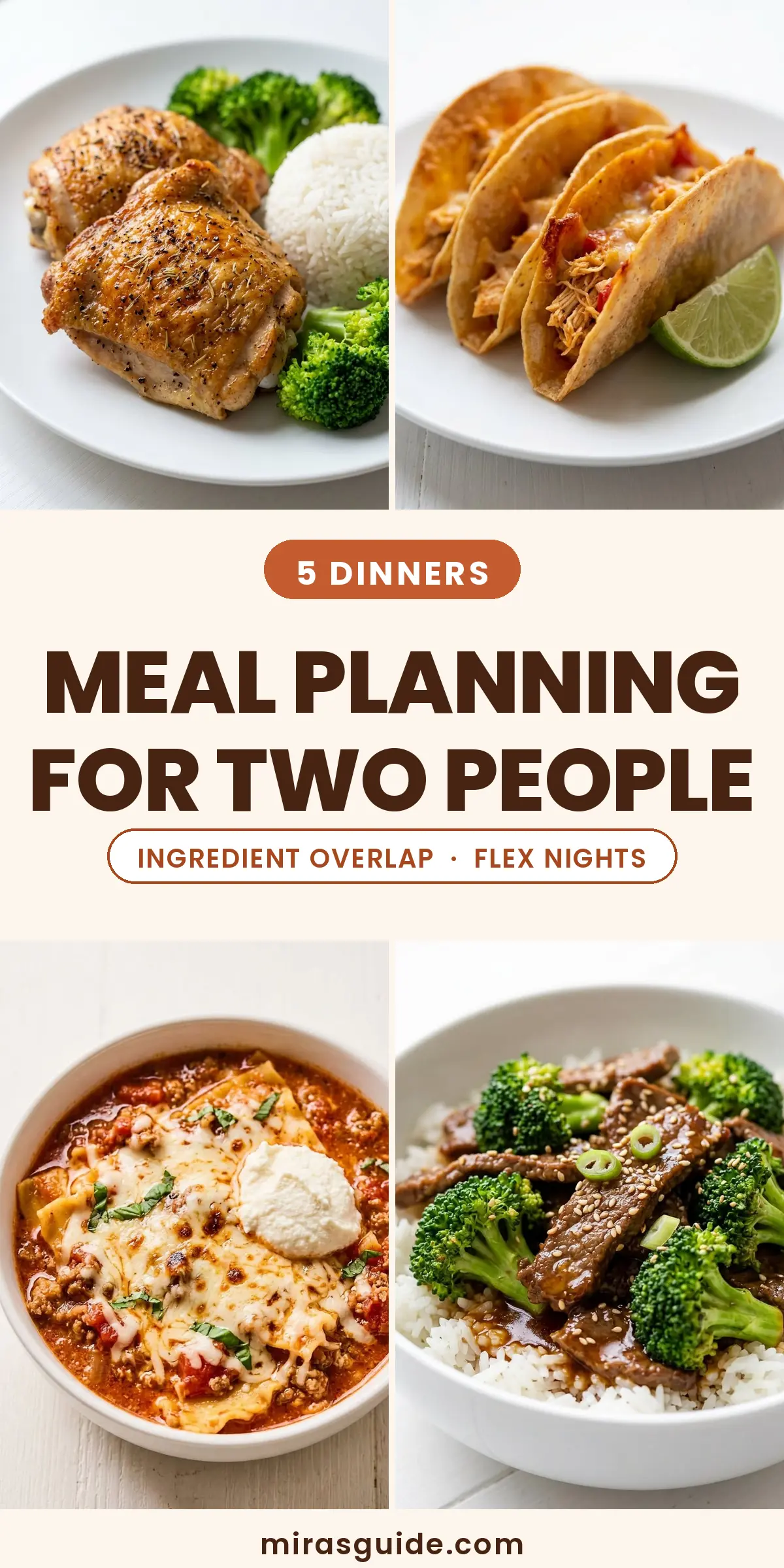
Meal planning for two is not just meal planning for four cut in half — that’s why most guides don’t work for couples. Cook the exact half-portion, and you’ll still end up with wilted spinach, a lonely half-jar of pasta sauce, and one uneaten chicken thigh nobody wants by Thursday.
The real trick is a system built specifically for two people: five planned dinners (not seven), shared-ingredient recipes (not miniature ones), and enough flexibility for date nights, takeout, and one partner working late.
This guide walks you through the exact 5-step framework couples actually stick with — even when you and your partner have completely different eating goals.
⚠️ Disclaimer: This meal plan is for general informational purposes only. Always consult your doctor before starting any new diet, especially if you have a medical condition, are pregnant, or nursing.
Why Meal Planning for Two Fails (When You Copy Family Systems) 🧭
The single biggest mistake couples make is trying to shrink family meal plans into a two-person version. Family plans assume:
- 🍗 You’ll finish a family pack of chicken thighs in one meal
- 🥬 A whole bag of spinach disappears in three days
- 🥫 A full jar of pasta sauce gets used across a week
- 🍝 Everyone eats the same thing
Cooking for two breaks every one of those assumptions. And when you try to force a family system onto a two-person kitchen, three specific things go wrong:
- Fresh produce spoils because packages are family-sized
- Fights start over “you always pick the meals” or “I don’t want chicken again”
- Takeout wins because Wednesday’s plan collapsed and no one has a backup
The fix isn’t willpower. It’s a system designed for two people from the ground up, with planned flexibility built in for the real-world stuff that always shows up.
The Big Truth About Cooking for Two 💡
Here’s the counterintuitive thing that changes everything: halving recipes barely saves money.
The real budget win for couples is
Want Dinner Decisions Handled for the Whole Household?
28 Days of Dinners Planned for You gives you 28 days of family-friendly dinners, already planned and portioned.
Plan My Next 28 Dinners →That’s because your grocery bill is driven partly by the number of unique items in your cart, not only the quantity of each item. EPA’s planning and shopping tips recommend checking your refrigerator, freezer, and pantry before shopping and buying only what you expect to use. Buy one bell pepper for two meals instead of two peppers for two meals, and both your budget and your fridge win.
Every step below is designed around this principle: use fewer ingredients, more times, across more meals.
The 5-Step Meal Planning System for Two 🗓️
Step 1 — Plan 5 Dinners, Not 7
The single biggest change: stop trying to plan every dinner of the week. Aim for 5 home dinners plus 2 flex nights for date night, takeout, or “clean out the fridge” meals.
Why 5 instead of 7? Because most couples: – 🍴 Eat out or with friends at least once a week anyway – 😴 Have at least one exhausted night where nobody wants to cook – ❄️ Can pull from the freezer or make eggs on night 7
Plan 5, and the plan survives real life. Plan 7, and you’ll either overshop, resent the plan by Thursday, or both.
Step 2 — Sit Down Together (Actually)
This is the step most couples skip. And it’s the whole reason meal planning fails as a couple.
Once a week — Sunday morning with coffee, or Friday evening with wine — spend 15 minutes together picking dinners. Not one person deciding alone. Both of you.
Why it matters: – 🎯 Both partners get input = no “I didn’t want that” fights later – 💡 You discover recipes you both actually enjoy (not just tolerate) – 🤝 One person doesn’t get stuck as “the cook” or “the planner”
Keep a shared list — a note on your phones, a Google Doc, a magnetic notepad on the fridge — of 20-30 dinners you both like. Every week, you’re picking 5 from that list. Not brainstorming from scratch.
Step 3 — Pick Meals That Share Ingredients
Don’t pick 5 recipes that share nothing. That’s how you end up with 15 half-used ingredients and a $90 grocery bill.
Use ingredient overlap — pick meals where one grocery item does double or triple duty. Example:
- 🍗 Buy a family pack of chicken thighs → use across 3 meals (roasted chicken Monday, chicken tacos Tuesday, teriyaki chicken bowls Thursday)
- 🥩 Buy 1 lb ground beef → use for firecracker beef bowls Monday, taco filling Tuesday, cheeseburger bowls Thursday
- 🥬 Buy one bag of spinach → use in salad, add to pasta, blend into a smoothie
That’s how you get 5 meals from ~10-12 grocery items instead of 15-18. Your bill drops 30-40% and you actually finish what you buy.
Step 4 — Cook Once, Eat Twice (On Purpose)
Batch cooking for a family means big pans. Batch cooking for two means making enough for tonight’s dinner + tomorrow’s lunch.
That’s it. You cook once → eat one serving fresh → refrigerate one for lunch → skip a cooking session tomorrow.
Some meals do this brilliantly. Others don’t:
| ✅ Great for cook-once-eat-twice | ❌ Bad for cook-once-eat-twice |
|---|---|
| Soups, stews, chili, curries | Fried foods (lose crispness) |
| Grain bowls, taco fillings | Delicate fish (dries out) |
| Roasted proteins (chicken, salmon) | Salads with dressing on |
| Casseroles, pasta bakes | Sushi or crispy tacos |
If both of you take lunch to work, this alone eliminates 2-4 cooking nights per week. Massive time win.
Step 5 — Build in 2 Flex Nights Every Week
The couples who stick with meal planning aren’t the ones with perfect plans. They’re the ones with built-in escape valves.
Plan 5 real dinners plus:
- 🥡 1 planned takeout/eat-out night (guilt-free, expected, budgeted)
- 🍳 1 “fridge cleanup” or backup meal night (eggs, sandwiches, leftovers, frozen pizza)
This is the difference between a plan that survives and a plan that dies on Wednesday. When Thursday’s plan blows up because one of you has a late meeting, you don’t scramble — you just use the flex night.
Handling Different Tastes and Goals 🤝
Every couple has this problem. One person wants smaller portions, the other wants more food. One is trying to lose weight, the other is trying to gain muscle. One loves spicy, the other hates it.
The solution isn’t cooking two separate meals. It’s building modular meals where each person adjusts.
🍽️ The “Same Base, Different Toppings” Strategy
Pick meals that let each partner customize their plate:
- 🌮 Taco night — same protein, everyone builds their own
- 🥣 Grain bowls — same base (rice + protein + veg), pick your own sauce and add-ons
- 🍕 Homemade pizza — same dough, personal toppings
- 🥗 Salad bar dinner — cook one protein, chop veggies, everyone assembles
- 🍜 Ramen night — same broth, different toppings per bowl
Our adult lunchable bento box approach works the same way — build modular meals, not identical plates.
📏 Different Portion Sizes, Same Meal
For couples with different calorie needs (weight loss vs. maintenance vs. muscle gain), don’t cook two meals. Cook one, then adjust plates.
Basic portion guidelines per person, per meal:
| Component | Standard Portion (per person) |
|---|---|
| 🍗 Protein | 4-6 oz |
| 🍚 Grains/starch | ⅓ – ½ cup uncooked |
| 🥦 Vegetables | 4 oz (about 1 cup) |
| 🥑 Healthy fats | 1-2 tablespoons |
The partner needing more calories doubles the grain or adds a slice of bread + butter. (For deeper background on balanced plate composition, the Harvard Healthy Eating Plate is the go-to free framework.) The partner needing fewer swaps in extra vegetables. Same meal, different plates.
🥩 One’s Vegetarian, One’s Not?
Cook a base meal that’s vegetarian, then let the meat-eater add cooked protein on top. Example: a pot of chili (or white chicken chili made with just beans and vegetables) → one bowl gets shredded chicken added, the other doesn’t.
You cook one meal, both partners get what they want. This is the framework that makes mixed-diet couples actually work long-term.
A Sample Week: Meal Planning for Two 📋
Here’s a real 5-dinner, two-person week using ingredient overlap. Grocery list fits in a small basket.
| Day | Breakfast | Lunch | Dinner |
|---|---|---|---|
| Mon | Overnight oats | Leftovers from Sunday | 🍗 Roast chicken thighs + rice + broccoli |
| Tue | Greek yogurt + berries | Chicken wrap (uses Mon’s chicken) | 🌮 Baked chicken tacos (fresh, uses Mon’s chicken) |
| Wed | Overnight oats | Leftover taco filling on greens | 🍝 Creamy lasagna soup (freeze half) |
| Thu | Eggs on toast | Leftover soup | 🥩 Beef and broccoli (uses ground beef) |
| Fri | Greek yogurt + berries | Big salad + canned tuna | 🍕 Homemade or frozen pizza (planned easy night) |
| Sat | Weekend breakfast | Whatever’s around | 🥡 Date night — eat out (planned) |
| Sun | Eggs + fruit | Leftovers | ❄️ Freezer meal + salad |
Grocery list (fits in a handheld basket, ~$55-70 for the week): 6 chicken thighs, 1 lb ground beef, 1 doz eggs, 1 tub Greek yogurt, 1 pack overnight oats, 1 loaf bread (freeze half), rice, tortillas, canned tuna, pasta, marinara, 1 head broccoli, 1 bag spinach, cheese, 2 onions, garlic, cherry tomatoes, cucumber, lemons.
That’s 3 cooking nights, 2 leftover nights, 1 easy night, 1 planned date-night out. Realistic. Sustainable. Not Instagram-worthy — but you’ll actually stick with it.
Common Couple Meal Planning Mistakes ⚠️
Almost every couple who quits meal planning quits for one of these reasons. None of them are about willpower.
- Only one partner plans and shops. Then that person “always picks the meals” and resentment builds. Fix: plan together, weekly, 15 minutes. Both people pick meals.
- Cutting family recipes in half without adjusting. Cooking times, spice ratios, and pan sizes all change when you halve. Fix: drop down one pan size, start with 60-70% of the seasoning (you can add more, you can’t remove).
- Buying “just in case” ingredients. Every couple does this — a random avocado, aspirational kale, a jar of curry paste. Half of it gets tossed. Fix: every item on your list must map to at least one specific meal.
- Planning 7 identical dinners. You’ll be sick of the meal plan by Wednesday. Fix: plan 5 with variety in protein and cuisine, plus 2 flex nights.
- Ignoring different goals. If one partner is trying to lose weight and the other isn’t, meals become a fight. Fix: cook one meal, adjust plates. Modular meals + portion adjustments.
The Two-Person Grocery Rules 🛒
Family shopping habits ruin two-person kitchens. Three rules that fix 90% of couple food waste:
🥕 Rule 1: Buy Loose Produce, Not Bagged
Two carrots from the loose bin, not a 2-lb bag. Three tomatoes, not a shrink-wrapped 6-pack. One bell pepper, not the 3-pack. The per-pound price is higher — but your per-meal cost is lower because you actually finish it.
🥩 Rule 2: Portion Family Packs The Day You Buy Them
The one exception to “buy small” is meat, where family packs are much cheaper per pound. Fix: the day you get home, portion the entire pack into 2-serving freezer bags (or 4-serving if you plan to cook once + eat twice). Freeze what you’re not eating in the next 2 days.
Never let raw meat sit in the fridge past day 2 — plan for it or freeze it.
🧊 Rule 3: Frozen Vegetables Are Not a Compromise
Frozen spinach, broccoli, peas, corn, stir-fry mixes — these are often more nutritious than fresh because they’re frozen at peak ripeness. And you use only what you need. The bag stays in the freezer indefinitely.
Couples who use 50% frozen vegetables cut their produce waste roughly in half. Bigger impact than any recipe change.
Two-Person Pantry & Freezer Starter Kit 📦
You don’t need everything on day one. But over 2-3 grocery trips, build up a base that lets you throw together a meal without shopping.
🥫 Two-Person Pantry Essentials
- Rice (small bag), oats, pasta
- Canned beans (black, chickpeas, cannellini)
- Canned tomatoes, canned tuna
- Olive oil, soy sauce, vinegar (small bottles)
- Onions, garlic
- Salt, pepper, 4-5 spices you both actually use
❄️ Two-Person Freezer Essentials
- Bread (freeze the day you buy — thaw slices as you need)
- Portioned raw chicken thighs / ground beef / salmon (2-serving bags)
- Frozen vegetables (spinach, peas, broccoli, stir-fry mix)
- Frozen berries (for smoothies + oats)
- 2-3 pre-made freezer meals from batch cooking
🧊 Two-Person Fridge Essentials (Rotate Weekly)
- Eggs (small carton)
- Greek yogurt (small tub)
- Cheese (small block, not shredded — lasts longer)
- 1-2 proteins for this week
- Salad greens (small clamshell) OR frozen alternative
With this base, you can throw together dinner for two on any night without shopping. The same balanced-meal principle applies whether you’re cooking for one or the whole family — use the Harvard Healthy Eating Plate as a flexible guide.
FAQ
How much should couples spend on groceries per week?
A realistic range for two people cooking mostly at home is $70-120/week in the US (higher in expensive cities, lower in the Midwest/South). Ingredient overlap consistently drops that by 20-30%. Couples using strict ingredient overlap can eat well on $50-70/week — see our cheap high-protein meal prep system for the exact grocery list approach.
How do we meal plan when we have different eating goals?
Cook one meal, adjust plates. For couples where one is losing weight and the other isn’t: same protein and vegetables for both, larger grain/carb portion for the higher-calorie partner. Or use “build-your-own” meals like grain bowls, tacos, and salad bars where each person customizes portions. Don’t cook two separate meals — it’s exhausting and unnecessary.
What if my partner is picky?
Start with the 10-15 meals you already know you both enjoy. Every couple has that overlap. Build your weekly plan from those first, then slowly test one new recipe per week. Don’t try to convert a picky partner with 5 new recipes at once — that’s a recipe for takeout every night. See our beginner guide to meal planning for the full “one new recipe per week” system.
How is meal planning for two different from meal planning for one?
Portion math and package sizes are less painful. Most family recipes divide cleanly by 2, and you can finish larger produce items faster. But you gain a new challenge: coordinating tastes and goals with your partner. If you’re transitioning from cooking for yourself, see meal planning for one for the solo fundamentals, then layer on the “plan together, adjust plates” rules above.
Should we use a meal delivery service like HelloFresh?
Meal delivery (HelloFresh, Blue Apron, etc.) solves the portion problem instantly and eliminates most waste. Downsides: costs 2-3x more per meal than home-cooked, more packaging, less flexibility. Best strategy: cook 3 nights from your own plan + use delivery 2 nights in busy weeks. Cheaper than full delivery, less stressful than cooking every night.
What if only one of us likes to cook?
Fine — but the non-cook should still help pick the meals. Otherwise the cook resents “always deciding” and the non-cook complains “I didn’t want that.” Split it: one person plans + shops, the other cooks. Or one person handles Monday-Wednesday, the other handles Thursday-Friday. Whatever the split, both people participate in some part of the system.
How do we handle date nights and weekends?
Build them in. Every meal plan for two should include one date night out (planned + budgeted) and one flexible weekend meal. Don’t try to plan Friday dinner if you know you’ll want to eat out — you’re just planning a plan that will get scrapped. Realistic beats aspirational every time.
Your Next Step 👉
Pick one habit to try this week — not five. My honest suggestion:
- Sit down together for 15 minutes and pick 5 dinners for this week.
- Look for at least one ingredient that shows up in 2+ meals (chicken, rice, ground beef, spinach).
- Write the grocery list from those 5 meals only.
That’s it. That’s your first two-person meal plan.
Once that feels automatic — usually 2-3 weeks — layer on Sunday prep. My beginner Sunday meal prep plan shows you how to prep 5 meals in one afternoon with a single grocery trip. Scale it for two people by cutting each recipe in half OR keeping full portions and freezing half for later weeks.
The best meal plan for two is the one you’ll both actually stick with — not the one that looks best on paper. Build the system for two from the ground up, and it works.
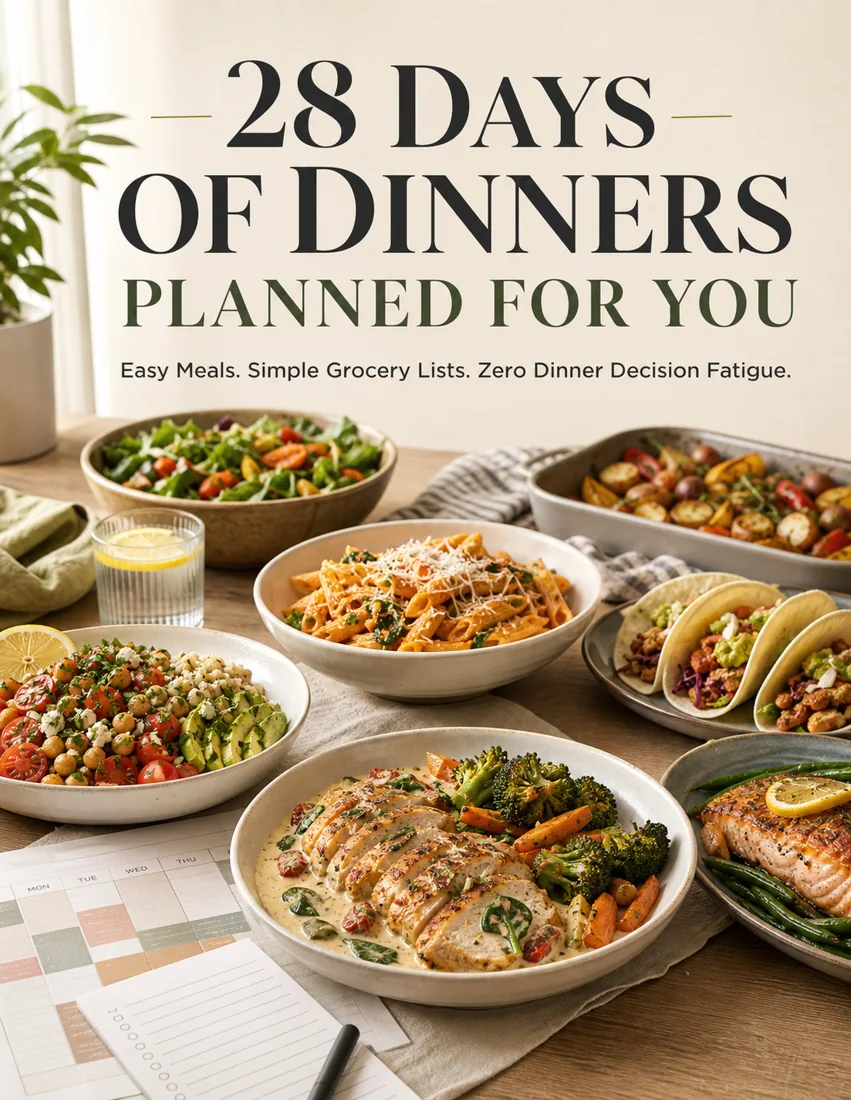
Stop wondering what’s for dinner
This article covers tonight. 28 Days of Dinners Planned for You covers the next 27—decided, shopped and prepped.
- ✓ 28 dinner recipes for real weeknights
- ✓ 4 weekly grocery lists, done for you
- ✓ Simple prep guidance for smoother evenings
- ✓ Leftover strategy & emergency dinners



Pingback: Meal Planning for a Family of 3: The Small-Family Guide
Pingback: Costco Meal Plan for 2: The Honest Bulk System
Pingback: Walmart Meal Plan for 2: The Honest Weekly System
Pingback: Costco Meal Plan for One: Solo Bulk-Buying Framework