Meal planning using same ingredients is the single most under-appreciated skill in home cooking — the trick that lets budget bloggers feed a family of 4 on $100/week while others spend $300+ for the same amount of food. The secret isn’t buying less, it’s buying fewer distinct items and using each one across 2-4 different meals. This guide walks you through the exact ingredient stacking system — how to pick your anchor items, build overlapping meal templates, and turn 10-15 groceries into 5-7 different dinners. You’ll cut waste, drop your grocery bill 25-35%, and finally end the “we have half-used ingredients in the fridge but nothing to eat” cycle.
⚠️ Disclaimer: This meal plan is for general informational purposes only. Always consult your doctor before starting any new diet, especially if you have a medical condition, are pregnant, or nursing.
Why “Same Ingredients, Different Meals” Beats Every Other Budget Hack 🧭
Here’s the counterintuitive math most people miss: your grocery bill is driven by the number of unique items in your cart, NOT the quantity of each item.
The two shoppers, same $150 budget:
Shopper A: “Different meals every night” – Buys 20-30 different ingredients – Uses each ingredient in 1 meal – Half of the fresh items go bad by day 5 – Grocery bill: $180 (over budget) – Real cost per meal: $12+ (with waste factored in)
Shopper B: “Same ingredients across meals” – Buys 10-15 versatile ingredients – Uses each one in 2-4 meals – Almost zero waste – Grocery bill: $120 (under budget) – Real cost per meal: $4-6
Same $150 budget, wildly different results. Shopper B eats just as varied meals — because ingredient stacking is about variety through preparation, not variety through unique ingredients. A pound of chicken becomes tacos on Monday, stir-fry on Wednesday, and chicken salad on Friday. Same chicken. Three completely different meals.
Every top budget cook uses this system. It’s not about eating boring food. It’s about maximizing every dollar you spend on groceries.
The 3 Pillars of Ingredient Stacking 💡
Before we get to specific meals, understand the framework. Every ingredient-stacking meal plan follows 3 pillars:
🎯 Pillar 1: Anchor Proteins (1-2 Per Week)
Pick 1-2 proteins for the whole week — not 5. Every dinner uses one of them.
Example week: – Anchor 1: 3 lbs chicken thighs → 3-4 dinners – Anchor 2: 1 dozen eggs → 2 breakfasts + 1 dinner
That’s it. Two proteins for the entire week. Every meal built around one or the other.
🎯 Pillar 2: Versatile Base Ingredients (5-8 Items)
These are your foundation — items that combine with everything and appear across multiple meals:
- 🌾 Grains (rice, pasta, oats) — 1-2 chosen for the week
- 🧅 Aromatics (onions, garlic) — used in every meal
- 🥫 Canned goods (beans, tomatoes) — 3-5 stocked
- 🥔 Long-shelf-life produce (potatoes, carrots, cabbage)
- 🧀 Dairy (cheese, yogurt) — 1-2 items
These are ingredients that don’t spoil quickly, work in many meals, and stretch further than expensive fresh items.
🎯 Pillar 3: Flex Items (Small Amount, Big Flavor)
The final layer: 3-5 fresh items OR sauces that add variety and freshness:
- 🥬 A bag of spinach (used in 2-3 meals)
- 🍅 3-4 fresh tomatoes (used in 2-3 meals)
- 🥑 An avocado (2-3 meals)
- 🌿 A lemon (multiple uses)
- 🌶️ A hot sauce, soy sauce, or salsa
Small amounts of these transform “same protein + same base” into 5 distinct meals.
The 5-Step Ingredient Stacking System 🗓️
Step 1 — Pick Your Anchor Protein (Just ONE)
For most families, pick ONE anchor protein per week. Multiple proteins = multiple grocery trips = higher waste + higher cost.
Best anchor proteins for stacking:
| Protein | Best For | Stacks Into |
|---|---|---|
| 🍗 Chicken thighs (family pack) | Roasted, shredded, stir-fried | Tacos, bowls, salads, soup, casseroles, pasta |
| 🥩 Ground beef/turkey | Cooked once, seasoned different ways | Tacos, pasta sauce, meatballs, stuffed peppers |
| 🐖 Pork shoulder | Slow-cooked, shredded | Pulled pork, tacos, sandwiches, rice bowls |
| 🍗 $5 rotisserie chicken (Costco) | Ready to shred | Anything the chicken thighs work in |
| 🥚 Eggs (backup protein) | Multiple prep methods | Breakfast, fried rice, quiche, salads |
Buy 2-3 lbs of your chosen anchor protein. Every dinner this week uses it.
Step 2 — Pick Your Base Ingredients (Same Every Week)
Your “base ingredients” are what you always keep stocked and use in every meal. Aim for 5-8 versatile items that combine with anything:
- 🍚 Rice (5 lb bag) — bowls, stir-fries, side dishes, casseroles
- 🍝 Pasta (2-3 boxes) — sauces, salads, casseroles
- 🥫 Canned beans (black, chickpeas) — 4-6 cans
- 🥫 Canned tomatoes — pasta sauces, chili, soups
- 🧅 Onions + garlic — the base of every meal
- 🧀 Cheese (1 block) — quesadillas, casseroles, salads, tacos
- 🥔 Potatoes — baked, mashed, hash
These items get used across 3-5 meals per week automatically. They’re the workhorses.
Step 3 — Add 3-5 “Flex Items” For Variety
Now add ingredients that give variety without exploding your grocery list. Pick items that appear in at least 2 meals:
- 🥬 Spinach or salad greens → in 2 salads + 1 pasta
- 🍅 Cherry tomatoes → salads + tacos + eggs
- 🥑 Avocado → tacos + toast + salad
- 🌶️ Bell peppers → stir-fry + tacos + fajitas
- 🥦 Broccoli → stir-fry + sheet pan + side
- 🍋 Lemons → seasoning + salad dressing + fish
Every flex item MUST have 2+ planned uses. If you’re only going to use it once, skip it — you’ll waste half.
Step 4 — Build Meals Using “Prep Once, Serve Different Ways”
The ingredient stacking magic happens when you cook ONE big batch of something, then use it 3-4 different ways:
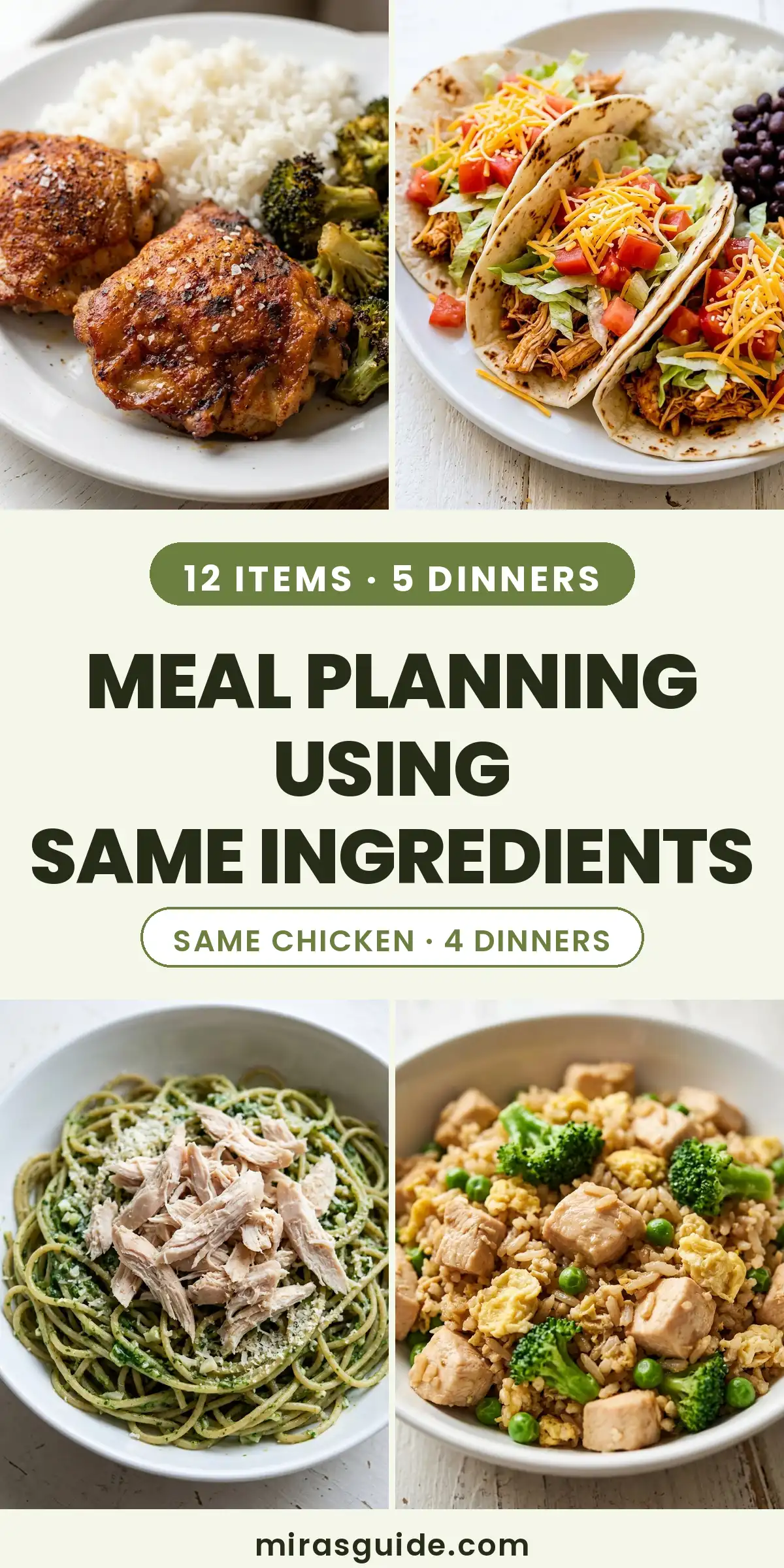
Sunday cook: 3 lbs chicken thighs
- 🍽️ Monday dinner: Sheet pan chicken + rice + roasted broccoli
- 🌮 Tuesday dinner: Chicken tacos with beans, cheese, tomato, lettuce
- 🍚 Wednesday dinner: Chicken fried rice (uses Monday’s leftover rice + frozen peas)
- 🥗 Thursday dinner: Big salad with shredded chicken + tomato + avocado + lemon dressing
Same chicken. Same rice. Same tomatoes. Four completely different dinners. Zero waste.
That’s ingredient stacking in action. Format changes = feels like variety. Ingredients repeat = grocery bill stays low.
Step 5 — Write A Short Grocery List (Not 30 Items)
If you’re doing ingredient stacking right, your grocery list should be 10-15 items MAX for the week — not 30.
Signs your list is right: – ✅ Under 15 unique items – ✅ Every item appears in 2+ planned meals – ✅ You can visualize each meal from the list – ✅ Total spend fits your weekly budget
Signs your list is wrong: – ❌ Over 25 items – ❌ Random items with no specific meal planned – ❌ Fresh produce you’ll never finish – ❌ Ingredients for “recipes you might make”
A Sample Week: 12 Ingredients → 5 Different Dinners 📋
Here’s a real example: 12 grocery items become 5 distinct dinners + breakfasts + lunches.
🛒 The 12-Item Grocery List (~$50-70 for family of 4):
Proteins (3 items): – 3 lb family pack chicken thighs — $8 – 1 dozen eggs — $3 – 2 cans black beans — $2
Bases (5 items): – 5 lb bag rice — $4 – 2 boxes whole-wheat pasta — $4 – 1 loaf whole-grain bread — $3 – 3 lb bag onions — $2 – 1 head garlic — $1
Flex (4 items): – 1 bag baby spinach — $3 – 4 tomatoes — $3 – 1 block cheddar cheese (16 oz) — $5 – 1 bag frozen broccoli — $2 – 1 gallon milk — $3
Total: 13 items, ~$45-55
Pantry staples assumed: olive oil, salt, pepper, cumin, chili powder, soy sauce, pasta sauce
🗓️ The 5-Dinner Plan (Massive Ingredient Overlap)
| Day | Dinner | Ingredients Used | New Ingredients |
|---|---|---|---|
| Mon | 🍗 Sheet pan chicken + rice + frozen broccoli | Chicken, rice, broccoli, onion, garlic | 0 (all from list) |
| Tue | 🌮 Chicken tacos (uses Mon’s chicken) + beans + rice + cheese + tomato | Chicken, beans, rice, cheese, tomato | 0 |
| Wed | 🍝 Pasta with chicken + spinach + garlic | Chicken, pasta, spinach, garlic, cheese | 0 |
| Thu | 🥗 Chopped salad: shredded chicken + spinach + tomato + beans + cheese | Chicken, spinach, tomato, beans, cheese | 0 |
| Fri | 🍳 Fried rice with eggs + frozen broccoli + leftover chicken | Eggs, rice, broccoli, chicken | 0 |
📊 Ingredient Usage Analysis:
- 🍗 Chicken thighs: 5 dinners (100%)
- 🍚 Rice: 3 dinners (60%)
- 🥫 Beans: 2 dinners (40%)
- 🥬 Spinach: 2 dinners (40%)
- 🍅 Tomatoes: 2 dinners (40%)
- 🧀 Cheese: 3 dinners (60%)
- 🥦 Broccoli: 2 dinners (40%)
Every ingredient works multiple times. Zero waste. Zero “half-used” leftovers. Real variety through format changes.
🥪 Bonus: Same Ingredients Fuel Breakfasts + Lunches Too
Breakfasts (rotate): – Eggs + toast + tomato slices (Mon) – Overnight oats (from your pantry base) (Tue) – Eggs + spinach scramble + toast (Wed) – Yogurt + berries (Thu) – Fried egg + cheese on toast (Fri)
Lunches (leftovers + assembly): – Leftover chicken + salad (Mon-Fri, various combinations) – Cheese + tomato sandwich – Bean + rice + cheese burrito with leftover chicken
Same 13 ingredients feeding 3 meals a day for a whole week. That’s the ingredient stacking payoff.
The 7 Ultimate “Stacker” Ingredients Every Home Should Keep 🌟
These 7 ingredients combine into more meals than any others. Always keep them stocked:
🥇 1. Rice
- Base for bowls, stir-fries, fried rice, soup, casseroles
- 30+ meal templates possible
🥇 2. Chicken (Thighs or Rotisserie)
- Roasted, shredded, cubed, stir-fried
- Combines with any grain + any vegetable
🥇 3. Eggs
- Breakfast + dinner (fried rice, quiches, frittatas)
- Cheapest complete protein at $0.25/serving
🥇 4. Beans (Canned)
- Meat stretcher, vegetarian protein, salad topping
- 1 can = 2-3 meals worth
🥇 5. Onion + Garlic
- Base of literally every savory meal
- Cheap ($1-2 for weeks of use)
🥇 6. Cheese
- Quesadillas, casseroles, salad topper, egg mix-in
- 1 block = 5-8 meals
🥇 7. Tortillas
- Tacos, quesadillas, wraps, breakfast burritos
- Fast dinner delivery vehicle
With these 7 + eggs + frozen vegetables + a few flex items = unlimited variety for $75-100/week.
Common Ingredient Stacking Mistakes ⚠️
- Buying different ingredients for every meal. Long list, high cost, tons of waste. Fix: 10-15 items MAX per grocery trip.
- Not planning meals around what overlaps. Random recipe picking = random ingredients. Fix: pick recipes that SHARE proteins, grains, or vegetables.
- Assuming ingredient stacking = boring. Wrong — variety comes from format + seasoning, not from having 20 different ingredients. Fix: same chicken can taste completely different in tacos vs. stir-fry vs. salad.
- Ignoring your existing pantry. Buying ingredients without checking what you have = duplicates. Fix: check your pantry FIRST (see our shop your pantry meal planning system).
- Not using leftovers strategically. “Leftover chicken” is a WASTED ingredient stacker opportunity. Fix: plan leftovers into the next day’s meal (Monday’s chicken = Tuesday’s tacos).
- Buying “flex items” you can’t finish. Bags of arugula, delicate herbs, exotic vegetables. Fix: every flex item must appear in 2+ planned meals.
The Ingredient Stacking Grocery Rules 🛒
🛒 Rule 1: Every Grocery Item Needs 2+ Planned Uses
If you’re buying a bell pepper, it goes in 2+ meals. Otherwise, half of it wilts. Same for bags of spinach, tubs of Greek yogurt, blocks of cheese. The 2-use rule is the single strictest filter for ingredient stacking success.
🥩 Rule 2: Anchor Protein → Multiple Meals
Buying a family pack of chicken thighs? Plan 3-4 meals for it BEFORE you buy. Don’t buy proteins without a stacking plan. Chicken thighs stretch across roasted → tacos → stir-fry → soup with almost no effort.
🥫 Rule 3: Canned + Frozen Are Stacking Champions
Canned beans, canned tomatoes, frozen vegetables — these NEVER waste (long shelf life) and stack across unlimited meals. Fresh produce is riskier (spoils fast) — buy less of it, use it strategically.
🥇 Rule 4: Format > Ingredient For Variety
If you’re bored of chicken 4 nights in a row, don’t buy a new protein. Change the format: – Night 1: whole thighs sheet-panned – Night 2: shredded in tacos – Night 3: sliced in stir-fry – Night 4: cubed in fried rice with a fried egg on top
Same protein, four completely different eating experiences.
FAQ
How much can I save with ingredient stacking?
20-35% off your grocery bill, typical. Families switching from “different meals every night” to ingredient stacking usually cut their weekly grocery bill by $30-80 immediately. Over a year: $1,500-4,000 saved without eating less well. The savings come from: fewer distinct items purchased + almost zero waste + smaller grocery lists that discourage impulse buys.
Isn’t this just “eating the same thing all week”?
No — that’s a different (much worse) strategy. Eating the same meal = same protein + same base + same seasoning 4 nights in a row = boring.
Don’t Want to Plan Every Dinner Yourself?
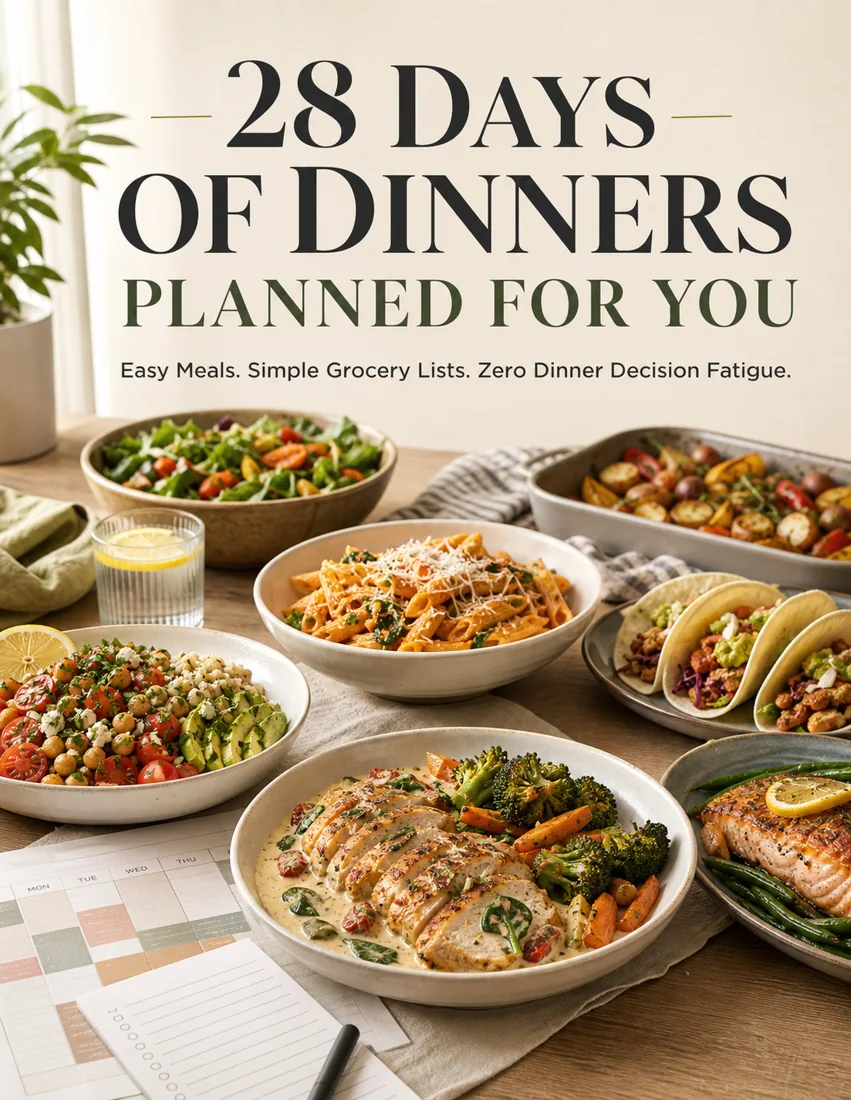
28 Days of Dinners Planned for You gives you 28 days of dinners, grocery lists and prep guidance already organized for you.
Plan My Next 28 Dinners →How is this different from “shop your pantry meal planning”?
Different focus, complementary strategies: – 🎯 Shop your pantry meal planning = weekly habit of checking inventory BEFORE buying (see our shop your pantry guide) – 🎯 Meal planning using same ingredients = strategic decision about WHICH ingredients to buy so they overlap across meals
Combine both for maximum savings. Weekly pantry audit → then plan meals with ingredient stacking → then grocery list of 10-15 items = the ultimate budget system.
What if my family gets bored eating chicken 3 nights in a row?
Change the format + seasoning. Chicken in tacos (Mexican) → chicken stir-fry (Asian) → chicken salad (Mediterranean) → chicken soup (comfort food) = 4 completely different meals. The protein is identical; the eating experience is completely different. Nobody complains “we just had chicken” if it’s presented as different meals.
How many different meals can I make with 10 ingredients?
Realistically 5-8 dinners + 5-8 breakfasts + 5-8 lunches with the right 10 ingredients. Example: rice + eggs + beans + cheese + tortillas + onions + garlic + tomatoes + chicken + spinach = burrito bowls, tacos, fried rice, quesadillas, chicken salad, breakfast burritos, chicken stir-fry, egg scrambles, spinach quiche. All feels like different meals. Same 10 ingredients.
What are the WORST ingredients for stacking?
Single-use ingredients you buy for ONE recipe: – 🌿 Exotic fresh herbs (basil bunch for one pesto recipe) – 🥭 Specialty produce (fresh pomegranate seeds, fresh figs) – 🥂 Specialty sauces (fish sauce, gochujang) unless you use them regularly – 🧀 Fancy cheeses (goat cheese, blue cheese for one salad)
These have their place in special-occasion cooking. For weekly grocery shopping, skip them — they blow the budget and create waste.
Do I need to plan the whole week at once?
Yes, that’s the point. Ingredient stacking requires seeing ALL 5-7 dinners at once so you can find overlap. Planning day-by-day = random ingredient buys = ingredient stacking impossible. 15 minutes on Sunday, plan the whole week, write a short list. That’s the system.
Your Next Step 👉
Pick ONE thing to try this week — not five. My honest suggestion:
- Pick ONE anchor protein for the week (chicken thighs family pack, ground beef, or a rotisserie chicken).
- Plan 3-4 meals using that anchor protein in different formats (roasted, tacos, stir-fry, soup, salad).
- Write a grocery list with 10-15 items total — every item appears in 2+ meals.
- Track the results. Most people spend $30-50 less than usual + waste almost nothing.
That’s your first ingredient stacking week.
Once that habit clicks (usually 2-3 weeks), combine ingredient stacking with our shop your pantry meal planning system for maximum savings. And if you want the fitness-focused version — high-protein meals that also use ingredient stacking — check out cheap high-protein meal prep which layers high-protein onto the same overlap principles.
Meal planning using same ingredients isn’t about eating boring or restricted food. It’s about buying fewer things and using each one 2-4 times. Do that, and 10-15 groceries become 5-7 completely different meals — with a grocery bill that drops 25-35% overnight.
Stop wondering what’s for dinner
This article covers tonight. 28 Days of Dinners Planned for You covers the next 27—decided, shopped and prepped.
- ✓ 28 dinner recipes for real weeknights
- ✓ 4 weekly grocery lists, done for you
- ✓ Simple prep guidance for smoother evenings
- ✓ Leftover strategy & emergency dinners