

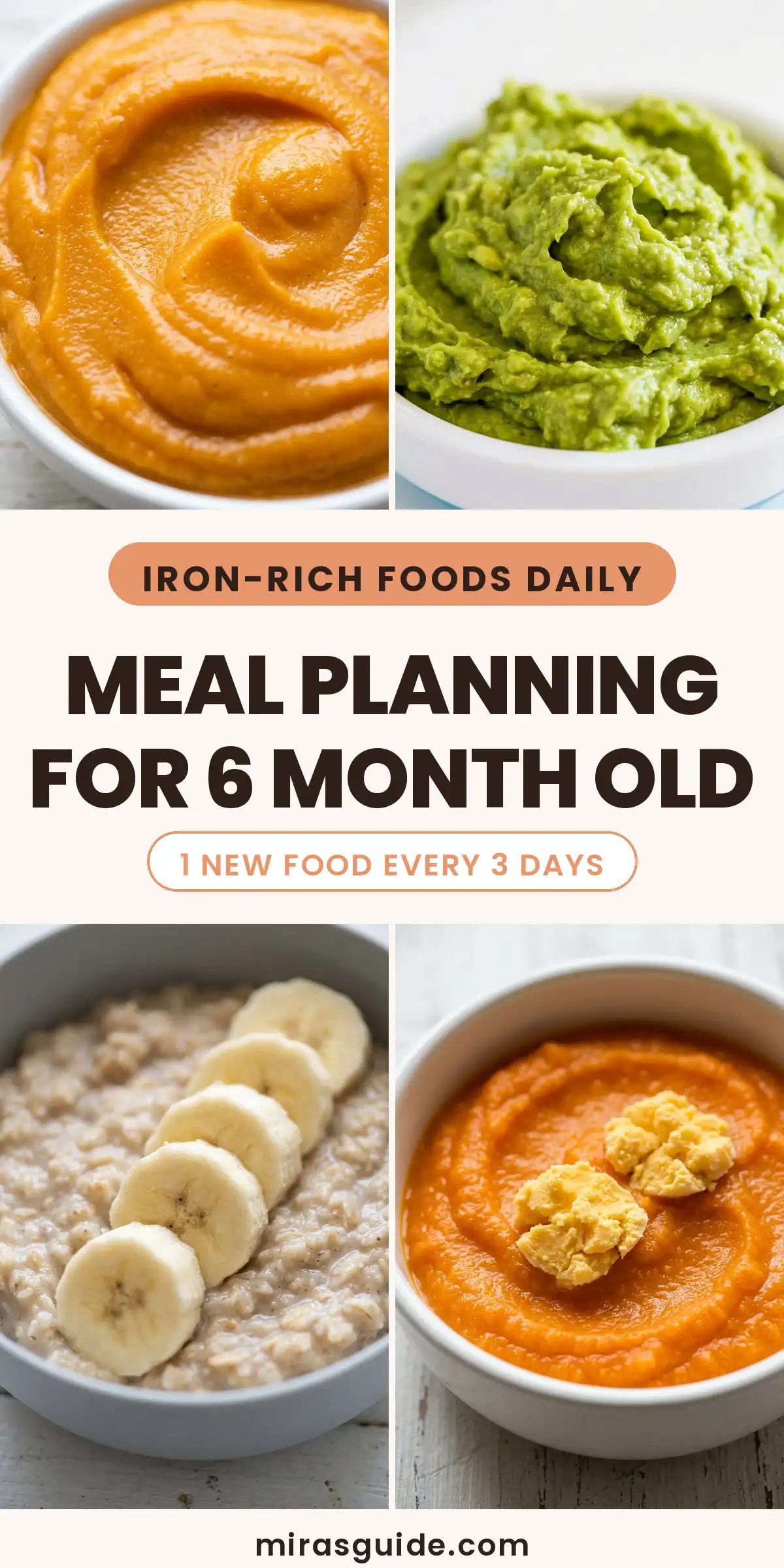
Meal planning for a 6 month old is one of the sweetest — and most anxiety-inducing — parenting milestones. You’re navigating first foods, allergens, purees vs baby-led weaning, iron needs, and the honest reality that most of the food will end up on the floor.
And every Instagram post makes it look effortless.
Don’t Want to Plan Every Dinner Yourself?
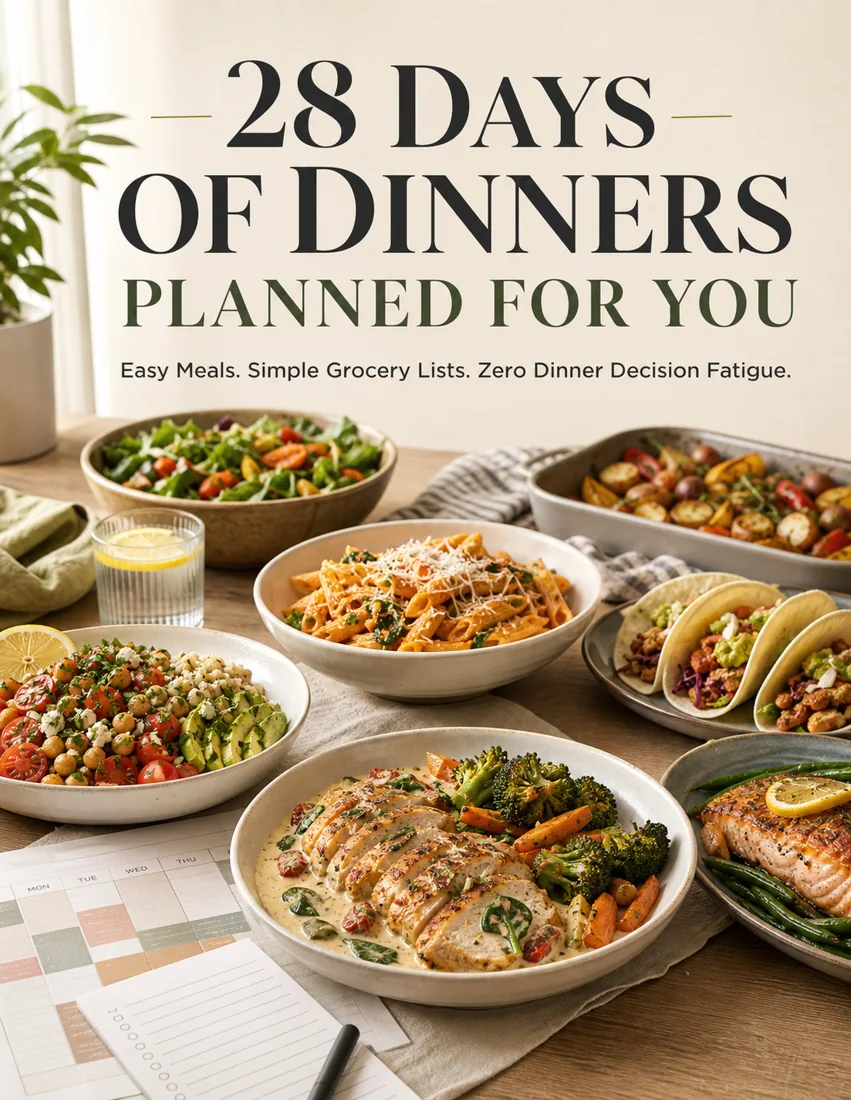
28 Days of Dinners Planned for You gives you 28 days of dinners, grocery lists and prep guidance already organized for you.
This guide is the practical, non-Instagram weekly meal planning framework for a 6-month-old: exactly what to serve, when to serve it, how to introduce allergens safely, and how to plan a week of first-food adventures without losing your mind. No 47-jar puree stockpile.
No pressure to make homemade everything. Just a real system for a real 6-month-old — one that respects that milk (breast milk or formula) is still their main nutrition, and food is exposure practice, not a full meal replacement.
👶 Pediatric Disclaimer: Every baby and child develops differently. Always consult your pediatrician before introducing new foods, changing your child’s diet, or starting a new feeding routine. This article is for informational purposes only and does not replace professional medical guidance.
Why Meal Planning at 6 Months Is Its Own Thing 🧭
At 6 months, “meal planning” doesn’t look like meal planning for adults. Your baby’s calories still come mostly from breast milk or formula. Food at this stage is about exposure, texture practice, allergen introduction, and iron support — not filling a plate.
Here’s what makes 6 months unique:
- 🍼 Milk is still 90% of nutrition — breast milk or formula stays their primary calorie source until ~12 months
- 🥄 Solids are practice — swallowing coordination, spoon skills, new flavors
- 🩸 Iron becomes critical — baby’s birth iron stores run out around 6 months
- 🥜 Allergen introduction is individualized — AAP guidance on common food allergens says there is no benefit to delaying age-appropriate allergenic foods once a baby is ready for solids. Infants with severe eczema, egg allergy, or a previous reaction should be assessed by a pediatrician before peanut introduction.
- 👶 Signs of readiness matter more than the calendar — sits with support, good head control, interest in food, no tongue-thrust reflex
The good news: a structured 6-month meal plan removes 90% of the daily “what do I feed the baby?” panic. Once you have a rotation, you’re just repeating a small set of safe, iron-rich foods.
The 4 Rules of Meal Planning for a 6 Month Old 🎯
Before the weekly plan, understand these four rules — they’re the foundation:
🎯 Rule 1: Milk First, Then Food
Always nurse or bottle-feed before offering solids. Food should come 30–60 minutes after a milk feed, not instead of one. If baby is hungry, they’ll be too frustrated to try new textures.
🎯 Rule 2: Iron-Rich Foods Are the #1 Priority
At about 6 months, iron needs depend on feeding history. American Academy of Pediatrics guidance on iron-rich foods explains that iron-rich complementary foods should be added as solids begin. Ask your baby’s clinician whether an iron supplement is needed, particularly for a breastfed or preterm infant.
- 🥩 Pureed or shredded meat (beef, chicken, turkey, lamb)
- 🫘 Mashed beans and lentils
- 🥣 Iron-fortified baby cereal (oatmeal, multigrain)
- 🥚 Egg yolk (well-cooked)
- 🐟 Flaked, boneless salmon
Aim for at least one iron-rich food per day starting from your very first week of solids.
🎯 Rule 3: Introduce Common Allergens With a Pediatric Plan
AAP food-allergen guidance says there is no benefit to delaying age-appropriate allergenic foods once a baby is developmentally ready for solids. Infants with severe eczema, egg allergy, or a previous food reaction need individualized advice before peanut introduction.
Introduce one new allergenic food at a time in an infant-safe texture and watch for a reaction. Never offer whole nuts or thick spoonfuls of nut butter because they are choking hazards. Ask your pediatrician how and how often to continue foods your baby tolerates.
🎯 Rule 4: Texture > Quantity
Your goal at 6 months isn’t calories — it’s texture practice. Start with smooth purees, then quickly progress to mashed, then chopped soft foods by 8–9 months. Don’t get stuck on purees.
The 5-Step 6-Month Meal Planning System 🗓️
Here’s your weekly framework.
Step 1: Start With 1 Meal a Day, Then Build 🥄
Week 1–2: One meal per day (usually lunch, when baby is alert but not tired). One food. Same food for 3 days to watch for reactions.
Week 3–4: Add a second meal (breakfast). Now baby has 2 solid meals per day.
Month 2 of solids: Add a third meal (dinner). By 8 months, 3 meals per day is normal.
Step 2: Pick 3 “Weekly Base Foods” 🥑
Choose 3 base foods that repeat every week — they become the reliable “yes” foods:
- 🍠 Sweet potato (mashed, easy, mild, iron with vitamin C)
- 🥑 Avocado (healthy fat, mashable, no cook)
- 🥣 Iron-fortified oatmeal (mixed with breast milk, formula, or water)
That’s your foundation — soft, safe, iron-conscious, and easy to combine.
Step 3: Add 1 New Food Every 3 Days 🆕
Every 3 days, introduce ONE new food. This lets you spot reactions. Rotation ideas for weeks 1–4:
- Days 1–3: Sweet potato puree
- Days 4–6: Avocado
- Days 7–9: Oatmeal + breast milk
- Days 10–12: Banana
- Days 13–15: Pureed carrot
- Days 16–18: Peanut butter (thinned, 1 tsp mixed into oatmeal)
- Days 19–21: Well-cooked egg yolk
- Days 22–24: Pureed chicken
- Days 25–27: Mashed beans
- Days 28–30: Flaked salmon
Step 4: Batch-Prep Purees or Mashables Weekly 🥄
Sunday puree prep = your whole week done. Pick 3 foods, cook + puree, freeze in ice cube trays (each cube ≈ 1 oz).
- 🥕 Steam carrots → puree → freeze
- 🍠 Bake sweet potato → mash → freeze
- 🍎 Simmer apple → puree → freeze
Pop 1–2 cubes into a bowl, thaw overnight or 20 seconds in microwave.
Step 5: Offer Water With Meals 💧
Once solids start, offer a few sips of water in a small open cup or straw cup with each meal — a total of 4–8 oz per day is plenty for a 6-month-old. This builds cup skills early and prevents constipation.
A Sample Week: 6-Month-Old Meal Plan 📋
Here’s a realistic week for a 6.5-month-old on 3 solid meals:
Monday
- Breakfast: 2 tbsp iron-fortified oatmeal + breast milk + ¼ mashed banana
- Lunch: 2 tbsp sweet potato puree + 1 tbsp pureed chicken
- Dinner: 2 tbsp mashed avocado + 1 tsp thinned peanut butter mixed in
Tuesday
- Breakfast: 2 tbsp oatmeal + 1 tbsp mashed berries
- Lunch: 2 tbsp pureed carrot + 1 tbsp mashed lentils
- Dinner: Full-fat yogurt (2 tbsp, plain, whole milk) + mashed banana
Wednesday
- Breakfast: 2 tbsp oatmeal + 1 tbsp mashed avocado
- Lunch: 1 well-cooked egg yolk mashed + 2 tbsp sweet potato
- Dinner: 2 tbsp pureed pear + 1 tbsp pureed chicken
Thursday
- Breakfast: 2 tbsp yogurt + 1 tbsp mashed berries
- Lunch: 2 tbsp mashed beans + 2 tbsp mashed sweet potato
- Dinner: 2 tbsp flaked salmon (deboned) + 1 tbsp avocado
Friday–Sunday
Rotate through the same base foods with 1 new food added midweek (e.g., tofu, cottage cheese, mashed peas).
Portion size at 6 months: 2 tbsp per food, 2–3 foods per meal. That’s plenty. Most will end up on the tray.
Managing Common 6-Month Meal Planning Challenges 🎯
Baby only takes 2 bites and refuses the rest
Totally normal. At 6 months, solids are practice. If baby turns away, ends the meal, or spits food out — end the meal. Try again in 6 hours. Never force.
Constipation after starting solids
- Add prunes, pears, or peaches to rotation (P-fruits)
- Offer more water
- Skip constipating foods like rice cereal, banana, applesauce for a week
- Talk to your pediatrician if it lasts more than 3 days
Not sure if it’s an allergic reaction
Mild reactions: rash around mouth, mild fussiness. Serious reactions: hives, vomiting, swelling, difficulty breathing = call 911 immediately. Between the extremes, call your pediatrician same-day.
Baby-led weaning vs purees — which?
Both work. Many families combine: purees for iron-fortified cereal + yogurt + soft mash, plus finger foods (soft avocado strips, banana spears, roasted sweet potato sticks) for BLW practice. Neither is superior — go with what feels safe to your family.
The 6-Month Baby Food Pantry Base 📦
Stock these — your first-foods foundation:
Refrigerator: – Ripe avocados – Full-fat plain yogurt (whole milk, unsweetened) – Fresh berries, ripe pears, ripe bananas – Cooked chicken or turkey (from adult meals, shredded fine)
Freezer: – Ice cube tray purees (sweet potato, carrot, apple, pea) – Frozen peas + berries (thaw for portions) – Individually-frozen salmon fillets (deboned)
Pantry: – Iron-fortified baby oatmeal (single ingredient, no added sugar) – Natural peanut butter (thin with water or breast milk) – Tahini (sesame allergen intro) – Canned wild salmon (rinsed, deboned) – Canned beans (low sodium, mash + rinse) – Baby-safe open cup or 360 cup
FAQ
How much food should a 6-month-old eat?
2–3 tablespoons per food, 2–3 foods per meal, 1–3 meals per day. Total daily solid food at 6 months is usually 4–12 tablespoons — very small. Milk (breast milk or formula) is still the main event. Most parents overestimate how much a 6-month-old needs.
Should I do purees or baby-led weaning?
Both are safe and both work. Purees are easier for iron-fortified cereals and yogurt-based foods. Baby-led weaning is great for finger foods like soft avocado, banana spears, and roasted sweet potato sticks. Most families combine both. Follow your comfort and baby’s cues. Always supervise, and know the difference between gagging (loud, normal) and choking (silent, emergency).
When do I introduce peanut butter?
Around 6 months, once baby has tolerated a few other foods. Current pediatric guidance recommends early introduction to reduce peanut allergy risk. Start with 1 tsp of natural peanut butter thinned with water or breast milk, mixed into oatmeal or yogurt. Never give a whole spoonful of thick peanut butter (choking risk) and never whole peanuts.
Do I need to make homemade baby food?
No. Store-bought pouches, baby cereals, and jarred purees are perfectly safe and nutritionally complete. Homemade is cheaper and lets you control texture, but there is no health advantage to homemade over quality store-bought options. Do whatever fits your bandwidth.
How does this fit with feeding older kids in the family?
Once you get to finger foods, baby’s meal is often just a modified version of the family meal. Our healthy kids lunchbox ideas guide covers meal planning for toddlers and older kids — many of the same batch-prep principles apply. Our beginner meal planning guide helps you plan family meals baby can eventually share.
Your Next Step 👉
Pick ONE thing this week. My honest suggestion:
- Buy an ice cube tray + one bag of frozen mango or one sweet potato. That’s your first puree.
- Introduce one allergen this week (thinned peanut butter is the easiest).
- Set a “one new food every 3 days” rule. No pressure to move faster.
- Skip the pinterest-perfect baby meal photos. Real 6-month meals look like 4 bites and a floor tornado.
That’s your first week of 6-month meal planning.
Once baby is on 3 solid meals per day (usually by 8 months), you’ll layer on more finger foods and family-adapted meals. Our beginner meal planning guide covers the fundamentals that apply here too — batch-prep 3 base foods, plan 3 meals a day, rotate + repeat.
Meal planning for a 6-month-old isn’t about calories. It’s about exposure, iron, and allergen introduction. Do those three well, and your baby’s foundation is strong — no matter how much food ends up on the floor.
Stop wondering what’s for dinner
This article covers tonight. 28 Days of Dinners Planned for You covers the next 27—decided, shopped and prepped.
- ✓ 28 dinner recipes for real weeknights
- ✓ 4 weekly grocery lists, done for you
- ✓ Simple prep guidance for smoother evenings
- ✓ Leftover strategy & emergency dinners


Pingback: Meal Planning for 11 Month Old: Pre-Toddler Weekly Guide
Pingback: Pregnancy Meal Plan: Trimester-by-Trimester Guide