

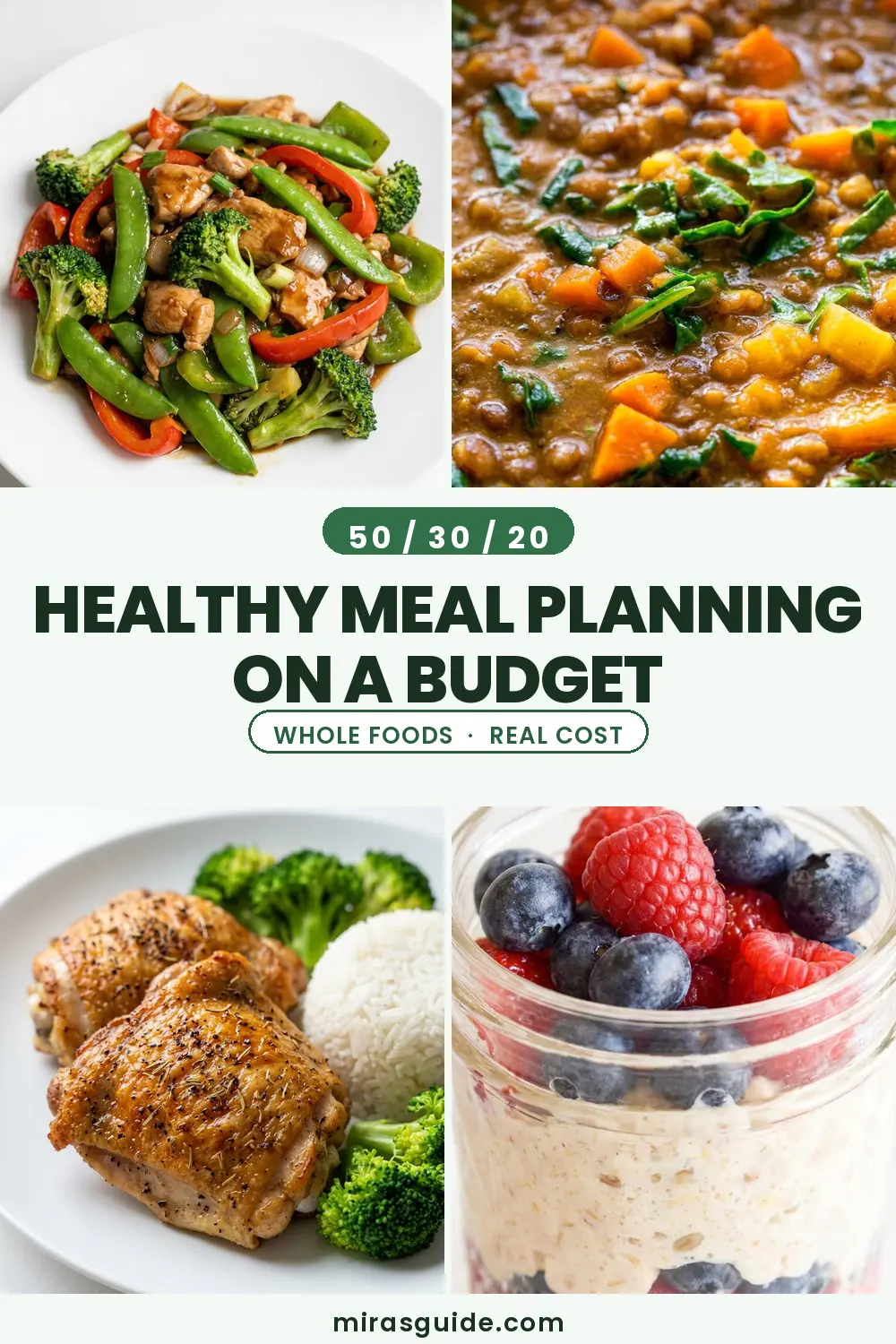
Healthy meal planning on a budget doesn’t mean choosing between nutrition and your grocery bill — that’s the false choice most guides push. The truth: eating balanced whole foods is often cheaper than eating processed convenience foods, once you know how to structure your grocery cart. This guide walks you through the 50/30/20 framework — 50% staples, 30% protein, 20% produce — that dietitians and budget-cooking families use to consistently hit $100-$150/week for balanced, nutritious meals. No high-protein-obsession, no rice-and-beans-every-night, no organic-produce guilt. Just real food, real planning, real numbers.
⚠️ Disclaimer: This meal plan is for general informational purposes only. Always consult your doctor before starting any new diet, especially if you have a medical condition, are pregnant, or nursing.
Why “Healthy” and “Budget” Aren’t Actually Opposites 🧭
There’s a persistent myth that eating healthy costs more. It’s mostly wrong. What actually costs more:
Want a Month of Dinners Planned Without Overspending?
28 Days of Dinners Planned for You gives you 28 days of dinners with organized grocery lists that make shopping simple.
Plan My Next 28 Dinners →- 🥩 Premium proteins (grass-fed beef, wild salmon, name-brand chicken breast)
- 🥦 Out-of-season fresh produce (asparagus in December, berries in January)
- 🥤 “Healthy” convenience foods (protein bars, meal kits, cold-pressed juice, snack packs)
- 🌾 Specialty diet products (keto crackers, gluten-free pasta, organic everything)
What’s actually cheap AND healthy:
- 🥚 Eggs — $0.25 per serving, complete protein
- 🥫 Dried or canned beans + lentils — $0.20-0.30 per serving, high fiber + protein
- 🍚 Whole grains (brown rice, oats, whole-wheat pasta) — $0.10-0.30 per serving
- 🥬 Frozen vegetables — often cheaper AND more nutrient-dense than fresh
- 🍎 Seasonal produce (bananas, apples, carrots, cabbage year-round)
- 🐟 Canned tuna/salmon — $1-2 per serving, omega-3s
The healthy meal planning on a budget shift isn’t about cutting food quality. It’s about restructuring what fills your cart so nutrient-dense whole foods make up 70-80% of your grocery spending, with the remainder going to variety and flavor.
The Truth About “Healthy Eating Is Expensive” 💸
Here are the honest numbers for a family of 4 eating balanced, nutritious meals:
| Budget Approach | Weekly Spend | Nutrition Quality |
|---|---|---|
| 🔴 Convenience-focused (takeout, packaged, meal kits) | $300-500 | Often poor |
| 🟡 “Healthy” premium (organic everything, name brands) | $250-350 | Excellent, unaffordable long-term |
| 🟢 Balanced whole-food budget ⭐ | $100-150 | Excellent + sustainable |
| 🔵 Ultra-frugal survival (rice/beans only) | $60-90 | Nutritionally limited |
The sweet spot: $100-150/week for a family of 4. That’s balanced protein + vegetables + whole grains + fruit, cooked mostly from scratch. This guide gets you there.
The 50/30/20 Healthy Budget Framework 🗓️
This is the dietitian-recommended, budget-tested framework used by real families eating well on less:
💰 50% Staples ($50-75/week for family of 4)
Whole grains, legumes, potatoes, oats — the FOUNDATION of every meal: – Brown rice, quinoa, whole-wheat pasta – Oats, whole-grain bread, tortillas – Dried beans, lentils, canned beans (chickpeas, black, cannellini) – Potatoes, sweet potatoes
Cost per serving: $0.10-0.50. Every meal starts with a staple base.
🥩 30% Protein ($30-45/week for family of 4)
Affordable protein sources that rotate: – Eggs (2-3 dozen) – Chicken thighs (family pack) – Ground turkey/beef (family pack) – Canned tuna or salmon – Greek yogurt, cottage cheese
Cost per serving: $0.25-2. Meat becomes a portion of the plate, not the center.
🥦 20% Produce ($20-30/week for family of 4)
Vegetables and fruit — heavy on frozen + seasonal: – Frozen vegetables (spinach, broccoli, peas, mixed veg) – Seasonal fresh (onions, garlic, cabbage, carrots year-round) – Bananas, apples, in-season fruit – Frozen berries
Cost per serving: $0.30-1. Frozen matches or beats fresh for nutrition + costs less.
That’s your framework. 50% staples + 30% protein + 20% produce = balanced, healthy, affordable. Every grocery trip, every meal.
The 5-Step Healthy Budget Meal Planning System 🗓️
Step 1 — Fill Half Your Plate With Vegetables (The Real Cost-Saver)
The single easiest way to eat healthier AND spend less: shift the plate proportion. A simple framework from the Harvard Healthy Eating Plate is to make roughly half the plate vegetables and fruits, one quarter whole grains, and one quarter healthy protein. This balance can also work well with budget-friendly staples.
Why? Because vegetables (especially frozen + seasonal + cabbage/carrots/onions) cost dramatically less per serving than meat. Every ounce of protein you replace with an ounce of vegetables saves ~$0.50-1.00.
Real example: A stir-fry with 1 lb chicken + 2 cups vegetables (family of 4) costs ~$6. Same stir-fry with 1/2 lb chicken + 5 cups vegetables = same volume, more nutrition, costs ~$4.
Every meal, aim to double the vegetables + halve the meat vs. what you’re doing now. Saves money AND boosts nutrition simultaneously.
Step 2 — Anchor Every Week Around 2 Cheap Proteins
Don’t buy 5 different proteins per week (fitness meal plans push this). For healthy budget cooking, pick 2 proteins per week and rotate them:
| Week | Protein 1 | Protein 2 |
|---|---|---|
| Week 1 | 🍗 Family pack chicken thighs | 🥚 2 dozen eggs |
| Week 2 | 🥩 Ground turkey family pack | 🥫 Dried lentils + canned beans |
| Week 3 | 🐟 Frozen fish fillets | 🥚 Eggs + canned tuna |
| Week 4 | 🍗 $5 Costco rotisserie chicken | 🥫 Beans + eggs |
Ranked cheapest protein per serving: 1. 🥚 Eggs — $0.25/serving 2. 🥫 Dried beans/lentils — $0.20-0.30/serving 3. 🍗 Chicken thighs (family pack) — $0.75-1.50/serving 4. 🥩 Ground turkey (family pack) — $1-1.50/serving 5. 🐟 Canned tuna/salmon — $1-2/serving
Combining 2-3 of these across a week hits the balance of variety + protein + affordability.
Step 3 — Use Frozen Vegetables Strategically (Budget-Friendly and Nutritious)
Frozen produce can be a nutritious budget option. Harvard’s comparison of fresh, frozen, and canned produce explains that nutrient levels depend on the food, processing method, and storage time. In some cases, frozen or canned produce may contain more nutrients than fresh produce that has been stored for too long.
For healthy meal planning on a budget: – ✅ Buy frozen for: spinach, broccoli, peas, corn, mixed vegetables, stir-fry mix, cauliflower rice, edamame – ✅ Buy fresh for: onions, garlic, potatoes, carrots, cabbage (long shelf life) – ⚠️ Buy fresh only in season: bell peppers, tomatoes, cucumbers, leafy greens
Frozen vegetables: – ✅ Can cost less than fresh, depending on the item and season – ✅ Last for months when stored correctly – ✅ Let you use only what you need – ✅ Remain nutritious, although exact nutrient levels vary by food and processing method
Using frozen vegetables for some meals can lower costs, extend shelf life, and reduce waste.
Step 4 — Cook Once, Eat Balanced Meals All Week
For healthy meal planning on a budget, component prep (not full-meal prep) is the winning strategy:
Sunday prep session (60-90 min): 1. 🍚 Cook 4-6 cups of a whole grain (brown rice, quinoa, or whole-wheat pasta) 2. 🍗 Cook 2-3 lbs of protein (roast chicken thighs OR brown ground turkey OR cook a big batch of lentils) 3. 🥦 Roast 1-2 sheet pans of vegetables (whatever’s in season + on sale) 4. 🥗 Wash + chop raw vegetables for salads, snacks, quick lunches
Then throughout the week: combine components differently each day. – Monday: Grain bowl (rice + chicken + roasted veg + sauce) – Tuesday: Wrap (chicken + veg in a tortilla + Greek yogurt sauce) – Wednesday: Big salad (lettuce + chicken + veg + boiled egg + vinaigrette) – Thursday: Soup night (leftover chicken + broth + frozen veg + rice) – Friday: Homemade pizza with the remaining vegetables as toppings
One cook session → 5+ different balanced meals for the whole family. Total cost: $25-35 in ingredients.
Our beginner Sunday meal prep plan walks through the exact framework.
Step 5 — Plan 1-2 Vegetarian/Vegan Nights Per Week
Every meatless dinner saves $5-15 vs a meat-based dinner. For a family of 4, one vegetarian night per week saves ~$40-60/month. Two nights = $80-120/month back in your pocket — without losing nutrition.
Cheap, healthy, vegetarian dinners: – 🍜 Lentil soup with whole-grain bread – 🌮 Black bean tacos with rice – 🍝 Pasta with chickpeas, spinach, and garlic – 🥔 Baked potato bar with beans + broccoli + cheese – 🍚 Rice + bean burrito bowls – 🥣 Vegetable stir-fry with tofu or eggs over rice – 🍕 Homemade veggie pizza
None of these feel like sacrifice. All are balanced, filling, and family-friendly.
A Sample Week: $130 Healthy Budget Meal Plan (Family of 4) 📋
Real 7-day plan hitting the 50/30/20 framework. Total ~$120-140 at Aldi/Walmart pricing.
🛒 Grocery List (~$130)
50% Staples ($60-65): – 5 lb bag brown rice: $6 – 3 lbs whole-wheat pasta: $6 – Rolled oats (large container): $5 – 3 cans black beans + 2 cans chickpeas + 1 can cannellini: $8 – 1 lb dried lentils: $2 – Whole-grain bread (2 loaves, freeze 1): $6 – Whole-grain tortillas (large pack): $4 – 5 lb bag potatoes: $4 – 2 sweet potatoes: $2
30% Protein ($40-45): – 3 lb family pack chicken thighs: $6-8 – 2 lb ground turkey: $8-10 – 2 dozen eggs: $6-8 – 1 large container Greek yogurt: $5 – 1 can tuna + 1 can salmon: $3-4 – 1 block cheddar cheese (16 oz): $5-6
20% Produce ($25-30): – 3 lb bag onions: $2 – 2 heads garlic: $1 – 2 bags frozen spinach: $4 – 1 bag frozen broccoli: $2 – 1 bag frozen mixed vegetables: $2 – 1 bag frozen peas: $2 – 1 bag frozen berries (breakfast): $3 – 1 head lettuce, 3 tomatoes, 2 cucumbers: $6 – Bananas, apples, in-season fruit: $6
Pantry basics assumed: olive oil, salt, pepper, cumin, chili powder, garlic powder, Italian seasoning, soy sauce, honey.
🗓️ The 7-Dinner Plan (Balanced, Family-Friendly)
| Day | Dinner | Nutrition |
|---|---|---|
| Mon | 🍗 Sheet pan chicken thighs + brown rice + roasted broccoli | Complete meal |
| Tue | 🌮 Chicken tacos (uses Mon’s chicken) + beans + veg | Ingredient overlap |
| Wed | 🍝 Whole-wheat pasta with turkey ragu + spinach-style | High-veg, high-fiber |
| Thu | 🥣 Lentil soup + whole-grain toast + side salad | 🌱 Vegetarian night |
| Fri | 🥔 Baked potato bar (potatoes + broccoli + cheese + Greek yogurt + optional beans/leftover chicken) | 🌱 Vegetarian option |
| Sat | 🍕 Homemade veggie pizza (whole-wheat tortilla base + sauce + cheese + vegetables) OR planned takeout | Flexible |
| Sun | 🍳 Breakfast for dinner (eggs + oatmeal + fruit + toast) | Balanced + fun |
Breakfasts (rotate): High-protein overnight oats, Greek yogurt with berries, cottage cheese egg bites, scrambled eggs with toast
Lunches (leftovers + easy): Leftover dinner, tuna sandwich on whole-grain bread, Greek yogurt parfait, big salad with boiled egg
Total weekly cost: ~$120-140 for a family of 4 = $30-35/person/week. Balanced, nutritious, sustainable.
Common Healthy Budget Meal Planning Mistakes ⚠️
- Buying “healthy” convenience foods. Protein bars, meal replacement shakes, prepped smoothie packs = 3-5x the cost of whole-food equivalents. Fix: whole foods only (eggs, fruit, nuts, yogurt for snacks).
- Prioritizing organic everything. Organic across the board doubles your grocery bill without proportional health benefit. Fix: prioritize organic only for the “Dirty Dozen” (strawberries, spinach, apples) if it fits budget.
- Only eating meat for protein. Beans + lentils + eggs cost 1/4 as much as chicken/beef, hit nutrition targets perfectly. Fix: 1-2 vegetarian nights per week.
- Ignoring frozen produce. “Fresh is best” is a myth. Fix: 50%+ frozen vegetables — save money, save time, cut waste.
- Buying fresh herbs weekly. $4/bunch of basil that dies in 3 days. Fix: dried spices for daily cooking, fresh only for special meals.
- Buying single-serving packages. “Convenience-sized” foods cost 2-3x per ounce vs bulk. Fix: buy bulk + portion at home into reusable containers.
The Healthy Budget Grocery Rules 🛒
🥩 Rule 1: Buy Cheap Cuts of Meat, Not Premium
For healthy meal planning on a budget: – ✅ Chicken thighs (not chicken breast) — cheaper, more flavorful, harder to overcook – ✅ Ground turkey/beef (80/20) — cheapest ground meat – ✅ Pork shoulder — inexpensive, feeds many – ✅ Whole chicken or rotisserie chicken — best value per pound
Skip premium (grass-fed, organic, wild-caught) unless it fits your budget after the essentials.
🥫 Rule 2: Beans + Lentils = Your Nutritional Superpower
Beans and lentils deliver: – ✅ High protein (7-9g per ½ cup) – ✅ High fiber (7-8g per ½ cup) – ✅ Complex carbs – ✅ ~$0.20-0.30 per serving
Add them to soups, salads, tacos, bowls, and pasta. Aim for beans/lentils in at least 3-4 meals per week. Our high-fiber meal prep covers exactly how to build meals around them.
🍞 Rule 3: 100% Whole Grains, Cheapest Version
Whole grains keep you full longer + provide more nutrients: – ✅ Rolled oats (huge container ~$4-5 lasts a month) – ✅ Brown rice (5 lb bag $4-6) – ✅ Whole-wheat pasta ($1-2 per box) – ✅ 100% whole-grain bread ($2-4 per loaf)
No need for specialty grains (quinoa, farro, freekeh) unless on sale. Rice + oats + pasta covers 95% of grain needs.
🍎 Rule 4: In-Season Fresh + Year-Round Frozen
For fruits and vegetables: – Fresh year-round staples: onions, garlic, carrots, potatoes, cabbage, apples, bananas – In-season fresh: whatever’s cheap this week at the farmers’ market or grocery store – Frozen for everything else: spinach, broccoli, peas, corn, berries, mixed vegetables
Skip out-of-season fresh (asparagus in winter, berries in November) — you’ll pay 3x for less nutrition than the frozen version.
The Healthy Budget Pantry Base 📦
Build over 2-3 grocery trips. Once stocked, you can always throw together a balanced meal without shopping.
🥫 Healthy Budget Pantry Essentials
- Rice (5-10 lb bag), oats (large container), whole-wheat pasta (4-6 boxes)
- Canned beans (black, chickpeas, kidney, cannellini) — 8-12 cans stocked
- Dried lentils + dried beans — 2-3 lbs each
- Canned tomatoes (diced + crushed), pasta sauce (2-3 jars)
- Canned tuna + salmon (4-6 cans)
- Olive oil, vinegar, soy sauce, honey
- Peanut butter (large jar)
- Onions, garlic, potatoes
- Basic spices: salt, pepper, cumin, chili powder, garlic powder, Italian seasoning, cinnamon
❄️ Healthy Budget Freezer Essentials
- Portioned raw chicken thighs/ground meat (from bulk packs)
- Frozen vegetables (spinach, broccoli, peas, mixed veg, stir-fry mix)
- Frozen berries (for smoothies + oatmeal)
- Frozen edamame (protein snack)
- Bread (freeze extras)
🧊 Healthy Budget Weekly Fresh Rotation
- Eggs (2 dozen)
- Milk (half gallon to gallon)
- Greek yogurt or cottage cheese (large tub)
- Cheese (block, 8-16 oz)
- 1-2 anchor proteins for the week
- 3-5 fresh vegetables (in-season + long-shelf-life)
- Fruit for snacks
With this base + $60-80 weekly fresh shopping, you eat balanced meals for $100-140/week for a family of 4.
FAQ
Is it really possible to eat healthy on a budget?
Yes — and it’s often cheaper than eating “unhealthy.” Whole grains + legumes + frozen produce + eggs + affordable protein cuts (chicken thighs, ground turkey) consistently cost less per serving than fast food, meal kits, or packaged convenience foods. The trick is restructuring your grocery cart away from premium products and toward nutrient-dense staples. Real families eat balanced meals on $100-150/week (family of 4) using the 50/30/20 framework above.
What are the cheapest healthy foods?
Ranked by nutrition per dollar: 1. 🥚 Eggs — $0.25/serving, complete protein 2. 🥫 Dried beans + lentils — $0.20-0.30/serving, high protein + fiber 3. 🌾 Rolled oats — $0.10/serving, fiber + whole grain 4. 🍚 Brown rice — $0.15/serving, complex carb 5. 🥬 Frozen spinach + broccoli — $0.30-0.50/serving, nutrient-dense 6. 🍌 Bananas + apples — $0.30-0.50 each, year-round 7. 🐟 Canned tuna — $1-2/serving, protein + omega-3s 8. 🍗 Chicken thighs (family pack) — $0.75-1.50/serving
Build 70-80% of your grocery cart from these — automatically healthy AND affordable.
Do I need to buy organic to eat healthy?
No — and buying organic everything actually undermines “healthy on a budget.” Organic across the board doubles your grocery bill. If it fits your budget, prioritize organic ONLY for the “Dirty Dozen” (strawberries, spinach, apples, grapes, cherries, peaches, pears, tomatoes, celery, potatoes, blueberries, kale). For everything else, conventional produce delivers nearly identical nutrition at half the cost.
How is this different from cheap high-protein meal prep?
Different audience + different priorities. Cheap high-protein meal prep is fitness-focused — maximizes protein per dollar (30g+ protein per meal for muscle gain / weight loss). “Healthy meal planning on a budget” is family-focused — maximizes balanced nutrition per dollar (protein + veg + whole grains + fruit in the USDA MyPlate proportions). Same budget, different plate composition.
Can I do this if I have kids who are picky eaters?
Yes — use modular meals. Cook ONE meal, let each person build their own plate. Example: taco night — one protein, one bean, one rice, one cheese, one veg. Kid A wants meat + cheese + rice. Kid B wants beans + rice. Adults want everything. Same cook, everyone happy. No separate meals. Always include one “safe food” each kid will eat willingly.
What about eating clean/whole foods only?
Totally doable on this budget. “Clean eating” mostly means minimizing processed foods — which is exactly what this framework does. 70-80% whole foods (grains, produce, protein, legumes) + 20-30% pantry/flavor items (canned goods, oils, spices) = “clean” by any reasonable definition. You don’t need $200/week of organic everything to eat clean.
How much should I plan to spend per week for a family of 4?
$100-150/week is realistic in most US metros using the 50/30/20 framework + Aldi/Walmart shopping. That’s $400-650/month total. Coastal cities and teens = add 20-30%. Comparison: USDA’s own “thrifty food plan” for a family of 4 is $230/week — this system cuts that by 30-40% while maintaining nutrition quality.
Your Next Step 👉
Pick ONE change to try this week — not five. My honest suggestion:
- Look at your last grocery receipt. Count how much you spent on: (a) packaged convenience foods, (b) premium meat cuts, (c) out-of-season produce.
- Replace 1-2 of those categories with the whole-food equivalents this week: bulk oats instead of packaged cereal, chicken thighs instead of breast, frozen spinach instead of fresh salad kits.
- Track the difference. Most families save $30-60 in one week just from this swap.
That’s it. That’s your first healthy budget shift.
Once that feels automatic, layer on Sunday prep. Our beginner Sunday meal prep plan walks through exactly how to prep 5 balanced meals in one afternoon. For the fitness-focused version (high-protein emphasis), see cheap high-protein meal prep — same budget principle, different plate composition.
Healthy meal planning on a budget isn’t about deprivation or extreme frugality. It’s about shifting where your grocery dollars go — from packaged convenience to whole-food staples. Do that, and $130/week feeds a family of 4 real, balanced, nutritious meals.
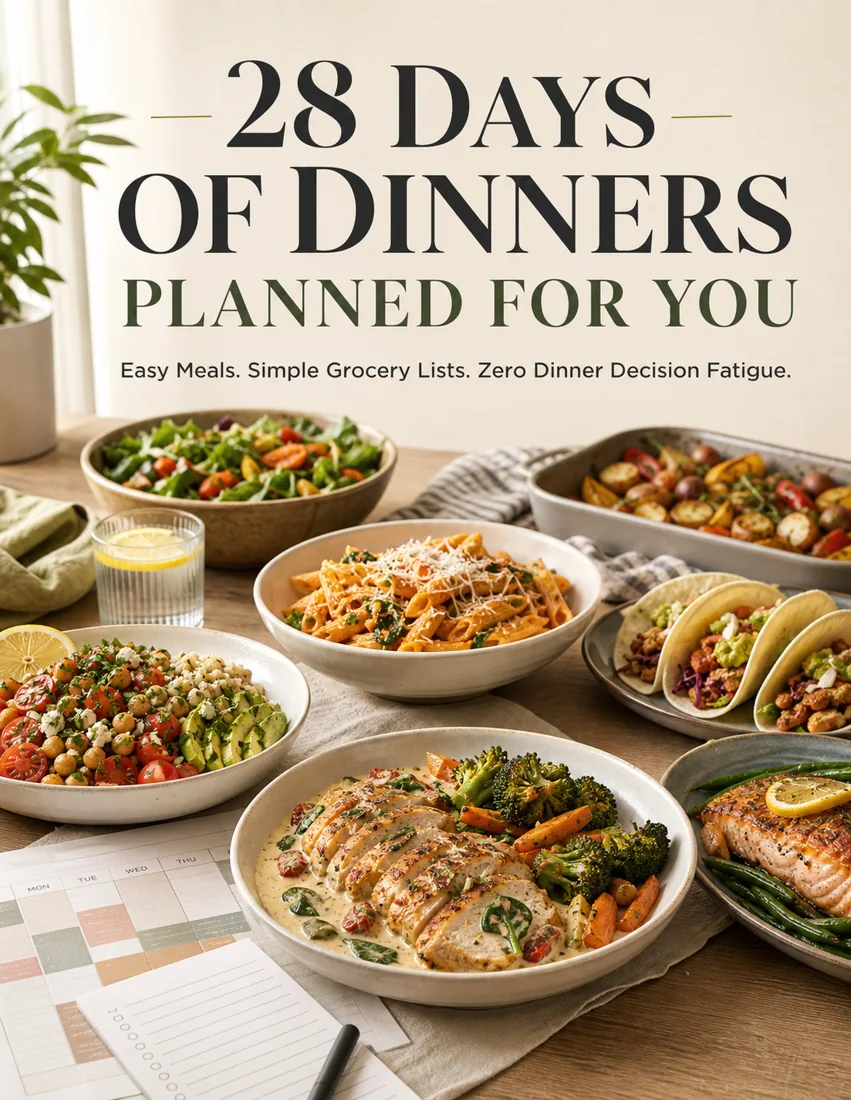
Stop wondering what’s for dinner
This article covers tonight. 28 Days of Dinners Planned for You covers the next 27—decided, shopped and prepped.
- ✓ 28 dinner recipes for real weeknights
- ✓ 4 weekly grocery lists, done for you
- ✓ Simple prep guidance for smoother evenings
- ✓ Leftover strategy & emergency dinners



Pingback: Aldi Meal Plan: The Honest Weekly System That Works
Pingback: 1400 Calorie Meal Plan: The Honest Weekly Framework
Pingback: Walmart Meal Plan Shopping Lists: Aisle-by-Aisle System
Pingback: Costco Meal Plan Shopping List: The Bulk Buying Framework