

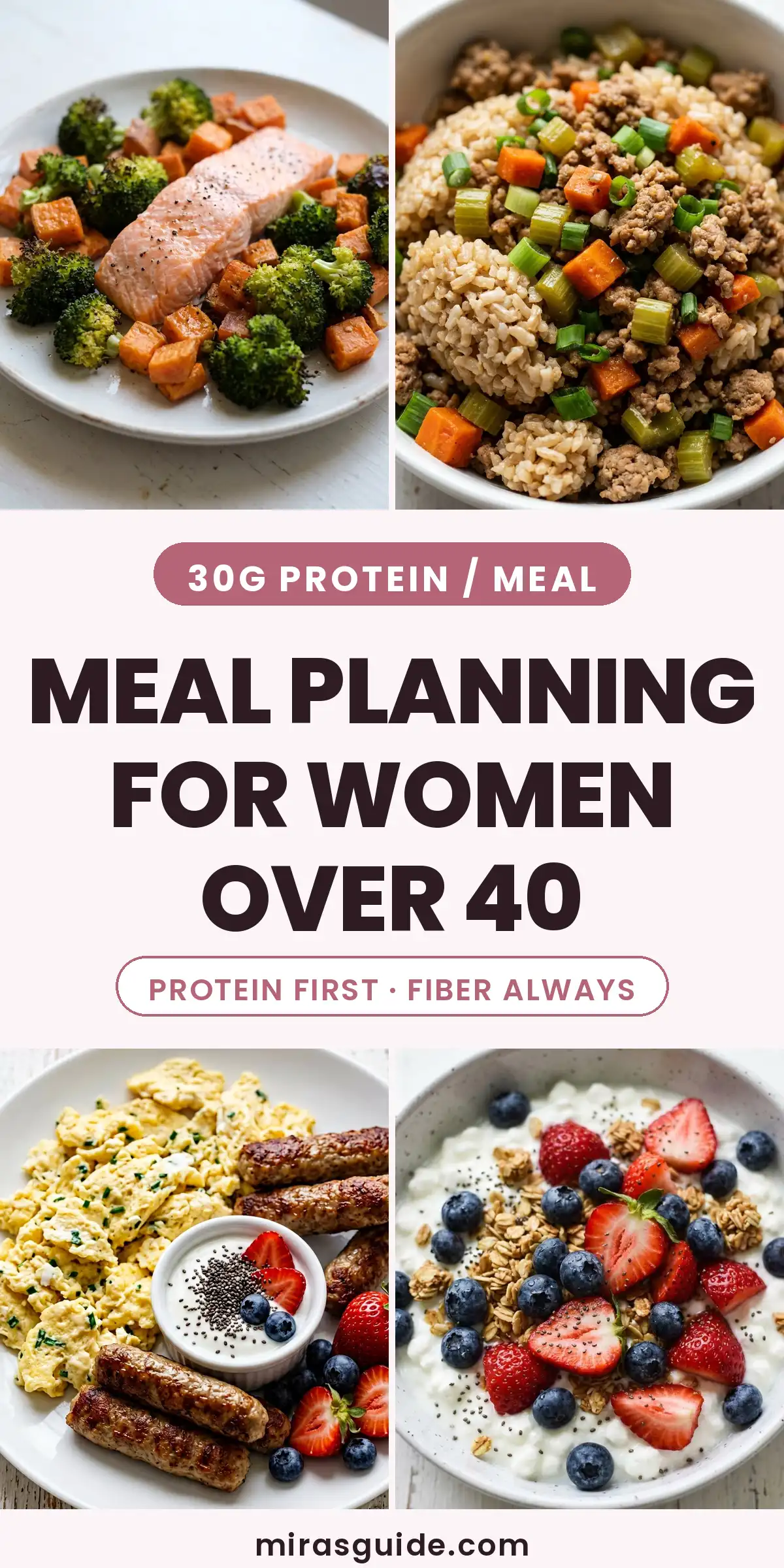
Meal planning for women over 40 does not require one rigid diet. During perimenopause and menopause, hormone changes can affect menstrual cycles, sleep, and bone health, but symptoms and nutrition needs differ from person to person. This educational Midlife Macro Method focuses on balanced meals with protein, fiber, and nutrient-rich foods. Personalize it with a clinician or registered dietitian, especially if you have a medical condition or use hormone therapy.
⚕️ Medical Disclaimer: This article is for educational purposes only and is not medical advice. I am not a doctor or registered dietitian. Always consult your physician before making dietary changes, especially if you take prescription medications (including GLP-1 drugs like Ozempic, Wegovy, Mounjaro, or Zepbound) or have a medical condition.
Why Meal Planning Changes at 40 🧭
Your body at 40+ is not a broken version of your 30-year-old body. It’s a different body — and it needs a different meal plan. Here’s what actually shifts:
Don’t Want to Plan Every Dinner Yourself?
28 Days of Dinners Planned for You gives you 28 days of dinners, grocery lists and prep guidance already organized for you.
Plan My Next 28 Dinners →- 🩸 Estrogen decline (perimenopause 35–50, menopause avg 51) — changes fat storage, insulin, and hunger cues
- 💪 Sarcopenia begins — you lose 3–8% muscle per decade unless you actively protect it
- 🍬 Insulin resistance rises — the same carbs that were fine at 30 spike blood sugar at 45
- 😴 Sleep quality drops — hot flashes, night sweats = worse hunger regulation the next day
- 🦴 Bone density falls — calcium and vitamin D become urgent, not optional
- 🔥 Metabolism slows ~5% per decade — but only about half of that is unavoidable; the rest is muscle loss
The good news: a midlife-specific meal plan solves nearly all of it. When you build meals around protein, fiber, and blood-sugar stability, you preserve muscle, sleep better, and stop the “everything makes me gain weight” cycle.
The 4 Rules of Meal Planning for Women Over 40 🎯
Before the weekly framework, these four rules run the whole system:
🎯 Rule 1: 30 g Protein at Every Meal (Non-Negotiable)
The single biggest research-backed shift for women over 40: hit 30–40 g of protein per meal, 3 meals a day.
Why 30 g minimum? Below that threshold, your body doesn’t get enough leucine to trigger muscle protein synthesis. After 40, your muscles get “anabolically resistant” — you need more protein per meal than you used to.
Daily protein targets: – 🎯 Minimum: 100 g/day (roughly 0.7 g per lb of body weight) – 🎯 Optimal: 120–140 g/day for muscle preservation – 🎯 If strength training: 140–160 g/day
Every meal starts with protein. Not carbs. Not “just a salad.” Protein first, everything else layered on.
🎯 Rule 2: Fiber Matters More Now (25–35 g Daily)
Fiber does three critical things for women over 40: – Slows blood sugar spikes (reduces afternoon crashes) – Feeds gut bacteria that metabolize estrogen – Supports regularity (which slows dramatically at menopause)
Best sources: berries, chia seeds, ground flax, avocado, beans, whole grains, and every leafy green you can fit on a plate.
🎯 Rule 3: Blood-Sugar-Stable Meals or Bust
The blood sugar rollercoaster that was mild in your 20s becomes brutal after 40. Every meal needs:
- Protein (30 g)
- Fiber (7–10 g)
- Healthy fat (avocado, olive oil, nuts)
- Complex carbs (not white bread, not sugar)
Skip the carb-only breakfast (bagel, muffin, cereal). It’s the fastest way to a 3 pm crash + evening cravings.
🎯 Rule 4: Calcium, Vitamin D, and Magnesium Need Age-Appropriate Targets
NIH reference amounts vary by age and sex: – 🦴 Calcium: 1,000 mg/day for women ages 19–50 and 1,200 mg/day for women ages 51–70 – ☀️ Vitamin D: 600 IU (15 mcg)/day for adults ages 19–70 and 800 IU (20 mcg)/day after age 70 – 💊 Magnesium: 320 mg/day for women ages 31 and older from all sources
These are general reference amounts, not automatic supplement doses. Prioritize food sources and discuss supplements with a clinician, especially if you take medication or have kidney or other health conditions.
The 5-Step Midlife Macro Method 🗓️
Here’s how you build a weekly plan that actually respects a 40-plus body.
Step 1: Anchor Every Day With a 30 g Protein Breakfast 🍳
This is the single most important shift. Most women over 40 eat 10–15 g of protein at breakfast — half of what their body needs. Bump every breakfast to 30 g:
- 🍳 3 eggs + turkey sausage (30 g)
- 🥣 1 cup cottage cheese + berries + chia (28 g)
- 🥛 Greek yogurt bowl + protein granola + walnuts (30 g)
- 🥤 Fairlife protein shake + banana + peanut butter (35 g)
- 🍞 Sourdough toast + 2 eggs + avocado + smoked salmon (32 g)
That one change stabilizes blood sugar all day and cuts afternoon cravings by half.
Step 2: Batch-Cook 3 Protein Sources Every Sunday 🥩
Pick 3 proteins, cook them all Sunday, portion them into 4 oz containers. That’s 15 servings for the week:
- 🍗 Baked chicken thighs (5 servings)
- 🐟 Baked salmon (5 servings)
- 🫘 Turkey meatballs or lentil sloppy joe base (5 servings)
Reheat + pair with a different vegetable + starch each night. No decision fatigue.
Step 3: Add 2 Fiber Vehicles Every Day 🥑
Non-negotiable daily fiber additions: – Morning: 2 tbsp chia seeds in yogurt (10 g) – Any meal: ½ avocado (5 g) – Any meal: ½ cup berries (4 g)
That’s 19 g fiber locked in before you eat a single vegetable.
Step 4: Front-Load Calories to Earlier in the Day 🌤️
Perimenopause + menopause research keeps landing on the same finding: women over 40 handle carbs and calories much better before 4 pm than after 7 pm. Try:
- Breakfast: 500–600 calories (biggest meal)
- Lunch: 500–600 calories
- Dinner: 400–500 calories (protein + veggies + small starch)
That structure improves sleep, reduces night sweats, and stops the late-night snacking cycle.
Step 5: Plan for Sleep-Friendly Nights 😴
Skip caffeine after noon. Skip alcohol on weeknights (both wreck perimenopausal sleep). Add a magnesium-rich evening snack:
- Dark chocolate square + a small handful of almonds
- Chamomile or peppermint tea
- Small bowl of tart cherries or kiwi (natural melatonin sources)
A Sample Midlife Week: Meal Plan 📋
Here’s exactly what one week looks like on the Midlife Macro Method:
Monday
- Breakfast: 3 eggs + turkey sausage + berries + chia yogurt (35 g protein)
- Lunch: Big salad with 5 oz chicken + avocado + chickpeas + olive oil (40 g protein)
- Dinner: Salmon + roasted sweet potato + broccoli (32 g protein)
- Snack: Cottage cheese + walnuts (18 g protein)
- Total: 125 g protein, 30 g fiber
Tuesday
- Breakfast: Cottage cheese bowl + berries + chia + granola (30 g protein)
- Lunch: Leftover salmon over greens + quinoa + avocado (32 g protein)
- Dinner: Ground turkey stir-fry with brown rice + veggies (35 g protein)
- Snack: Fairlife shake + banana (30 g protein)
- Total: 127 g protein, 28 g fiber
Wednesday
- Breakfast: Greek yogurt + protein granola + walnuts + berries (32 g protein)
- Lunch: Turkey + hummus wrap + veggies + Greek yogurt cup (35 g protein)
- Dinner: Chicken thighs + roasted vegetables + lentils (38 g protein)
- Snack: Dark chocolate + almonds (8 g protein)
- Total: 113 g protein, 26 g fiber
Thursday–Sunday
Repeat with slight rotation — swap salmon for shrimp, chicken thighs for beef stir-fry, turkey wraps for lentil soup. Same protein, fiber, and blood-sugar structure every day.
Managing Common Midlife Meal Planning Challenges 🎯
Sudden weight gain around the middle
- Cut alcohol to weekends only
- Add 20 g protein to breakfast + lunch
- Walk 30 minutes daily (insulin sensitivity)
- Sleep is 40% of the equation — protect it
Hot flashes disrupting meals
- Skip spicy foods and alcohol at dinner
- Cold overnight oats or Greek yogurt for hot-flash mornings
- Room-temperature soups instead of steaming hot ones
Constant afternoon energy crash
- Your breakfast is likely carb-heavy and protein-light
- Fix: bump breakfast protein to 30–35 g
- Add fat + fiber (avocado, nuts, chia) to slow digestion
Cravings that weren’t there before
- Usually a protein deficit, not willpower
- Every craving is your body asking for protein first
- Try 20 g protein (Greek yogurt, jerky, hard-boiled egg) — wait 15 minutes
Loss of muscle tone despite same workouts
- You need more protein than you did at 30
- Bump to 30 g per meal minimum
- Add resistance training 2–3x/week (essential after 40)
The Midlife Pantry Base 📦
Stock these — they’re the foundation of the Midlife Macro Method:
Refrigerator: – Cottage cheese, Greek yogurt (2% or higher fat, not fat-free) – Rotisserie chicken (weekly) – Salmon, shrimp, ground turkey – Eggs (18-count) – Avocados, berries, leafy greens, sweet potatoes
Freezer: – Frozen salmon fillets, shrimp, ground turkey – Frozen berries, edamame, riced cauliflower – Batch-cooked lentil soup, turkey meatballs
Pantry: – Steel-cut oats, quinoa, brown rice, lentils – Chia seeds, ground flax, walnuts, almonds – Extra-virgin olive oil, avocado oil – Canned wild salmon, sardines, tuna – Dark chocolate 70%+ (evening snack) – Fairlife or Premier protein shakes – Magnesium glycinate (talk to your doctor)
FAQ
How much protein do women over 40 really need?
Aim for 100–140 g protein per day, or roughly 0.7–1.0 g per pound of body weight. After 40, muscle becomes “anabolically resistant” — meaning it takes more protein to trigger muscle-building than it did in your 20s. Under-eating protein is the #1 reason women lose strength, energy, and metabolism in perimenopause.
Is intermittent fasting good for women over 40?
It depends. Some women thrive on a 12-hour overnight fast (7 pm to 7 am). Longer fasts (16+ hours) can worsen perimenopause symptoms — more cortisol, worse sleep, more hot flashes. Start with a gentle 12-hour eating window and see how your body responds before trying anything longer. Talk to your doctor if you have hormone imbalances.
Should I cut carbs after 40?
Cut refined carbs — keep complex carbs. White bread, sugar, and pastries spike blood sugar hard after 40. But whole grains, sweet potatoes, oats, quinoa, and beans give you fiber, energy, and serotonin support. Aim for 100–150 g of complex carbs daily, paired with protein and fat.
What if I’m on hormone replacement therapy (HRT)?
HRT doesn’t change the meal plan — it just makes it easier. You still need 30 g protein per meal, fiber, calcium, and blood-sugar-stable meals. HRT can reduce cravings and improve sleep, which makes sticking to a plan easier. Always coordinate diet + HRT with your prescribing doctor.
How does this compare to your other meal plans?
The Midlife Macro Method builds on our high-protein foundations with hormone-specific tweaks. Our high-protein meal plan for weight loss works great as a starting point — just bump breakfast protein up. Our 7-day high-protein meal plan provides the base structure, and our anti-inflammatory meal prep adds the joint + inflammation support many women over 40 also need.
Your Next Step 👉
Pick ONE change this week. My honest suggestion:
- Move breakfast to 30 g protein — this week, starting tomorrow. This one shift changes everything downstream.
- Add 2 tbsp chia seeds to whatever you eat in the morning. 10 g fiber locked in.
- Swap one glass of wine per week for tart cherry juice or chamomile tea. Sleep improves. Everything downstream improves.
- Batch-cook 3 proteins on Sunday. Chicken, salmon, turkey meatballs. That’s your whole week of dinners.
That’s your first Midlife Macro Method week.
Once these habits stick, layer on Sunday meal prep. Our Sunday meal prep plan is the exact routine to build 3 batch proteins in under 90 minutes. Our high-fiber meal prep hits the 30 g fiber target most women over 40 miss. And our anti-inflammatory meal prep layers in the joint + sleep support that becomes non-negotiable in midlife.
Meal planning for women over 40 isn’t about eating less. It’s about eating strategically — more protein, more fiber, more magnesium, less sugar, better sleep. Do that, and you rebuild the metabolism, mood, and energy you thought was permanently gone.

Stop wondering what’s for dinner
This article covers tonight. 28 Days of Dinners Planned for You covers the next 27—decided, shopped and prepped.
- ✓ 28 dinner recipes for real weeknights
- ✓ 4 weekly grocery lists, done for you
- ✓ Simple prep guidance for smoother evenings
- ✓ Leftover strategy & emergency dinners


Pingback: Menopausal Diet Meal Plan: Hormone-Aware Weekly System
Pingback: DASH Diet Meal Plan: The Honest Heart-Healthy Guide