

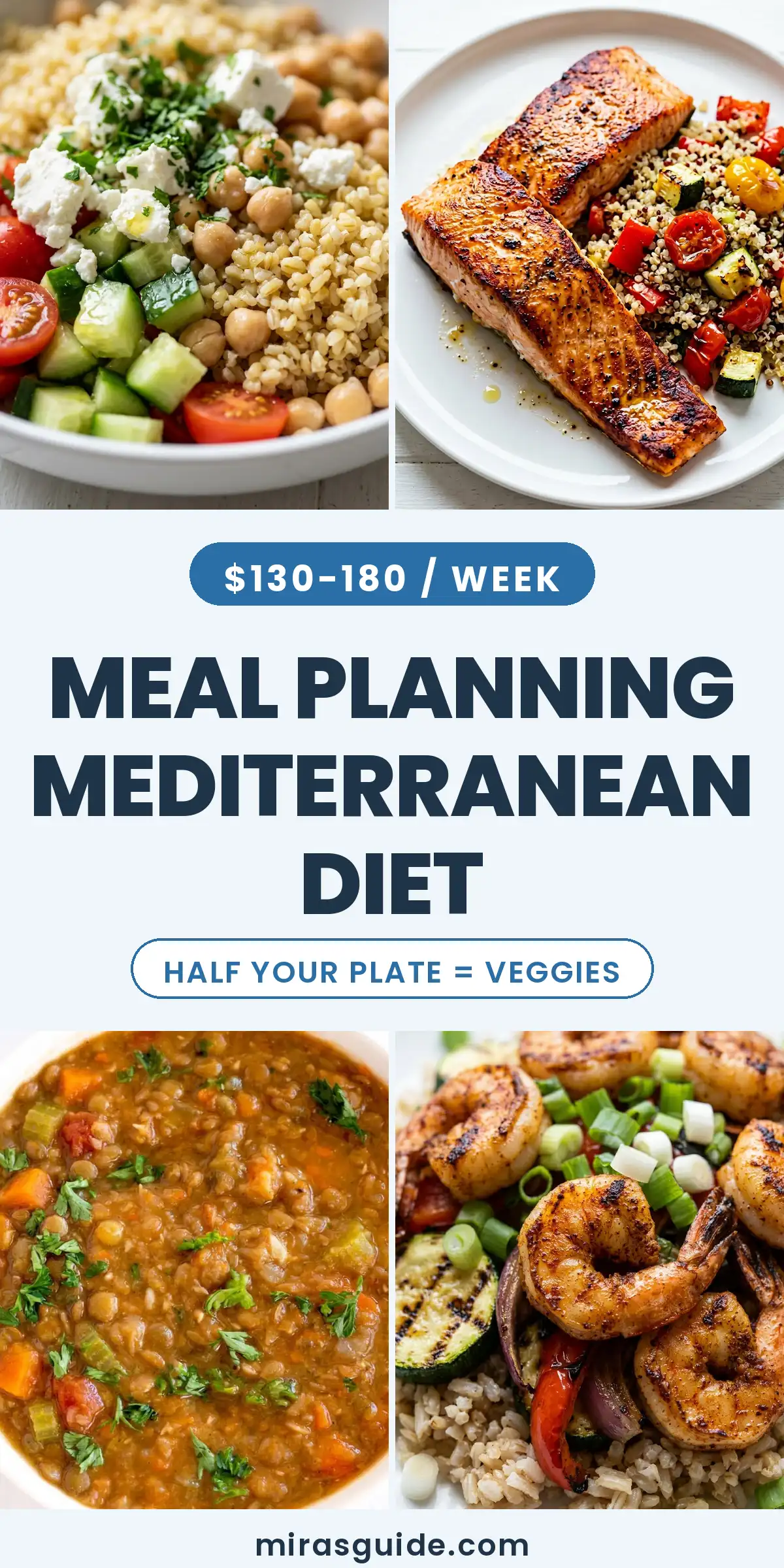
Meal planning for the Mediterranean diet is a practical way to build a week around vegetables, legumes, whole grains, fish, nuts, and olive oil. Harvard’s Mediterranean Diet review summarizes evidence supporting the pattern for cardiovascular health and healthy aging, while noting that research on cognitive effects continues. This guide turns the eating pattern into a 7-day system with a grocery list and family-friendly meals designed to avoid unnecessary specialty ingredients.
⚠️ Disclaimer: This meal plan is for general informational purposes only. Always consult your doctor before starting any new diet, especially if you have a medical condition, are pregnant, or nursing.
Why Mediterranean Meal Planning Is Different From Regular Meal Planning 🧭
The Mediterranean diet isn’t just “healthy eating with olive oil” — it’s a specific eating pattern with clear food frequency rules:
Want Your Meals to Follow a Plan That Works With Your Goals?
28 Days of Dinners Planned for You gives you 28 days of dinners, grocery lists and prep guidance—structure without daily decisions.
Plan My Next 28 Dinners →- 🥬 Vegetables + fruits at every meal (daily foundation)
- 🌾 Whole grains every day (bulgur, farro, brown rice, whole-wheat pasta, whole-grain bread)
- 🫒 Extra virgin olive oil as primary fat (replaces butter, canola, vegetable oil)
- 🐟 Fish + seafood 2-3x per week (salmon, sardines, cod, shrimp)
- 🥫 Legumes 2-3x per week (chickpeas, lentils, white beans)
- 🍗 Poultry 2-3x per week (chicken, turkey — not daily)
- 🥩 Red meat rarely (max 1-2x per month, not per week)
- 🧀 Moderate dairy (Greek yogurt, feta, cheese — not center of the meal)
- 🍷 Optional wine (with meals, in moderation)
- 🍰 Sweets occasionally (fresh fruit is the default dessert)
Understanding this frequency framework is 80% of Mediterranean meal planning. Once you internalize it, meal planning becomes matching the right foods to the right frequency slots each week.
The Real Cost of Mediterranean Meal Planning 💸
There’s a persistent myth that Mediterranean eating requires expensive imported ingredients. It doesn’t. Here’s what you actually spend:
| Approach | Weekly Cost (Family of 4) | Notes |
|---|---|---|
| 🟢 Basic Mediterranean ⭐ | $130-180 | Naturally Mediterranean whole foods, canned fish, dried legumes |
| 🟡 Mid-tier Mediterranean | $180-250 | Some fresh fish, occasional imports |
| 🔴 Premium “authentic” | $300+ | Wild-caught salmon, imported cheeses, specialty olive oils |
This guide targets the basic tier — $130-180/week. The Mediterranean diet is remarkably budget-friendly when you know the tricks: canned fish beats fresh, dried lentils beat pre-made hummus, seasonal vegetables beat “imported greens.”
The 5-Step Mediterranean Meal Planning System 🗓️
Step 1 — Fill Half Your Plate With Vegetables (Every Meal, Every Day)
The single most important Mediterranean habit: vegetables at every meal. That includes breakfast — a Mediterranean breakfast often includes tomato, cucumber, or spinach.
Aim for 5-9 servings of vegetables + fruits per day. This sounds huge, but it’s easy when you spread them across meals:
- 🥣 Breakfast: yogurt with berries, or eggs with tomato + spinach
- 🥗 Lunch: big salad or grain bowl with 3-4 vegetables
- 🍽️ Dinner: 2 vegetable sides + protein
- 🍎 Snacks: fruit, hummus + carrots, olives
Once vegetables become the plate’s foundation (not garnish), you’re 80% Mediterranean.
Step 2 — Anchor Every Week Around Legumes + Fish
For Mediterranean meal planning, plan your protein sources by frequency:
Weekly protein plan (Mediterranean framework): – 🥫 Legumes 2-3 meals (lentil soup, chickpea salad, white bean stew) – 🐟 Fish/seafood 2-3 meals (canned tuna/salmon, frozen shrimp, salmon fillet) – 🍗 Poultry 2 meals (chicken thighs, ground turkey) – 🥚 Eggs 1-2 meals (frittata, breakfast for dinner) – 🥩 Red meat 0-1 meal max (occasional lean beef, lamb)
This frequency alone gets you 90% of Mediterranean nutrition benefits. Legumes + fish become the stars; red meat becomes rare.
Step 3 — Replace All Fats With Olive Oil (Almost Everything)
The Mediterranean diet’s biggest health claim comes from extra virgin olive oil replacing other fats. In a Mediterranean kitchen:
- 🫒 Olive oil replaces butter (drizzled on bread, sautéing, salad dressings)
- 🫒 Olive oil replaces vegetable/canola oil (all cooking)
- 🫒 Olive oil replaces mayonnaise (in some dressings)
- 🥑 Avocado + nuts add healthy fats (weekly snacks)
Buy the biggest bottle of decent extra virgin olive oil you can afford (Costco/Kirkland is well-rated). One large bottle lasts a family 3-4 weeks and covers all cooking.
Step 4 — Choose Whole Grains Every Time
Mediterranean cooking uses whole grains as bases — not white rice, not white bread, not regular pasta. Best options:
- 🌾 Bulgur (fastest cooking whole grain)
- 🌾 Farro (chewy, nutty texture)
- 🌾 Brown rice (backup when nothing else on hand)
- 🌾 Whole-wheat pasta (best affordable option)
- 🌾 Whole-grain bread (small pieces, alongside meals — not the meal itself)
- 🌾 Quinoa (technically a seed, but fits perfectly)
- 🌾 Rolled oats (breakfast base)
Start replacing 1-2 refined grains per week with whole-grain alternatives. Full transition takes 3-4 weeks.
Step 5 — Prep Mediterranean Batch Items on Sunday
Mediterranean meal planning wins with batch prep because so many components are shared across meals:
Sunday Mediterranean prep (60-90 min): 1. 🌾 Cook 4-6 cups of a grain (quinoa, bulgur, or brown rice) 2. 🥫 Cook a big pot of lentils or beans (or open 3-4 cans) 3. 🥕 Roast 2 sheet pans of vegetables (broccoli, peppers, zucchini, sweet potato) 4. 🍗 Cook 2-3 lbs of protein (chicken thighs OR salmon) 5. 🥗 Wash + chop salad vegetables (cherry tomatoes, cucumber, bell peppers) 6. 🥣 Make 1 batch of dressing (olive oil + lemon + garlic + herbs)
Result: 5-7 different Mediterranean meals across the week from these components. Grain bowls, salads, wraps, soups — all built from the same batch-prepped items.
A Sample Week: 7-Day Mediterranean Meal Plan 📋
Real 7-day plan following Mediterranean frequency rules. Total ~$140-170 at regular grocery pricing (Aldi/Walmart even cheaper).
🛒 Grocery List (~$150 for family of 4)
Proteins (~$40): – 3 lbs chicken thighs (family pack) — $8 – 2 cans salmon + 2 cans tuna (water-packed) — $8 – 1 lb frozen shrimp — $8 – 1 dozen eggs — $3 – 2 cans chickpeas + 2 cans cannellini beans + 1 bag dried lentils — $8 – 1 tub Greek yogurt (plain, large) — $5
Grains + Bread (~$18): – 1 bag quinoa OR bulgur (16 oz) — $4 – 5 lb brown rice — $5 – Whole-wheat pasta (2 boxes) — $4 – 1 loaf whole-grain bread — $4 – Rolled oats (large container) — $4 (already stocked)
Produce (~$45): – 5-lb bag onions — $3 – 2 heads garlic — $1 – Fresh spinach (bag) — $3 – Cherry tomatoes (pint) — $3 – 2 cucumbers — $2 – 2 red bell peppers — $3 – 1 head broccoli + 1 zucchini + 1 eggplant — $6 – Sweet potatoes (3-4) — $4 – Green beans (1 lb) — $3 – Lemons (4) — $3 – Bananas, apples, oranges, berries — $12
Dairy (~$18): – Feta cheese (8 oz) — $4 – Parmesan wedge (small) — $4 – Milk (half gallon) — $3 – Butter (used minimally in Med diet) — $3 – Greek yogurt (already listed above)
Pantry Add-ons (~$25): – Extra virgin olive oil (large bottle) — $12 – Kalamata olives (jar) — $4 – Sun-dried tomatoes (jar) — $4 – Walnuts + almonds (small bags) — $6 – Fresh herbs (parsley, dill) — $3
Pantry staples assumed: salt, pepper, oregano, cumin, garlic powder, paprika, honey, red wine vinegar.
🗓️ The 7-Dinner Plan
| Day | Dinner | Mediterranean Frequency |
|---|---|---|
| Mon | 🐟 Baked salmon with roasted vegetables + quinoa | 🐟 Fish |
| Tue | 🥫 Lentil soup + whole-grain bread + salad | 🥫 Legumes |
| Wed | 🍗 Grilled chicken with farro + sautéed spinach + lemon | 🍗 Poultry |
| Thu | 🐟 Shrimp + vegetable skewers + brown rice | 🐟 Fish |
| Fri | 🌾 Mediterranean grain bowl (bulgur + chickpeas + cucumber + tomato + feta + olive oil dressing) | 🥫 Legumes |
| Sat | 🍕 Homemade pizza on whole-wheat crust + big salad | Weekly treat |
| Sun | 🍗 Roast chicken + roasted vegetables + whole-grain bread | 🍗 Poultry |
🥣 Breakfasts (Mediterranean-Style)
- Greek yogurt with walnuts, berries, honey
- Oatmeal with berries + almonds + drizzle of olive oil
- Whole-grain toast with mashed avocado + tomato + hard-boiled egg
- Vegetable omelet with feta + tomato + spinach
- Smoothie with spinach + banana + almond milk
🥪 Lunches (Leftovers + Assembly)
- Leftover dinner (grain bowls, salmon over greens, chicken with grain)
- Chickpea salad (chickpeas + cucumber + tomato + feta + olive oil)
- Tuna + white bean salad (canned tuna + cannellini + red onion + lemon + olive oil)
- Big salad with olives + chickpeas + grilled chicken + feta
🥜 Mediterranean Snacks
- Fresh fruit (apples, oranges, grapes)
- Handful of nuts (almonds, walnuts, pistachios)
- Hummus + cucumber/carrots
- Greek yogurt with honey
- Olives + small piece of cheese
Total weekly cost: ~$140-170 for a family of 4 = $35-45/person/week for balanced Mediterranean eating. Real, satisfying, backed by decades of health research.
Common Mediterranean Meal Planning Mistakes ⚠️
- Treating it as “just adding olive oil” to your current diet. The Mediterranean diet requires actual food frequency changes (more legumes, less red meat). Fix: follow the frequency rules — legumes 2-3x/week, fish 2-3x/week, red meat max monthly.
- Buying only fresh fish (expensive). Fresh salmon is $10-15/lb. Fix: use canned salmon, canned tuna, canned sardines, frozen fish — all authentically Mediterranean AND affordable.
- Skipping the vegetables at breakfast. A Mediterranean breakfast includes vegetables (tomato, cucumber, spinach). Fix: add one vegetable to every breakfast — even a tomato slice with your eggs.
- Overdoing red meat “occasionally.” Once a month = truly rare. Once a week = you’re not doing Mediterranean. Fix: track red meat frequency — 1-2 times per month max.
- Buying imported specialty products. Italian olive oil for $40/bottle, Greek yogurt for $8/tub. Fix: Kirkland/Costco olive oil is fine; store-brand Greek yogurt is fine.
- Cutting out dairy entirely. Mediterranean includes moderate dairy (feta, Greek yogurt, aged cheese). Fix: include small amounts — 1 oz feta on a salad, 1 cup Greek yogurt at breakfast.
Mediterranean Grocery Rules 🛒
🫒 Rule 1: Extra Virgin Olive Oil In Everything
Replace all other fats (butter, canola, vegetable oil, mayo in dressings) with extra virgin olive oil. Buy the biggest bottle you can afford — Kirkland/Costco is well-rated for the price. One large bottle lasts a family 3-4 weeks.
🥫 Rule 2: Canned + Frozen Fish = Same Health Benefits
Fresh salmon costs $10-15/lb. Canned salmon delivers identical omega-3 benefits at $2-3 per can. Same for canned tuna, sardines, mackerel. Include 3-4 canned fish meals per week — this alone hits the “fish 2-3x per week” Mediterranean target on a budget.
🌾 Rule 3: Whole Grains Only
Every grain purchase should be whole: – Brown rice, not white – Whole-wheat pasta, not regular – Whole-grain bread, not white – Bulgur, farro, quinoa (all naturally whole) – Rolled oats
Buy 1-2 grain types per week + rotate. Skip refined grains completely if you can.
🥕 Rule 4: In-Season, Local, Seasonal Vegetables
Mediterranean cooking is inherently seasonal. Buy whatever’s cheap and in season: – Winter: cabbage, carrots, potatoes, sweet potatoes, citrus, hearty greens – Spring: asparagus, peas, artichokes, spinach, strawberries – Summer: tomatoes, zucchini, peppers, eggplant, cucumbers, berries – Fall: squash, apples, pears, root vegetables, kale
Skip out-of-season vegetables — they’re expensive AND less nutritious than frozen alternatives.
The Mediterranean Pantry Base 📦
Build over 3-4 grocery trips. Once stocked, you can always throw together a Mediterranean meal.
🥫 Mediterranean Pantry Essentials
- Extra virgin olive oil (large bottle)
- Brown rice, quinoa, whole-wheat pasta, rolled oats
- Dried lentils + canned beans (chickpeas, cannellini, black)
- Canned tomatoes (diced + crushed)
- Canned tuna + salmon + sardines (4-6 cans total)
- Kalamata olives, sun-dried tomatoes, capers
- Red wine vinegar, apple cider vinegar
- Nuts (walnuts, almonds, pistachios) + seeds
- Honey (Mediterranean natural sweetener)
- Spices: oregano, garlic powder, cumin, paprika, red pepper flakes
- Fresh: onions, garlic, lemons (long shelf life)
❄️ Mediterranean Freezer Essentials
- Frozen shrimp + fish fillets (salmon, cod)
- Frozen vegetables (spinach, broccoli, peas, mixed veg)
- Frozen berries (for oatmeal + yogurt)
- Whole-grain bread (freeze the day you buy)
- Portioned chicken thighs
🧊 Mediterranean Weekly Fresh Rotation
- Eggs
- Greek yogurt (plain)
- Feta cheese
- 1-2 anchor proteins (chicken thighs OR fresh fish)
- 5-8 fresh vegetables (in-season)
- Fresh herbs (parsley, dill, basil — use quickly)
- Fresh fruit
FAQ
What makes the Mediterranean diet different from other healthy diets?
Specific food frequency + olive oil emphasis. Unlike vague “eat healthy” advice, the Mediterranean diet has clear rules: fish 2-3x/week, legumes 2-3x/week, red meat rarely, olive oil as primary fat, vegetables at every meal. The frequency is the whole thing. It’s the only diet consistently ranked #1 by U.S. News for both short-term and long-term health outcomes.
Is Mediterranean meal planning expensive?
Not if you focus on staples. The “expensive Mediterranean” myth comes from imported specialty products (imported cheese, wild-caught salmon, Italian olive oil). Real Mediterranean staples are cheap: dried lentils, canned fish, seasonal vegetables, olive oil, whole grains. Realistic weekly cost: $130-180/week for a family of 4 at Aldi/Walmart pricing.
Can I do Mediterranean meal planning if I have picky eaters?
Yes — Mediterranean food is naturally kid-friendly. Pasta, pizza (with whole-wheat crust), rice, chicken, eggs, cheese, fruit, olive oil — these are foods most kids already like. Introduce fish gradually (canned tuna sandwiches, salmon patties). Bean dishes work as sides while kids fill up on the “safe” parts of the meal.
How is this different from just “eating healthy”?
Two specific differences: (1) Mediterranean is a defined food frequency pattern (specific weekly ratios of fish/legumes/meat/dairy), not vague healthy-eating advice, and (2) it emphasizes olive oil as primary fat rather than butter or vegetable oils. These 2 differences drive most of the health benefits — you can eat “healthy” without doing either.
Do I need to give up wine, cheese, or bread?
No — they’re all included, just in moderation. Mediterranean allows: 1 glass of red wine with dinner, small amounts of aged cheese, whole-grain bread with meals. What’s minimized: sweets (fresh fruit is default dessert), red meat (monthly not weekly), refined grains, processed foods, sugary drinks.
What about the keto diet or intermittent fasting?
Different approaches entirely. Mediterranean isn’t low-carb (whole grains are encouraged) or restrictive on eating windows (moderate meals throughout the day). It’s a lifestyle pattern, not a diet in the “restrictive rules” sense. Most people find it much easier to sustain long-term than keto or IF because it doesn’t require cutting out food groups.
How is Mediterranean meal planning different from my other articles?
Same fundamentals, different food emphasis. Our beginner meal planning guide teaches the core meal planning system. Mediterranean adds specific food frequency rules (more fish, more legumes, less red meat, more olive oil, more vegetables). If you’re already meal planning, converting to Mediterranean is just swapping ingredients within the same system.
Your Next Step 👉
Pick ONE change to try this week — not five. My honest suggestion:
- Replace ALL cooking fats with extra virgin olive oil this week. Butter, canola, vegetable oil → all replaced with olive oil.
- Plan 2 fish meals for the week (canned salmon salad + shrimp stir-fry works great).
- Plan 2 legume meals (lentil soup + chickpea grain bowl).
- Skip red meat this week entirely.
That’s your first Mediterranean-style week.
Once these habits stick (usually 2-3 weeks), gradually shift breakfasts to include vegetables (tomato with eggs, spinach in yogurt). For the batch cooking approach that makes Mediterranean sustainable, our beginner Sunday meal prep plan works perfectly with these ingredient patterns. And for our Mediterranean-inspired chicken meal that’s a great starting point, try our Greek chicken meal prep bowls — they hit every Mediterranean box.
Meal planning mediterranean diet isn’t about complicated recipes or imported ingredients. It’s about shifting your weekly ratios — more fish, more legumes, more olive oil, more vegetables, less red meat. Do that, and you get the world’s most-researched, longest-life-expectancy eating pattern for the same weekly grocery bill.
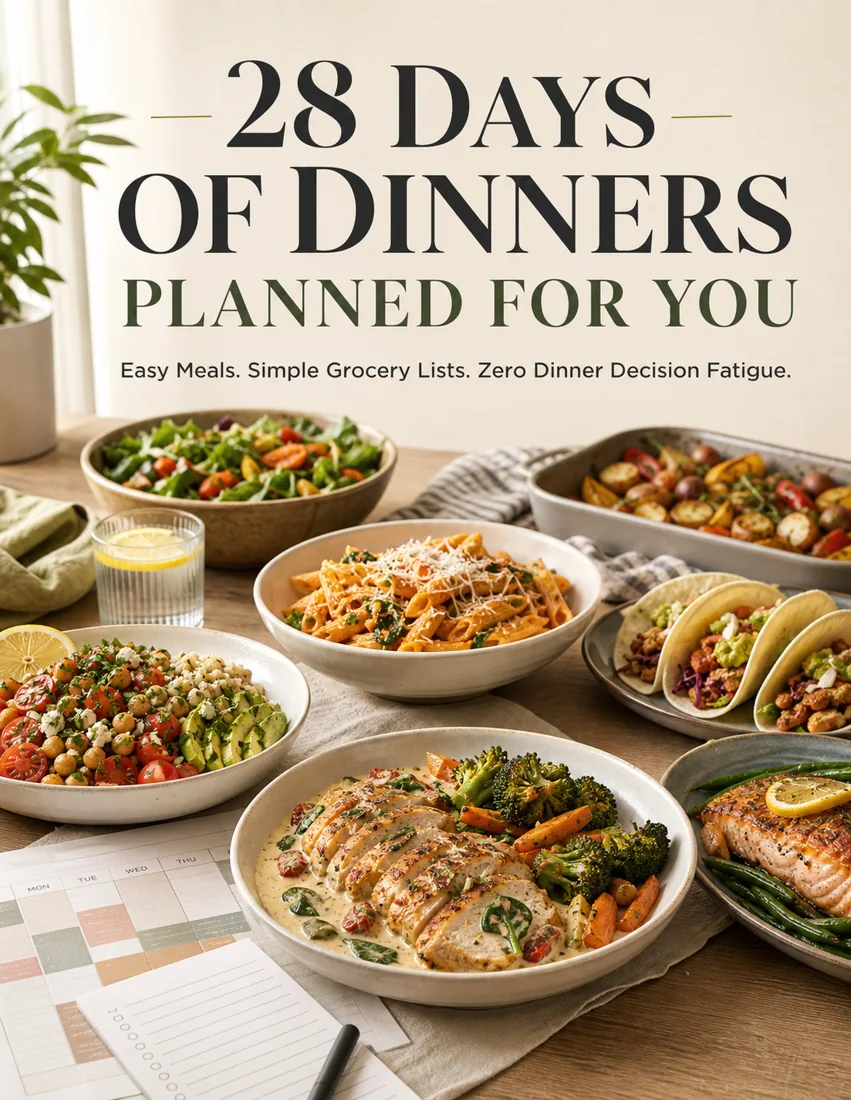
Stop wondering what’s for dinner
This article covers tonight. 28 Days of Dinners Planned for You covers the next 27—decided, shopped and prepped.
- ✓ 28 dinner recipes for real weeknights
- ✓ 4 weekly grocery lists, done for you
- ✓ Simple prep guidance for smoother evenings
- ✓ Leftover strategy & emergency dinners




Pingback: Clean Eating Meal Plan: The Honest Whole-Food System
Pingback: Prediabetic Meal Plan Ideas: The Honest A1C Reversal Guide
Pingback: Pregnancy Meal Plan: Trimester-by-Trimester Guide
Pingback: Keto Meal Plan for Beginners: The Honest First-Week Guide
Pingback: DASH Diet Meal Plan: The Honest Heart-Healthy Guide
Pingback: Costco Healthy Meal Plan: The Whole-Food System