

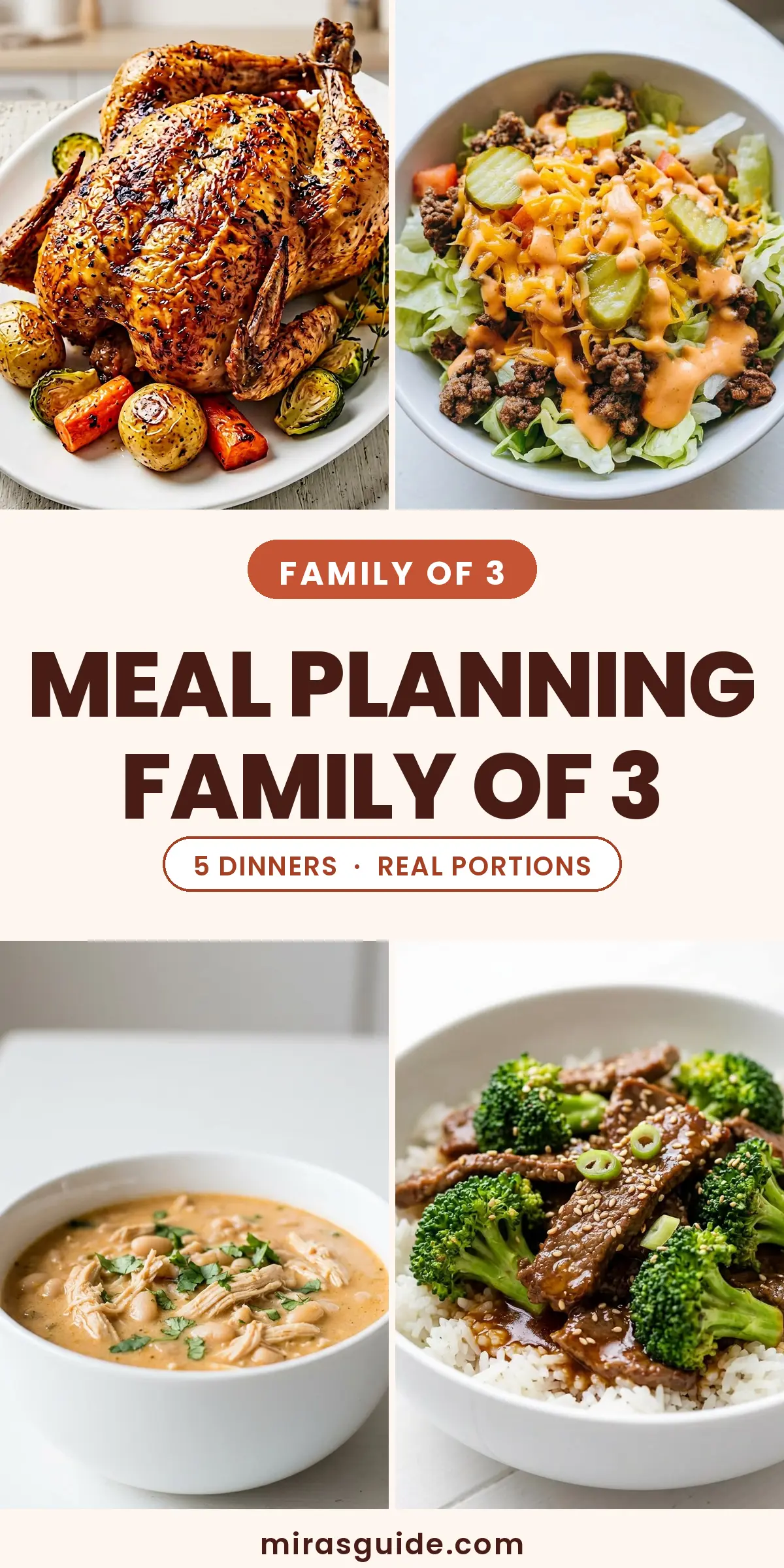
Meal planning for a family of 3 lives in the awkward middle — too big for couples plans, too small for family-of-four plans.
Most recipes yield 4-6 servings (so you have leftovers you weren’t planning for), grocery packs are sized for 4+ people (so you overbuy), and the “family meal plans” you find online assume 2 adults + 2 kids.
This guide walks you through the exact system for planning meals when you’re 3 people — whether that’s 2 adults and a toddler, 2 adults and a teen, a single parent with 2 kids, or 3 adult roommates.
Different portion math, different grocery reality, same goal: real dinners without daily “what’s for dinner?” chaos.
⚠️ Disclaimer: This meal plan is for general informational purposes only. Always consult your doctor before starting any new diet, especially if you have a medical condition, are pregnant, or nursing.
Why Meal Planning for 3 Is Its Own Beast 🧭
Three-person households have a specific problem that neither couples nor bigger families face:
- 🍗 Recipes yield too much — a 4-serving recipe gives you one full meal + 1 stray portion nobody wants
- 🛒 Meat packs are the wrong size — family packs are for 4+ meals, single-serve packs cost 30-50% more
- 🥬 Produce goes bad awkwardly — half a head of lettuce, 2 leftover carrots, ⅓ of a bell pepper
- 👶 Portion math changes — 2 adults + 1 toddler ≠ 3 adult servings; you’re actually feeding about 2.5
The good news: three-person households have unique advantages too. Leftovers are perfectly sized for one adult’s lunch the next day. Batch cooking a family-of-4 recipe gives you an intentional freezer meal. And with only one “small eater” at the table (usually), you can plan around one anchor meal + minor tweaks instead of cooking two versions.
This guide is built around feeding 2.5-3 adult portions per meal — the real math of a family of 3.
The Portion Math Nobody Tells You 📏
Before we get into the system, understand the actual numbers:
| Household Type | Adult Equivalents | Recipes You Should Scale |
|---|---|---|
| 2 adults + 1 baby (under 1) | 2.0 | Cook standard 2-person recipes |
| 2 adults + 1 toddler (1-3) | 2.25 | 2-person recipes with slight extra |
| 2 adults + 1 kid (4-8) | 2.5 | 2-person recipes, plan for lunch leftovers |
| 2 adults + 1 tween (9-13) | 3.0 | Standard 3-serving recipes |
| 2 adults + 1 teen | 3.5-4.0 | Family-of-4 recipes (they eat more than adults!) |
| Single parent + 2 kids | 2.5-3.5 | Depends on kids’ ages |
| 3 adult roommates | 3.0 | Standard 3-serving recipes |
For most families of 3, you’re planning for ~2.5-3 adult portions per meal. That means a standard 4-serving recipe gives you dinner + 1 lunch = perfect. A 6-serving recipe gives you dinner + 2 lunches OR dinner + 1 lunch + 1 freezer meal. Both work.
The average grocery budget for a family of 3 in the US runs $150-225/week ($600-900/month), depending on location and eating style. Frugal families can hit $100-125/week using the system below.
The 5-Step Meal Planning System for a Family of 3 🗓️
Step 1 — Plan 5 Dinners, Cover 7 Nights
Same rule as smaller households, different math: 5 planned dinners + 2 flex nights.
For a family of 3 that math works like this: – 🍽️ 5 fresh dinners (each yields dinner + 1-2 lunches) – ❄️ 1 freezer meal night (pull from previous batch cooking) – 🥡 1 flex night — takeout, eating out, or “clean out the fridge”
This gives you real variety, built-in leftovers for lunches, and enough flexibility to survive Wednesday when the toddler refuses dinner and the sitter cancels.
Step 2 — Get Input From All 3 Eaters
If you’re the only one planning, you’ll burn out. If you’re also the only cook, you’ll burn out faster. Every week (Sunday works for most families), spend 10-15 minutes getting input:
- 👨👩👧 Ask your partner what they want this week
- 👶 Ask your kid what they want (even toddlers have opinions)
- 📋 Keep a running list of 20-30 family favorites — meals everyone eats without a fight
Then pick 5 dinners from that list. Not brainstorming from scratch. Rotating known winners keeps everyone happy and cuts planning time to under 10 minutes.
If your kid is a picky eater, plan at least 2 of the 5 dinners as “safe wins” (the meals you know they’ll eat). Then push slightly on the other 3 with new-adjacent ingredients. Progress, not perfection.
Step 3 — Anchor Every Week Around ONE Protein
Instead of buying chicken + beef + fish + pork every week (which is family-of-6 shopping), pick ONE anchor protein and stretch it across 3-4 meals:
- 🍗 Whole roasted chicken → dinner Monday + chicken tacos Tuesday + chicken fried rice Wednesday
- 🥩 2 lb ground beef family pack → firecracker beef bowls Monday + tacos Tuesday + cheeseburger bowls Thursday
- 🐔 Family pack of chicken thighs → sheet pan Monday + baked chicken tacos Wednesday + teriyaki bowls Friday
Then add 1-2 “supplemental” proteins — eggs (for breakfast + one dinner), canned beans (for a soup or bowl), maybe fish sticks for the kid.
The single best value for a family of 3: a $5 rotisserie chicken from Costco/Sam’s. One bird yields 3-4 dinners for 3 people + bone broth. Life-changing purchase.
Step 4 — Use Ingredient Overlap (The Real Money Saver)
Halving recipes barely saves money.
Want Dinner Decisions Handled for the Whole Household?
28 Days of Dinners Planned for You gives you 28 days of family-friendly dinners, already planned and portioned.
Plan My Next 28 Dinners →Instead of buying 5 unrelated ingredient lists, buy fewer items that each appear in 2-3 meals:
- 🧅 One 3-lb bag of onions → 4 meals
- 🍅 One can diced tomatoes → pasta sauce + chili + taco filling
- 🍚 One 5-lb bag of rice → 5+ meals across a week
- 🧀 One block of cheese → quesadillas + baked potatoes + eggs
- 🥦 One head of broccoli → sheet pan + stir-fry + side of pasta
Aim for 12-15 total grocery items for the week, each doing double or triple duty. That’s how you keep the cart small but still make 5 different dinners.
Step 5 — Cook Once, Eat Multiple Ways
For a family of 3, the “cook once, eat twice” rule from couples cooking becomes cook once, eat three ways. You’ll cook one large-ish meal that gives you:
- 🍽️ Tonight’s dinner (all 3 people)
- 🥪 Tomorrow’s lunch (1-2 servings)
- ❄️ Freezer meal for later (1-2 servings)
Best meals for this approach: – 🍲 White chicken chili or any big-batch soup – 🥩 Beef and broccoli or stir-fry – 🍝 Creamy lasagna soup or pasta bake – 🍗 Slow cooker chicken burrito bowls – 🍚 Chicken enchilada bowls
Cook 6 servings of any of these → eat 3 tonight → 1-2 lunches tomorrow → freeze the rest. One 45-minute cook session = 4-5 fed people-meals.
Handling Picky Eaters (The 3-Person Reality) 🎯
Here’s the truth about feeding a family of 3 with a picky toddler or kid: you cannot cook 3 separate meals every night and stay sane. You need a system that works around it.
🍽️ The “Same Base, Different Toppings” Strategy
Cook meals where each person customizes their plate. Kid’s version = plain, adults’ version = full flavor:
- 🌮 Taco/burrito bowls — kid gets plain rice + beans + cheese; adults get everything
- 🍜 Pasta night — kid gets plain buttered noodles + veggies on side; adults get sauce
- 🍕 Pizza night — kid picks 1 topping; adults pick anything
- 🥣 Rice bowls — same rice, same protein, different toppings
- 🥔 Baked potato bar — everyone tops their own
This one strategy alone cuts 40% of family cooking arguments.
👶 The “One Familiar + One New” Plate Rule
For each dinner, make sure the kid has at least ONE thing on their plate they’ll actually eat. New foods go alongside familiar wins — never REPLACE them.
If you’re serving Greek chicken bowls to adults, the kid gets plain chicken + rice + cucumber (familiar) plus a spoonful of the Greek toppings (exposure). Keep offering a small amount without pressure. American Academy of Pediatrics guidance for picky eaters notes that it can take children 15-20 tries to like a new food and recommends allowing them to refuse while offering it again later.
🚫 Battles NOT Worth Fighting
- Serving 3 vegetables at every meal
- Making kids finish their plates
- Cooking a 4th “backup” meal when they refuse dinner
- Guilt over serving chicken nuggets sometimes
Save your energy for cooking, not policing.
A Sample Week: Family of 3 Meal Plan 📋
Real 5-dinner week for a family of 3 (2 adults + 1 kid/toddler), using ingredient overlap. Feeds everyone, provides 3-4 lunches, and lands around $130-160 at Aldi/Walmart pricing.
| Day | Dinner | What to Cook | Leftovers Plan |
|---|---|---|---|
| Mon | 🍗 Sheet pan chicken thighs + roasted potatoes + broccoli | Cook 6 thighs + 2 lbs potatoes | 1-2 chicken portions → tomorrow’s tacos |
| Tue | 🌮 Baked chicken tacos (uses Mon’s chicken) + rice + beans | Assemble only — 20 min | 1 lunch portion for tomorrow |
| Wed | 🍝 Pasta with turkey ragu (1 lb ground turkey + jarred sauce) | Cook once, 30 min | 2 lunches |
| Thu | 🍔 Cheeseburger bowls (uses remaining ground turkey/beef) | Assembly bowl format | 1 lunch |
| Fri | 🍕 Homemade or frozen pizza + salad (planned easy night) | 20 min | None planned |
| Sat | 🥡 Takeout OR family-favorite comfort meal (planned flex) | Off-plan | None |
| Sun | ❄️ Freezer meal (chili/soup from a previous batch) + salad | Reheat + assemble | None |
Grocery list (~$130-160): – 6 chicken thighs (family pack), 1-2 lb ground turkey/beef, 1 doz eggs, small block cheese, Greek yogurt or sour cream – Rice, pasta (2 boxes), tortillas, jarred pasta sauce, 2 cans black beans, 1 can diced tomatoes – 3-lb bag onions, 2 heads garlic, 5-lb bag potatoes, 1 head broccoli, bag frozen mixed veggies, 1 head lettuce, tomatoes, cucumber – 1 gallon milk, cereal or oats, bread (freeze half), fruit for kid snacks – Frozen pizza (1) + basic pantry staples (already have)
Feeds 3 people for 7 days + provides 4-5 packed lunches. Realistic, sustainable, kid-friendly.
Common Family-of-3 Mistakes ⚠️
Nearly every three-person family that quits meal planning quits for one of these reasons:
- Trying to cook 3 different meals every night (one for adults, one for the kid, and something “healthy” for later). Fix: modular meals where each person customizes their plate.
- Buying like a family of 4-5 because “we’ll finish it eventually.” You won’t. Fix: build the grocery list from the meal plan, not the other way around.
- Not planning around one anchor protein. Buying chicken + beef + fish + pork every week is family-of-6 shopping. Fix: one main protein per week, stretched across 3-4 meals.
- Skipping the freezer. Cook once → eat once → toss extras. Waste. (EPA estimates food waste costs each U.S. consumer about $728 per year; three consumers represent roughly $2,184 under that national estimate.) Fix: cook every meal to make dinner + 1-2 lunches + 1 freezer portion.
- Weekly plans that die by Wednesday. Rigid schedules break when the kid gets sick or the toddler refuses dinner. Fix: 5 planned + 2 flex nights built into the week.
The Family-of-3 Grocery Rules 🛒
🥩 Rule 1: Family Packs of Meat + Portion Immediately
Family packs of chicken thighs, ground beef/turkey are dramatically cheaper per pound than smaller portions. The moment you get home:
- Open the pack
- Portion into meal-sized freezer bags (label with date + weight)
- Freeze what’s not being used in the next 2 days
For a family of 3, a 2-lb ground turkey family pack portions into 2 servings of 1 lb each (2 different meals). A 6-pack of chicken thighs portions into 3 sets of 2, or 2 sets of 3.
🧊 Rule 2: Frozen Vegetables Are Your Best Friend
Fresh produce spoils on a family-of-3 timeline — you can’t finish a family pack of bell peppers before they wilt. Frozen vegetables: – ✅ Cost less per serving – ✅ Last indefinitely – ✅ Use only what you need – ✅ Often more nutritious than out-of-season fresh
Buy frozen: spinach, broccoli, peas, corn, mixed veggies, stir-fry blends. Buy fresh: onions, garlic, potatoes, carrots, cabbage (all long shelf-life).
🛒 Rule 3: Shop the Discount Chains
Aldi, Walmart, Costco (bulk), Grocery Outlet — 15-25% cheaper on comparable items vs. traditional supermarkets. If you have Costco/Sam’s, the $5 rotisserie chicken alone can justify the membership for a family of 3.
One trip per week. Impulse buys kill the budget.
🍞 Rule 4: Small Loaves + Freeze Half
Bread goes stale fast for 3 people. The day you buy a loaf, freeze half. Thaw slices as you need them. Same for tortillas, bagels, buns.
The Family-of-3 Pantry Base 📦
Build these over 2-3 grocery trips so you can always throw together dinner without shopping.
🥫 Family-of-3 Pantry Essentials
- Rice (5 lb bag), pasta (3-4 boxes), oats
- Canned beans (black, chickpeas, cannellini) — 4-6 cans
- Canned tomatoes, jarred pasta sauce (2-3 jars)
- Olive oil, soy sauce, honey, vinegar
- Onions, garlic, potatoes (long shelf life)
- Kid-friendly cereal + peanut butter + snacks
- Basic spice rack (salt, pepper, cumin, chili powder, garlic powder, Italian seasoning, cinnamon)
❄️ Family-of-3 Freezer Essentials
- Portioned raw chicken thighs / ground meat (in meal-size bags)
- Frozen vegetables (spinach, broccoli, peas, mixed veggies, stir-fry mix)
- Frozen berries (for smoothies + oatmeal)
- 1-2 pre-made freezer meals (soup, chili, casserole)
- Bread (freeze the day you buy)
- Kid backup: frozen chicken nuggets, waffles, pizza
🧊 Family-of-3 Weekly Fresh Rotation
- 1 dozen eggs
- 1 gallon milk (or half gallon if you don’t finish)
- Greek yogurt or sour cream
- 1 anchor protein for the week
- 1 block cheese (shredded costs more)
- 3-4 fresh vegetables + kid snack fruits
With this base + $80-100 in fresh weekly shopping, a family of 3 eats well on $150-180/week.
FAQ
How much does a family of 3 spend on groceries per week?
The US average for a family of 3 is $150-225/week ($600-900/month). Frugal families following the ingredient-overlap + anchor-protein system above can hit $120-140/week at Aldi/Walmart. Comfortable budgets ($200+) allow for more variety, premium proteins, and organic produce. Location matters — coastal cities run 15-25% higher than the Midwest/South.
How is meal planning for 3 different from meal planning for 4?
Two big differences: portion math (you’re planning ~2.5-3 adult servings vs 4, so most recipes need slight adjustments) and grocery pack sizes (family packs of meat/produce are sized for 4+ meals, so you either overbuy or split and freeze immediately). Family-of-4 recipes work great for 3 → they give you dinner + 1 lunch portion, which is often perfect.
What if my kid is a picky eater?
Use the “same base, different toppings” strategy — cook one meal, let each person customize their plate. Always include ONE familiar food on the kid’s plate alongside anything new. Don’t cook a separate meal for them (unsustainable long-term). Pediatric feeding therapists recommend 10-15 exposures to a new food before most kids try it — patience is the game.
How do we plan when we’re transitioning from cooking for 2 to cooking for 3?
The biggest shift: portion sizing + grocery pack math. If you’re used to cooking for two, most of your recipes still work — you’re just adding 25-50% more (depending on your kid’s age). Buy the smallest family pack of meat available and freeze what you don’t use. The beginner meal planning guide walks through the fundamentals if you’re starting fresh.
What’s the best meal prep strategy for a family of 3?
Component prep, not full-meal prep. For a family of 3, prepping 15 identical containers doesn’t work — everyone gets bored. Instead, spend 60-90 minutes on Sunday cooking: – 1 protein (roasted chicken, ground meat, or chicken meal prep bowls) – 1 grain (rice or quinoa) – 1 tray of roasted vegetables
Then use those components to assemble different meals throughout the week. Way less monotony than identical containers.
Should we do monthly meal planning instead of weekly?
Monthly works great for families of 3 if you have the discipline. The setup: create 4-5 weekly meal “templates” (Week A, Week B, Week C, Week D), rotate them monthly. Same core recipes → less mental load → easier grocery lists. Most busy parents find monthly planning cuts their weekly overhead from 30 minutes → 5 minutes. Start with weekly, build up.
How do we handle date nights or nights the kid eats at grandma’s?
Build them into the plan. If Friday is date night out → skip Friday’s dinner in your plan. If the kid is at grandma’s Wednesday → plan an adult-only meal Wednesday (fish, spicy food, or a meal they don’t like). Don’t waste those windows planning kid-friendly meals when the kid isn’t home. The plan should reflect reality, not an idealized 21-meal week.
Your Next Step 👉
Pick ONE change to try this week — not five. My honest suggestion:
- Sit down for 15 minutes with your partner (and kid if old enough).
- Pick 5 dinners for this week from meals you already know your family eats.
- Look for at least one anchor protein that appears in 2-3 of those meals.
- Write the grocery list from those 5 meals only.
That’s it. That’s your first family-of-3 meal plan.
Once that feels automatic (usually 2-3 weeks), layer on Sunday prep. Our beginner Sunday meal prep plan shows you how to prep 5 meals in one afternoon — scale each recipe to feed 3 people + provide lunches. For kid-specific lunches to pack for daycare/school, our healthy kids lunchbox ideas covers the packed-lunch side.
Feeding a family of 3 well doesn’t require a Pinterest-perfect plan or hours of cooking every night. It requires a system built for your actual family size — not a shrunken family-of-4 plan or a scaled-up couples plan.

Stop wondering what’s for dinner
This article covers tonight. 28 Days of Dinners Planned for You covers the next 27—decided, shopped and prepped.
- ✓ 28 dinner recipes for real weeknights
- ✓ 4 weekly grocery lists, done for you
- ✓ Simple prep guidance for smoother evenings
- ✓ Leftover strategy & emergency dinners


Pingback: Budget Meal Planning Family of 4: The $150/Week Guide
Pingback: Walmart Meal Plan Family of 6: Weekly Framework