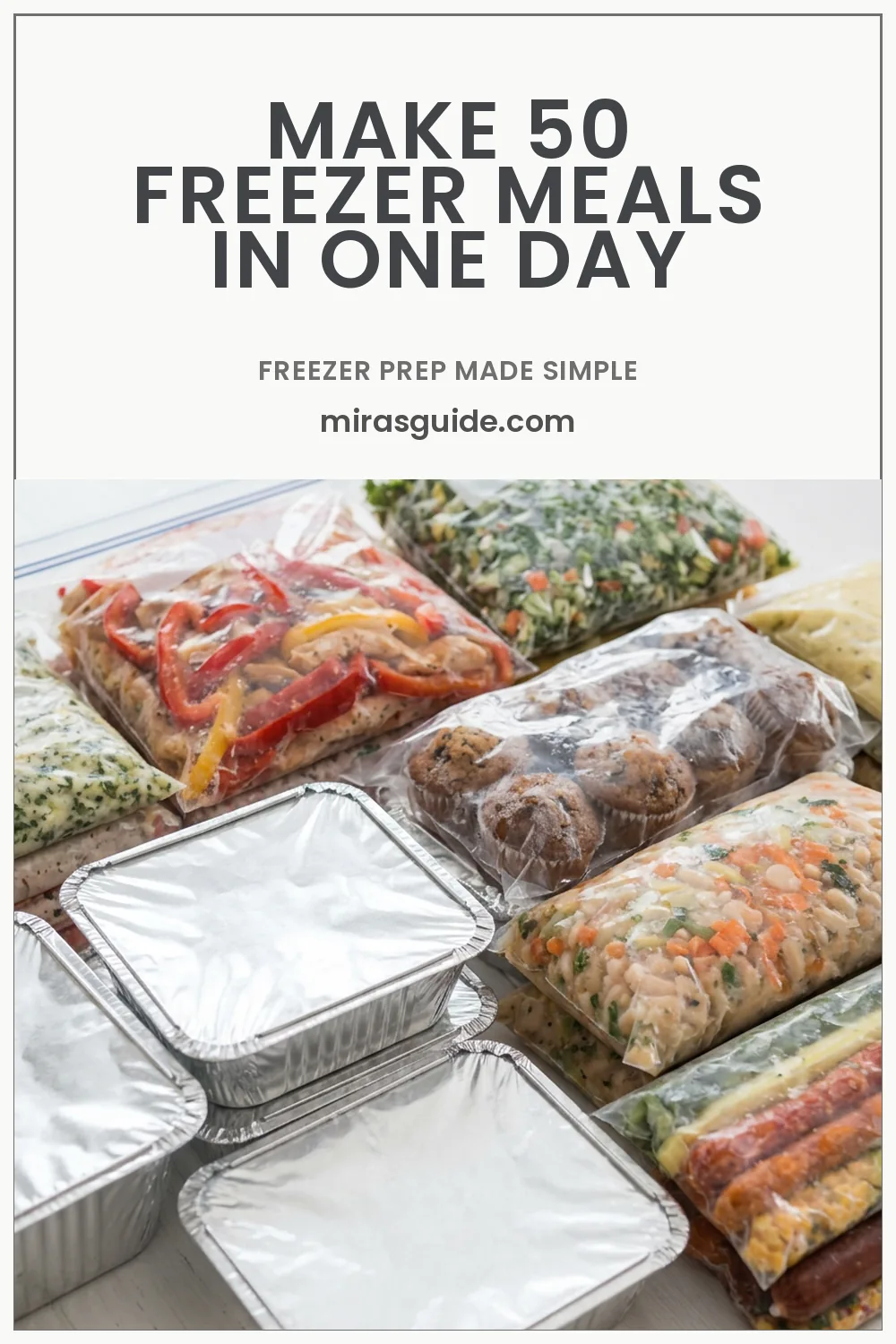
Fifty freezer meals in one day sounds like an internet exaggeration until you’ve done it. The process is not heroic — it’s an assembly line. One big shop, one table cleared, ingredients prepped in bulk batches, and a production rhythm that keeps you moving: bag, protein, vegetables, sauce, seal, label, next. Eight hours of work becomes roughly six weeks where dinner is already decided.
Why a Single Batch Day Works 🧊
- You shop once for six weeks — one list, one trip, one checkout line.
- The chopping happens in bulk — dicing eight onions in one session takes less time than dicing two onions four times.
- Cost per serving drops — buying 20 lbs of chicken on sale and portioning it yourself beats the per-pound price of any prepared meal.
- The mess happens once — one counter, one sink full of dishes, then six weeks of almost nothing.
- Decision fatigue disappears — the hardest part of weeknight cooking is choosing, and that’s already done.
Recipe at a Glance
Shop: 1½ hours (or a delivery order the day before)
Prep: 2 hours
Assembly: 4 hours
Yield: 50 meals, 4–6 servings each
Difficulty: Moderate — long, not hard
Method: Freezer meal batch assembly
Ingredients 🛒
One day of work, six weeks of dinners
28 Days of Dinners Planned for You hands you a month of weeknight dinners with the shopping list already written—no more 5pm decisions.
This is a shopping list, not a recipe. It’s built to produce 50 meals across eight meal families, so you buy each protein once and portion it many ways.
Proteins
- 10 lbs boneless skinless chicken breast
- 6 lbs chicken thighs (boneless)
- 6 lbs lean ground beef or turkey
- 4 lbs beef chuck, cubed
- 3 lbs pork tenderloin
- 2 lbs Italian sausage, casing removed
- 4 cans chickpeas and 4 cans black beans (for meatless meals)
Vegetables — buy pre-cut where it’s worth it
- 8 onions
- 6 bell peppers (mixed colors)
- 4 lbs carrots
- 2 bunches celery
- 3 lbs mushrooms
- 3 heads cauliflower
- 4 lbs green beans
- 6 lbs potatoes (for same-day use, not freezing — see notes)
Pantry
- 12 cans diced or crushed tomatoes (no-salt-added)
- 8 cans beans of choice
- 6 cans light coconut milk
- 4 quarts low-sodium chicken broth
- 2 quarts low-sodium beef broth
- 2 quarts low-sodium vegetable broth
- Salsa, soy sauce, rice vinegar, olive oil, honey, Dijon
- Spice blends: taco, curry, Italian, chili powder, cumin, smoked paprika, oregano, thyme, rosemary, garlic powder, onion powder
Supplies
- 50 freezer-safe gallon bags
- Masking tape and a permanent marker
- Two large sheet pans (for freezing bags flat)
Buy pre-cut vegetables for the ones that are miserable to prep. Cauliflower florets, green beans, and mushrooms are worth the markup on a batch day because they eliminate the slowest manual work. Onions and peppers are cheap and fast enough to do yourself.
Low-sodium broth is not optional at this scale. A slow cooker traps nearly all its liquid, so six hours of cooking concentrates whatever salt went in. Regular broth produces meals that taste aggressively salty.
Ground meat must be browned before it’s frozen. Raw ground meat in a slow cooker spends hours coming up to temperature, and ground meat is the highest-risk form of protein because it’s been exposed to air throughout. Browning it first takes about 45 minutes for 6 lbs and solves both the safety question and the flavor question.
Equipment
- A second refrigerator or a chest freezer — 50 meals will not fit in a standard freezer compartment alongside anything else.
- Two large cutting boards — one for raw protein, one for vegetables. Keep them separate all day.
- A large stockpot or Dutch oven — for browning 6 lbs of ground meat in batches.
- A bag holder or a deep bowl — holding a zip-top bag open with one hand while filling it with the other gets old in about ten minutes.
How to Do It 👩🍳
1. Plan the meals before you shop
Choose eight meal families and multiply by six. A workable set: lemon herb chicken, salsa chicken, teriyaki chicken thighs, coconut chickpea curry, turkey chili, beef and barley stew, Italian sausage and peppers, and pork with apples. Write the full list — meal name, bag count, and cook time — on a sheet of paper before you buy anything. Improvising at the grocery store is how you end up with 10 lbs of chicken and no plan for it.
2. Label all 50 bags first
Before any food comes out of the refrigerator, write the meal name, the date, and the cook time on all 50 bags. This takes fifteen minutes and saves you from a freezer full of unidentified red blocks. Tape the marker to the counter so it doesn’t wander off.
3. Set up three stations
Think of it as a production line rather than a cooking session. Station one is the protein board — where chicken gets trimmed and cubed. Station two is the vegetable board — where everything gets chopped into a few large bowls by type. Station three is the assembly table — bags, bowls of prepped vegetables, cans, and seasonings, all within arm’s reach. Keeping the raw protein separate from the vegetables all day is both a food-safety measure and the only way to keep your hands and tools from cross-contaminating everything.
4. Prep in bulk, not per-recipe
This is the step that makes the day possible. Don’t dice two onions for one meal — dice all eight onions at once into one bowl. Don’t open one can of tomatoes — open all twelve. Chop all the carrots, all the peppers, all the celery, and set each in its own large bowl. Batching identical tasks eliminates the setup-and-teardown cost that makes 50 individual recipes take three days instead of one.
5. Brown the ground meat
Brown all 6 lbs of ground beef or turkey in batches in the stockpot over medium-high heat, breaking it up as it cooks. Don’t crowd the pot — crowded meat steams instead of browning, and you lose the flavor that makes chili worth eating. Drain the fat, spread the browned meat on a sheet pan to cool quickly, and set aside. Cool it fully before it goes into bags; warm meat will steam inside the bag and create ice crystals.
6. Assemble in meal batches
Now work meal by meal. For each one, lay out the number of bags you need and fill them in a rhythm: protein first, then vegetables, then liquid, then seasoning scattered on top. Working meal-by-meal rather than ingredient-by-ingredient keeps you from losing count. Press the air out of each bag by laying it flat and rolling from the bottom, then seal and lay it flat on a sheet pan.
7. Freeze flat, then stack
Slide the sheet pans into the freezer and let the bags freeze solid — about 4 hours — before moving them into a stacked arrangement. Freezing flat first is what makes 50 meals fit; bags frozen in a heap take up three times the space and thaw unevenly.
8. Build the inventory list
Tape a sheet of paper to the outside of the freezer, listing every meal and how many bags of each. Cross off as you cook. Forty meals into a sixteen-cubic-foot freezer, you will not remember what’s in the back, and the meals you forget are the ones that get freezer burn.
Why the Technique Works
Batch cooking is efficient for a reason that has nothing to do with cooking and everything to do with task-switching. Every time you move between chopping, measuring, opening cans, and cleaning, you pay a fixed cost in setup and teardown. Making one recipe means paying that cost once; making fifty means paying it fifty times — unless you restructure, which is exactly what bulk prepping does. Chopping all the onions at once means one cutting board, one knife, one cleanup, and one continuous motion instead of eight interruptions. The same logic applies to browning all the ground meat in one session and opening all the cans at once. The assembly line doesn’t make any individual task faster; it removes the transitions between them, and the transitions are what eat the day.
Cooking Tips & Expert Advice
- Shop and prep on separate days. Buying everything Friday night and assembling Saturday morning makes the assembly day roughly twice as fast.
- Wear gloves for the protein station. It sounds excessive until you’ve washed your hands forty times in one afternoon.
- Keep a trash bowl on the counter. Walking to the bin with every onion skin adds up to a mile over a batch day.
- Underfill by design. Two-thirds full is the ceiling. Contents expand as they freeze and a full bag leaks or splits.
- Don’t freeze dairy. Cream, milk, and yogurt separate and stay grainy. Add them at the end of cooking instead.
- Write the cook time on the bag. Six weeks later you won’t remember whether this one is 4 hours or 8, and guessing produces either dry chicken or raw beef.
- Plan a few meals for the first week too — something to eat the night you finish, so you’re not tempted to order takeout after eight hours of work.
- Split the day if you have help. One person on protein, one on vegetables, and one on assembly cuts the day down to about four hours.
Variations & Substitutions
- Ten-meal starter version: halve everything and do ten meals in two hours — a much better first batch if you’ve never done this before.
- Chicken-only batch: buy 20 lbs of chicken and use it across six different sauces. Cheaper and faster, but less variety.
- Meatless batch: replace all the protein with 20 cans of beans and 8 cups of dried lentils. Cost drops sharply and assembly gets faster since nothing needs trimming.
- Breakfast additions: add 10 bags of freezer breakfast burritos or overnight oats for a fully stocked freezer.
- Instant Pot batch: the same bags cook under pressure in 25–30 minutes from frozen with an extra ½ cup of liquid — the fastest way to use them.
- Half-crockpot, half-oven: freeze some meals as oven casseroles instead — assemble in foil pans and bake covered at 350°F for 50 minutes.
Serving Suggestions
Every one of these is a main, so plan a rotating set of fast sides you can make in ten minutes: microwave rice, frozen quinoa, a bag of salad, and sliced bread. Having one bag of rice and one bag of salad in the house at all times turns a freezer meal into a complete dinner in the time it takes the slow cooker to be opened.
Storage, Freezing & Reheating
Freezer bags are good for 3 months at 0°F for quality, longer for safety. Thaw overnight in the refrigerator — the safest method and the one that keeps cook times predictable. In a pinch, a sealed bag submerged in cold water thaws in about an hour. Cooked leftovers keep 4 days refrigerated. Reheat on the stovetop or in the microwave, adding broth if a sauce has tightened up.
Troubleshooting
Why do my freezer meals taste bland? Slow cooking mutes dried herbs and spices over several hours, and there’s no evaporation to concentrate flavor. Season slightly more than feels right, and finish every meal with acid — lemon juice, vinegar, or a squeeze of lime — at the end.
Why is everything watery? Too much liquid went into the bags. Add liquid to only a third of the way up the contents; the meat and vegetables release plenty of their own.
Why did some bags leak in the freezer? They were overfilled or the seal had liquid in it. Keep them two-thirds full and wipe the inside of the seal dry before closing.
Why is my chicken dry after 8 hours? Chicken breast is done at 165°F, which typically happens at 3–4 hours on low. Reserve the 8-hour times for beef chuck, pork shoulder, and dried beans, which need them.
Is this actually cheaper than shopping weekly? Usually — bulk protein on sale is the biggest saving. But it only pays off if you eat the meals. If your freezer tends to fill and stay full, a ten-meal batch is a better fit than fifty.
❓ FAQ
How long does the whole day actually take? For a first attempt, plan on 8–9 hours including shopping. With practice and pre-cut vegetables, 6 hours is realistic. Splitting shopping to the day before cuts about an hour and a half off the assembly day.
Do I need a chest freezer? For 50 meals, yes, or a second refrigerator. A standard fridge freezer holds roughly 12–15 flat bags. Size your batch to your storage.
Can I cook these from frozen? Yes, adding about 2 hours on low, but thawing first gives noticeably better texture. The Instant Pot is the exception — frozen bags work well under pressure.
What shouldn’t go in a freezer bag? Dairy, fresh herbs, zucchini and summer squash, and pasta or rice. Add all of those at cooking time instead of freezing them.
Will my family get bored of the same meals? Fifty meals across eight families means you eat each one about six times over six weeks. Rotate the order so no family repeats within the same week.
Can I do this with a friend and split the cost? It’s the best version of this day. Double the quantities, work in two kitchens or one big one, and split the finished bags. You get 50 meals each for one day of work.
Nutrition, Allergens & Dietary
Nutrition depends entirely on your chosen meals and ingredient brands. Across these eight families, most servings land between 300 and 450 calories with 25–35g of protein. Allergens vary: soy appears in teriyaki meals, dairy in any recipe finished with yogurt, and gluten in barley and any pasta additions. Use certified gluten-free broth and check spice blends if that matters. All figures are estimates.
Final Thoughts
The thing that makes a batch day succeed isn’t speed or skill — it’s working in bulk and working in order. Chop everything once, brown everything at once, and assemble meal by meal while everything is already prepped and in front of you. Do that, and fifty meals is genuinely one day’s work.

Once these run out, what’s for dinner next month?
A batch day stocks you for six weeks. 28 Days of Dinners fills the gaps between batches with meals that need no prep at all.
- ✓ 28 weeknight dinners, already chosen
- ✓ Shopping lists done for you
- ✓ No specialty ingredients
- ✓ Works with a normal freezer