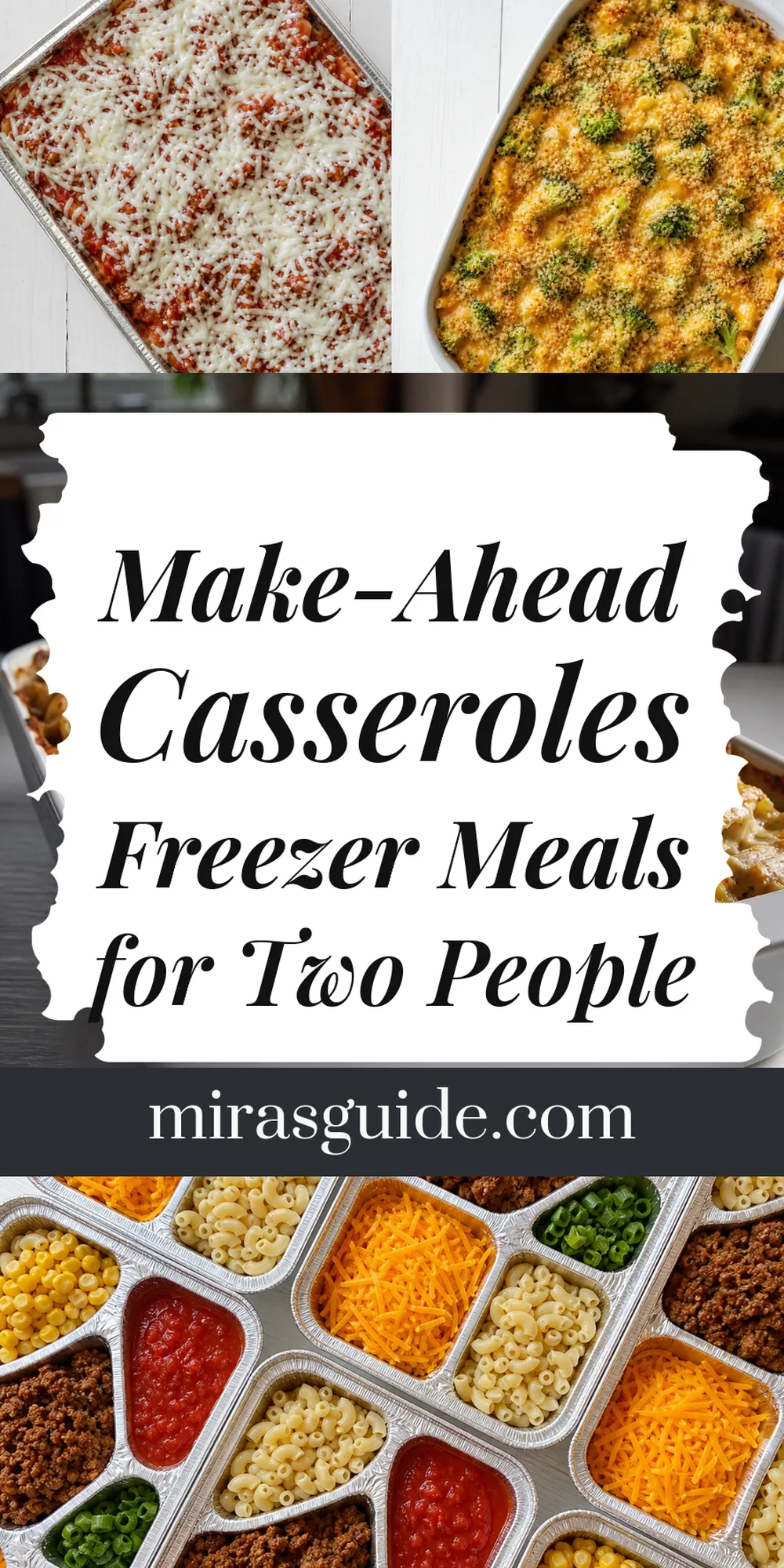
Freezer casseroles for two solve a problem most casserole recipes create: a 9×13 feeds eight, which means a couple eats the same dish four nights running or throws half of it away. These are built in 8×8 pans, loaf pans, and individual ramekins — properly scaled for two people, with the small-pan adjustments that make the difference between a casserole that bakes evenly and one that dries out around the edges.
Why Small-Batch Casseroles Are Different 🍽️
- Scaled to two, not divided from eight — real proportions for the pan size, not a halved recipe that bakes wrong.
- Three pan sizes, one system — 8×8 for two dinners, loaf pans for two servings, ramekins for singles.
- Lower sodium by design — smaller batches mean you’re not salting for volume, which matters more as you get older.
- Softer textures where useful — easy on the jaw, easy to reheat, easy to eat.
- No leftovers fatigue — each pan is one or two meals, so nothing repeats four nights running.
- Perfect for couples and for older households — portions that match how two people actually eat.
Recipe at a Glance
Assembly: 15–20 minutes per casserole
Bake: 25–35 minutes
Yield: 8 casseroles, 2–4 servings each
Freezer life: 3 months for best quality
Difficulty: Easy
Method: Small-pan freezer casserole assembly
The Small-Pan Rules 🛒
Casseroles sized for two, not eight.
28 Days of Dinners Planned for You hands you a month of weeknight dinners with the shopping list already written—no more 5pm decisions.
Halving a recipe isn’t just dividing by two
Four specific things need adjusting when you scale a casserole down:
- Bake time drops, temperature stays. A smaller volume of food heats through faster. Most 9×13 casseroles need 40–50 minutes; the same recipe in an 8×8 needs 25–35. The temperature doesn’t change — only the time.
- Eggs and thickeners don’t halve cleanly. Half an egg is real, and one large egg is about 3 tablespoons — beat it and use half. Cornstarch and cornstarch-based sauces sometimes need slightly more proportionally in a small batch because there’s more surface area relative to volume.
- Sauce-to-solid ratio shifts slightly wetter. Small pans have more surface-to-volume and lose more moisture in the oven, so add a spoonful extra sauce rather than less.
- Toppings need less. A quarter cup of breadcrumbs over an 8×8 is plenty; the same amount that covered a 9×13 will dominate.
The three pan sizes that do all the work
- 8×8 pan — two generous servings or four smaller ones. The workhorse for couple-sized casseroles.
- Loaf pan (9×5) — two perfect servings, freezes and stacks efficiently, and bakes fast because it’s shallow.
- Individual ramekins (8–10 oz) — single servings that reheat in 90 seconds, ideal when the two of you eat at different times.
Lower-sodium approach
Small-batch cooking is a good opportunity to bring sodium down, since you’re not feeding a crowd that expects a certain intensity. Use no-salt-added canned goods, rinse beans thoroughly (which removes roughly 40% of the added sodium), lean on herbs and acid for flavor instead of salt, and check broth labels — the low-sodium versions vary widely in how much they actually reduce.
Texture considerations
Small casseroles dry out faster at the edges because there’s proportionally more edge. Two fixes: cover with foil for the first two-thirds of the bake, and add a bit more sauce than a large version would use. If softer textures are what you want, this works in your favor — a small casserole with extra sauce comes out tender rather than crusty.
Equipment
- 2 × 8×8 foil pans
- 3 × 9×5 loaf pans
- 4 individual ramekins
- Foil and marker for wrapping and labeling
The 8 Casseroles 👩🍳
1. Chicken and rice casserole for two
1 cup cooked rice, 1 cup shredded chicken, ½ cup Greek yogurt, ½ cup chicken broth, ½ cup frozen peas, garlic, onion powder, a sprinkle of Parmesan. Pan: 8×8. Bake: 375°F, 25 minutes. Small-pan note: cover with foil for the first 15 minutes — rice casseroles dry out fast at this size.
2. Turkey and vegetable casserole
8 oz lean ground turkey (browned), 1 cup mixed frozen vegetables, 1 cup cooked small pasta, ¾ cup crushed tomatoes, Italian seasoning, ¼ cup mozzarella. Pan: loaf pan. Bake: 375°F, 25 minutes. Small-pan note: just ¼ cup of cheese is enough top cover for a loaf pan.
3. Individual spinach and feta egg bakes
4 eggs, 2 egg whites, 1 cup sautéed spinach, ⅓ cup crumbled feta, ½ cup cottage cheese, onion, dill. Pan: 4 ramekins. Bake: 350°F, 22 minutes. Small-pan note: ramekins need to be greased well; egg bakes stick at this size.
4. Two-serving beef and vegetable pie
1 cup cooked ground beef, ½ cup diced carrots and peas, ¾ cup beef gravy thickened with cornstarch, topped with 1½ cups mashed potato (half cauliflower if you like). Pan: loaf pan. Bake: 400°F, 30 minutes. Small-pan note: keep the potato layer thin — a thick top layer won’t heat through in 30 minutes.
5. Black bean enchilada bake for two
4 small corn tortillas, 1 can black beans (rinsed), ½ cup enchilada sauce, ½ cup corn, ⅓ cup shredded cheese, cumin. Pan: 8×8. Bake: 375°F, 25 minutes. Small-pan note: tear tortillas to fit rather than overlapping; they steam rather than crisp when layered thickly.
6. Tuna noodle casserole, lightened
1½ cups par-cooked egg noodles, 1 can tuna, ½ cup peas, ⅔ cup sauce made from blended cottage cheese + milk + Dijon, 2 tablespoons breadcrumbs added at bake time. Pan: loaf pan. Bake: 375°F, 25 minutes. Small-pan note: keep the breadcrumbs to 2 tablespoons — more overwhelms a small pan.
7. Cauliflower and chickpea curry bake
2 cups roasted cauliflower, 1 cup chickpeas, ¾ cup curry-coconut sauce, 1 cup spinach, topped with 2 tablespoons toasted panko at bake time. Pan: 8×8. Bake: 400°F, 25 minutes. Small-pan note: roast the cauliflower first — raw cauliflower releases too much water in a small pan.
8. Chicken parmesan quinoa bake
1 cup cooked quinoa, 1 cup diced chicken breast, ¾ cup marinara, ⅓ cup mozzarella, 2 tablespoons Parmesan, 2 tablespoons breadcrumbs at bake time. Pan: 8×8. Bake: 375°F, 25 minutes. Small-pan note: add a spoonful of extra marinara — quinoa absorbs aggressively.
Freezing all eight
Assemble in the pan, cool completely, cover with foil, wrap tightly, and label with the name, oven temperature, bake time, and whether it’s frozen or thawed. Small pans freeze in about 2 hours and stack neatly.
Why the Technique Works
Scaling a casserole down isn’t arithmetic — it’s geometry. A 9×13 pan holds about twice the volume of an 8×8, but it has roughly 1.5 times the surface area. That means a small casserole has proportionally more exposed surface per unit of food, so it loses moisture faster and browns faster at the edges. This is why halved recipes often come out dry even when the ingredient ratios are correct: the recipe scaled, but the evaporation didn’t. The practical responses are to add slightly more sauce than a straight halving suggests and to cover with foil for the first two-thirds of the bake, so the interior cooks through before the top and edges over-brown. The corollary is that small casseroles actually bake faster and more evenly through the center, which is why they’re suited to ramekins and loaf pans — shapes with more surface area relative to depth heat through quickly and uniformly.
Cooking Tips & Expert Advice
- Cover with foil for the first two-thirds of the bake. Small pans dry out at the edges; the foil prevents it.
- Add a spoonful extra sauce when halving. Evaporation doesn’t halve proportionally.
- Halve eggs by beating and measuring. One large egg is about 3 tablespoons.
- Rinse canned beans to cut sodium. It removes a meaningful portion of the added salt.
- Keep topping quantities small. Two tablespoons of breadcrumbs is plenty for a loaf pan.
- Precook vegetables that release water. Mushrooms, zucchini, and spinach especially.
- Freeze unbaked. Par-cooked pasta and uncooked sauce hold up far better than a baked-then-frozen casserole.
- Use a thermometer the first time. 165°F in the center for anything with poultry; after that you’ll know your pan.
- Label with the pan size — different pans need different times, and the note saves you guessing.
Variations & Substitutions
- Single servings: move everything to ramekins. Bake time drops to 20–25 minutes and reheating takes 90 seconds.
- Dairy-free: use coconut milk in place of yogurt sauces; casseroles 5 and 7 are naturally dairy-free.
- Gluten-free: use GF noodles and breadcrumbs, corn tortillas, and check the enchilada sauce and broth.
- Even lower sodium: no-salt-added tomatoes and beans, homemade broth, and herbs plus vinegar in place of salt.
- Higher protein: add an extra half cup of chicken or beans and increase sauce by two tablespoons.
- Volume cooking: make four pans at once — same effort, and you get eight meals instead of two.
- Softer texture: add two extra tablespoons of sauce and cover for the entire bake. Ideal if chewing is tiring.
Serving Suggestions
Serve straight from the pan with a small salad or a steamed green vegetable. Because these are complete meals, the side is about freshness rather than nutrition. A slice of good bread alongside is worth keeping in the freezer for sopping up sauce.
Storage, Freezing & Reheating
Freeze unbaked, tightly wrapped, for up to 3 months at 0°F for quality. Bake from frozen at the same temperature, covered with foil for the first half, adding 15–20 minutes. Baked leftovers keep 4 days refrigerated; reheat individual portions in the microwave until steaming, 165°F for poultry dishes. Ramekin portions reheat in about 90 seconds.
Troubleshooting
Why did my halved casserole come out dry? Small pans evaporate proportionally more. Add an extra spoonful of sauce and cover with foil for the first two-thirds of the bake.
Why did the edges burn before the center was hot? It needed foil. Cover it and extend the time.
Why is it watery? Raw vegetables released water. Sauté mushrooms, zucchini, and spinach first.
Why did the pasta turn mushy? It was fully cooked before freezing. Par-cook it to well under al dente and freeze unbaked.
Why is the topping soggy? It was added before freezing. Add crumbs and nuts at bake time only.
Why is it bland? Freezing mutes seasoning and small batches have less carryover flavor. Season the sauce more boldly and finish with acid.
❓ FAQ
Can I just halve my favorite 9×13 recipe? Yes, with three adjustments: use an 8×8 or loaf pan, reduce the bake time by about a third, and cover with foil for most of the bake.
Do I need special pans? No — disposable foil 8×8 and loaf pans cost very little and go from freezer to oven without a transfer step.
How do I reheat a frozen casserole for two? Bake covered from frozen at the recipe temperature, adding 15–20 minutes, or thaw overnight in the fridge and bake as written.
Are these good for older households? Yes, and the smaller portions, lower sodium, and softer textures are deliberate choices that suit them well.
Can I make these in bulk for two? Yes — make four small pans instead of one large one. Same effort, four separate meals.
How long do they keep? Three months at 0°F for quality. Baked leftovers keep 4 days in the fridge.
Nutrition, Allergens & Dietary
Per serving, these generally land between 320 and 480 calories with 18–28g of protein. Allergens vary: dairy in 1, 2, 3, 5, 6, and 8; gluten in 2, 4, 6, and 8; eggs in 3; fish in 6. Casseroles 5 and 7 are dairy-free, and 7 is vegan. Check the sodium content of your canned goods if you’re watching salt. Nutrition figures are estimates.
Final Thoughts
The trick to small-batch casseroles is accepting that scaling down changes how the pan behaves, not just how much goes in it. Add a little extra sauce, cover with foil for most of the bake, keep the toppings restrained, and freeze it unbaked. Do those four things and a casserole for two stops being a halved recipe and starts being a properly designed one.
Once these run out, what’s for dinner next month?
Eight small-batch casseroles for two, done. 28 Days of Dinners keeps the next month of weeknights planned.
- ✓ 28 weeknight dinners, already chosen
- ✓ Shopping lists done for you
- ✓ Scaled for smaller households
- ✓ Everyday ingredients, no specialty store