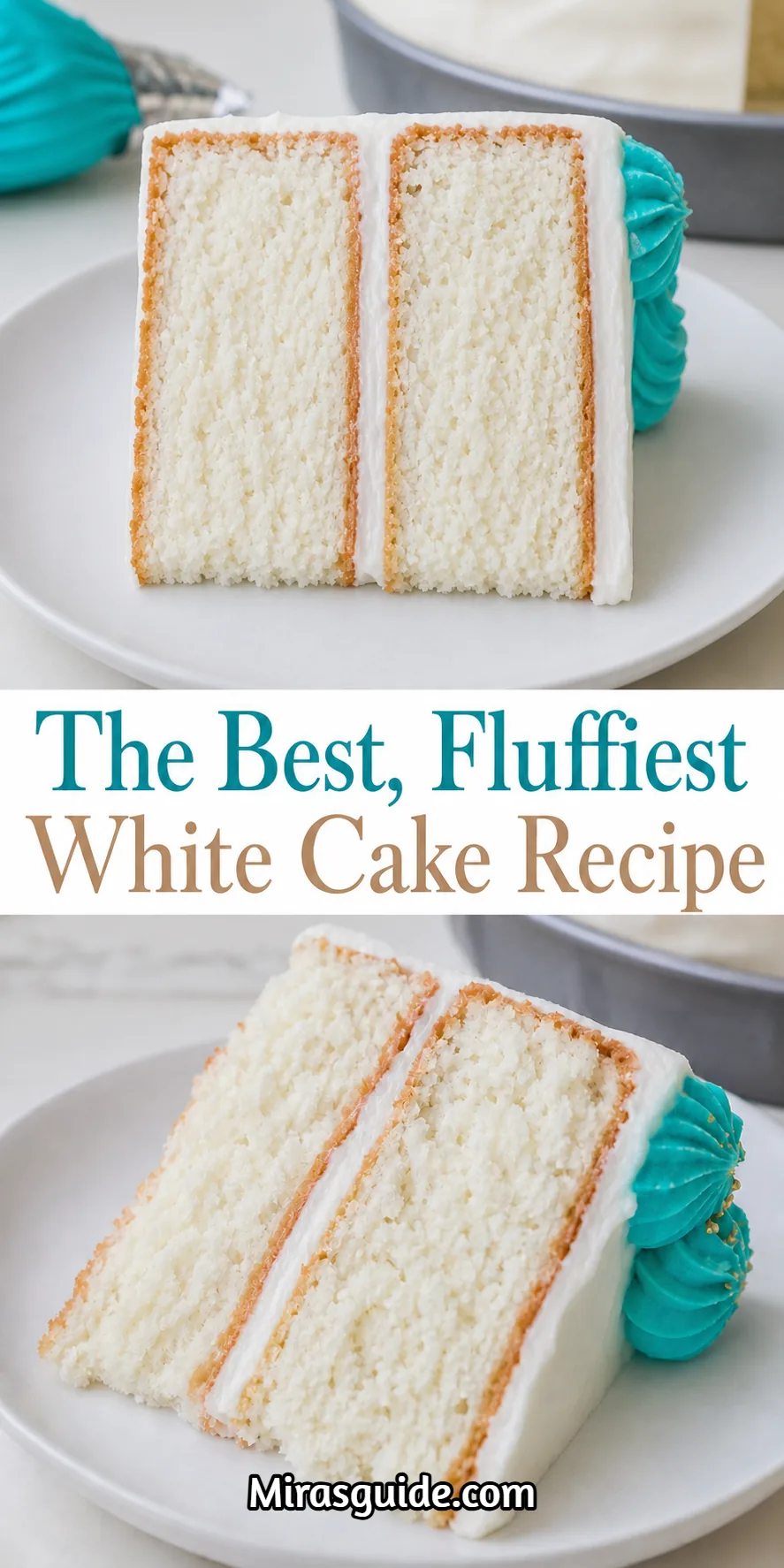
The best white cake recipe earns the word “best” on structure, not hype: an exceptionally soft, moist, fine-crumbed white cake that stays genuinely snowy — no yolks yellowing the interior — with a plush, tender texture that holds up for days and slices cleanly for weddings, birthdays, and every layered occasion in between. It uses the reverse-creaming method and a mix of butter and oil to solve white cake’s two eternal failures: dry crumbs and coarse texture.
Why You’ll Love This White Cake 🤍
- Actually white — egg whites only and clear vanilla keep the crumb snow-pale from edge to center.
- Moist for days, not hours — a tablespoon of oil into the butter-based crumb is the insurance against the classic dry white cake.
- Bakery-fine crumb — reverse creaming (butter beaten into flour first) gives velvety, even texture with almost no dome.
- Level, stackable layers — bakes flat enough that stacking needs no trimming.
- Universal carrier — vanilla-forward but neutral; every frosting, filling, and fruit works with it.
Recipe at a Glance
Prep: 25 minutes
Bake: 28–34 minutes
Yield: two 9-inch layers (or three 8-inch), 12–16 servings
Difficulty: Moderate (technique-driven, still very approachable)
Method: Reverse creaming
Ingredients 🛒
Want More Easy Desserts Like This?
The Ultimate Easy Dessert Vault gives you 50 easy desserts organized by craving, occasion and prep style—including no-bake treats, cookies, cakes, and quick dessert fixes.
For the cake
- 2½ cups cake flour (spooned and leveled — see note)
- 1¾ cups granulated sugar
- 1 tablespoon baking powder
- ¾ teaspoon fine salt
- ¾ cup (1½ sticks) unsalted butter, at cool room temperature, cut into cubes
- 3 tablespoons neutral oil (canola or light olive)
- 1 cup whole milk, room temperature, divided
- ¼ cup sour cream, room temperature
- 5 large egg WHITES (no yolks), room temperature
- 1 tablespoon clear vanilla extract (or very good pure vanilla — see note)
- Optional: ¼ teaspoon almond extract (the bakery-white-cake signature note)
For a simple vanilla buttercream (enough to fill + frost a 9-inch two-layer)
- 1½ cups (3 sticks) unsalted butter, softened
- 5–6 cups powdered sugar, sifted
- ¼ teaspoon fine salt
- 1 tablespoon clear or pure vanilla
- ¼–⅓ cup heavy cream, as needed for texture
Cake flour is structural, not snobbery. Its lower protein keeps the crumb tender at this fat level; all-purpose at the same liquid ratio bakes bready. No cake flour? Make a substitute: for each cup, replace 2 tablespoons of the AP flour with cornstarch and sift twice.
Clear vanilla is the difference between “white” and “ivory.” Imitation clear vanilla keeps the interior snow-white and tastes slightly marshmallowy (pleasantly nostalgic); a quality pure vanilla tastes deeper but tints the crumb toward cream. Both are right — pick by priority.
Room temperature is a recipe ingredient. Cold whites and milk solidify the butter-and-oil fat into lumps the batter can’t re-emulsify, leaving greasy streaks and tunnels. Everything sits out 45–60 minutes first.
How to Make It 👩🍳
1. Prep
Heat the oven to 350°F. Grease two 9-inch round pans, line the bottoms with parchment rounds, and grease again. (White cake’s tender crumb is sticky; the double-greased parchment round is the no-tear release system.)
2. Reverse-cream the dry base
In a stand mixer with the paddle, whisk cake flour, sugar, baking powder, and salt for 30 seconds. On low, add the butter cubes a few at a time, then drizzle in the oil, mixing until the texture turns to even damp sand — about 2 full minutes. The flour coated in fat is the whole trick: gluten gets literally waterproofed, which is why reverse-creamed cakes stay velvety where traditional creaming bakes coarse.
3. Add the liquid base
Whisk ¾ cup of the milk with the sour cream. Pour half into the sandy base and beat on medium 90 seconds — the batter will look fluffy and paste-like, which is correct. Scrape the bowl thoroughly; reverse creaming hides unincorporated pockets at the bottom.
4. Whites go in last
Whisk the remaining ¼ cup milk with the egg whites and vanilla (and optional almond) just to combine — don’t whip foam into them. Add to the batter in 3 additions, mixing on medium-low 20–30 seconds after each and scraping between. Final batter: thick, satiny, lump-free, and pourable like pancake batter with body.
5. Pan and bake
Divide evenly between the pans (a scale makes level layers — about 620 g per pan) and smooth the tops. Bake 28–34 minutes: tops pale gold, edges pulling gently from the sides, centers springing back to a light touch, and a toothpick emerging with a few moist crumbs (wet batter = more time; clean-dry = slightly overbaked). White cake should NOT take dark color — color means the crumb’s drying.
6. Cool with discipline
Cool in pans on racks 15 minutes — this lets the crumb set so it survives unmolding — then invert onto racks, peel the parchment, and cool completely before frosting (2 hours; a warm cake + butter buttercream = a melted slide). For zero-crumb frosting, wrap cooled layers and freeze 30 minutes first.
7. Frost
Beat butter 3 full minutes until pale and fluffy. Add powdered sugar in 3 additions with salt and vanilla, then cream a tablespoon at a time until the buttercream holds a peak but spreads like silk. Fill, crumb-coat thinly, chill 20 minutes, then finish-frost. The crumb coat traps stray crumbs so the final coat stays pristine white.
Why the Technique Works
Classic creaming whips butter and sugar first, trapping air that expands in the oven — fine for volume, but the uneven bubbles make coarse crumbs and rounded domes. Reverse creaming coats every flour particle with fat before any liquid arrives, which caps gluten development and spreads mixing evenly; the chemical leavener does the lifting without air pockets, baking up flat and velvet-crumbed. Oil stays liquid at room temperature (butter re-firms), so its fraction keeps the crumb perceptibly moist on day three. Egg whites supply protein structure without yolk fat or color, and sour cream’s acidity tenderizes protein further while its fat adds plushness without thinning the batter.
Tips & Expert Advice
- Dense or gummy streaks? The batter was undermixed at step 3 (the fluffing stage is doing real work) or cold ingredients broke the emulsion. Room temp is discipline, not suggestion.
- Dry cake: almost always overbaking. Start checking at 26 minutes; moist crumbs on the pick is the signal, not clean-dry.
- Soggy center ring: oven was under-temperature. An oven thermometer ends this category of mystery permanently.
- Weigh the flour if you can: 280–290 g. Scooped-and-packed cake flour measures heavy and dries the crumb before the oven does.
- Level tops without trimming: cake strips (or wet towel bands wrapped around pan exteriors) slow edge-setting and let the centers rise evenly.
Variations & Substitutions
- Almond-white bakery version: keep the almond extract and frost with almond-scented buttercream — this is the flavor behind most wedding cakes.
- Lemon-white: 2 tablespoons lemon zest into the sugar, lemon buttercream — the zest oils perfume without watering down the structure.
- Funfetti: fold ½ cup jimmies into the finished batter at the last second; jimmies, not nonpareils (the nonpareil dyes bleed).
- Cupcakes: yields about 24; bake 17–21 minutes, same doneness cues.
- Dairy-free: full-fat plant milk + vegan butter sticks work at 1:1; crumb is slightly softer but entirely respectable.
Serving Suggestions
Room temperature, not cold — butter-based crumb eats dry when chilled and soft, plush, and full-flavored at room temp (pull refrigerated slices 30 minutes before serving). Raspberry or lemon filling between layers is the classic companion; fresh berries and softly whipped cream alongside are fuss-free luxury.
Storage & Freezing
Frosted cake keeps at room temperature under a dome 2–3 days (buttercream-sealed crumb stays fresh); refrigerate up to 5 but serve at room temperature. Freeze unfrosted layers, double-wrapped, up to 2 months — thaw wrapped in the fridge overnight, then frost. Freeze frosted cake by firming it uncovered 1 hour, then wrapping airtight; thaw overnight in the fridge.
❓ FAQ
Why no yolks — is it just the color? Color first, texture second: whites give structure without the yolks’ emulsified fat and water, keeping the crumb light and the flavor clean-vanilla.
Can I skip the oil? You can (add 3 more tablespoons butter) — the cake is excellent fresh but noticeably drier by day two. The oil is the keep-fresh trick.
My buttercream is yellowish; can I whiten it? Beat it longer (5 full minutes lightens it by air), use clear vanilla, and a toothpick-dip of violet gel color neutralizes yellow optically.
Three 8-inch layers instead of two 9-inch? Divide evenly and start checking at 22 minutes — same doneness cues, taller cake.
Why did my layers dome? Oven running hot, or pans too dark. Lower to 340°F, use light-colored pans, or use cake strips — the reverse-creaming method alone usually bakes flat.
Final Thoughts
A white cake that stays white, stays moist, and stays level without trimming — this is the one recipe you treet for every occasion that needs a cake to behave. Learn the reverse-creaming rhythm here and it quietly upgrades every boxed-mix critic in your family into a from-scratch witness.
Have an easy dessert ready for every craving & occasion
You found tonight’s cake recipe. Now imagine having 50 easy desserts at your fingertips whenever a craving hits.
- ✓ 50 easy dessert recipes in one vault
- ✓ Organized by craving, occasion & prep style
- ✓ Cookies, bars, cakes, no-bake & frozen treats
- ✓ Simple ingredients, clear steps