Zero waste meal planning sounds intimidating — like something only zero-waste TikTok creators can do — but the honest truth is that the average American family throws out $1,500 worth of food every year, and most of that is fixable with a simple weekly planning system. You don’t need a fancy compost bin or reusable produce bags to start. You need a plan that uses what’s already in your fridge, buys only what you need, and turns “leftover ingredients” into next week’s meals. This guide walks through the honest weekly zero waste meal planning framework: inventory-first shopping, ingredient stretching, freezer strategy, and the “cook once, use three ways” rotation that eliminates 80% of household food waste — no lifestyle overhaul required.
⚠️ Disclaimer: This meal plan is for general informational purposes only. Always consult your doctor before starting any new diet, especially if you have a medical condition, are pregnant, or nursing.
Why Zero Waste Meal Planning Matters (and Not Just for the Environment) 🧭
The average U.S. household wastes ~30% of the food they buy. That’s a huge number with a huge cost — and a simple weekly plan solves most of it. Here’s what’s actually at stake:
Don’t Want to Plan Every Dinner Yourself?
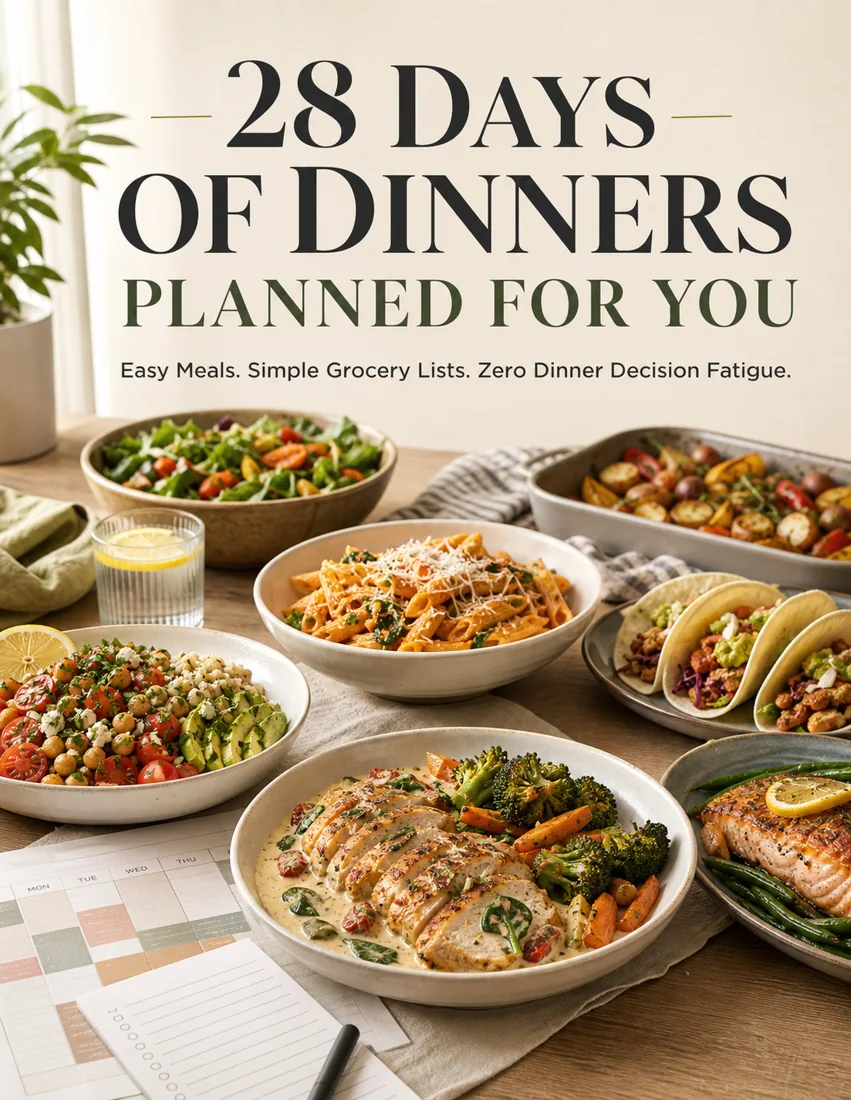
28 Days of Dinners Planned for You gives you 28 days of dinners, grocery lists and prep guidance already organized for you.
Plan My Next 28 Dinners →- 💸 $1,500+ per household per year in wasted groceries
- 🌍 ~40% of U.S. food supply ends up in the trash annually
- 🕐 20 min of weekly planning eliminates most household waste
- 🥫 Freezer + fridge inventory = the missing meal planning skill
- 🌱 Composting is optional — reducing waste at the plan stage is where real change happens
The good news: you don’t need to be a minimalist to do this. Zero waste meal planning is just meal planning done in a specific order — inventory first, plan second, buy third. That’s it.
The 4 Rules of Zero Waste Meal Planning 🎯
Before the weekly framework, these four rules run everything:
🎯 Rule 1: Shop Your Fridge Before You Shop the Store
Every Sunday, before you make a grocery list, do a fridge + freezer + pantry inventory. What’s already there? What needs to be used first? Build the week’s meals around existing ingredients before buying anything new.
🎯 Rule 2: Every Ingredient Should Feed Two Meals (Minimum)
Bought a rotisserie chicken? That’s dinner Monday AND lunch Tuesday. Bought a bunch of spinach? That’s the salad AND the smoothie AND the pasta greens. Every ingredient that comes into your house should have 2+ jobs.
🎯 Rule 3: Save Scraps → Turn Them Into Something
- 🥔 Potato peels → homemade chips (bake with salt)
- 🥕 Vegetable scraps → freeze in a bag until you have enough for stock
- 🥖 Stale bread → croutons, breadcrumbs, panzanella salad, French toast
- 🍎 Wilted fruit → smoothies, baked oatmeal, jam
- 🥬 Wilted greens → soup, sauté, pesto, smoothie
🎯 Rule 4: Freezer Is Your Best Friend
Almost everything freezes. Almost everything defrosts fine. Use it aggressively:
- Leftover cooked chicken → freeze in 4 oz portions
- Extra rice or pasta → freeze flat in zip bags
- Ripe bananas → peel + freeze for smoothies
- Half a can of tomato paste → freeze in tablespoon dollops on parchment
- Herbs about to wilt → chop + freeze in olive oil in ice cube trays
The 5-Step Zero Waste Meal Planning System 🗓️
Here’s the exact weekly framework.
Step 1: Sunday Inventory (10 Minutes) 📋
Before anything else, take stock:
- Fridge: what proteins, vegetables, dairy, and leftovers are here?
- Freezer: what protein / vegetable / prepared items are here?
- Pantry: what canned goods, grains, and staples are here?
Write it all down. Circle anything that needs to be used in the next 3 days.
Step 2: Plan the Week Around What Needs Using First 📅
Match the “use first” items to meals:
- Half a rotisserie chicken → Monday chicken tacos
- 2 wilty bell peppers → Tuesday sheet pan
- 1 pint of Greek yogurt about to expire → breakfast smoothies + tzatziki sauce
- 3 old carrots → Wednesday soup base
That’s already 3 dinners planned without buying anything.
Step 3: Build a “Waste-Free” Grocery List 🛒
Now, and only now, make your grocery list. Only what you need to complete the week’s meals. Aim for 15–20 items maximum for a family of 4.
Zero waste grocery rules: – Buy only what you have a plan for – Check unit price on bulk items (only bulk if you can freeze extras) – Skip pre-cut vegetables (higher cost, faster spoilage) – Buy loose produce, not packaged bulk
Step 4: Cook Once, Use Three Ways 🔄
Every protein you cook feeds 2–3 meals:
- 🍗 Chicken thighs (baked Sunday):
- Mon: chicken tacos
- Tue: chicken pasta
-
Wed: chicken soup (broth from bones)
-
🍞 Loaf of sourdough:
- Mon: sandwiches
- Wed: garlic bread with pasta
-
Fri: French toast (stale bread)
-
🥕 1 lb bag of carrots:
- Snacks (raw with hummus)
- Roasted side (sheet pan Thu)
- Soup base (Sunday soup)
Step 5: Weekly Fridge Sweep + Compost (Friday Night) 🧹
Every Friday night, before the weekend:
- Sweep the fridge — anything not used gets a Friday-night meal
- “Everything soup,” “kitchen sink stir-fry,” or “clean-out omelet” — dinner from leftovers
- Compost peels, cores, and truly unusable scraps
- Wipe shelves so Sunday inventory is easy
A Sample Week: Zero Waste Meal Plan 📋
Here’s an actual week that generates minimal waste, feeding a family of 4 for ~$110.
Sunday (Inventory + Prep)
- Roast whole chicken (dinner + leftovers)
- Save bones + carcass in freezer bag (for future stock)
- Bake 2 sweet potatoes (dinner side + leftover mash for Wed pancakes)
- Cook 3 cups rice (covers 3 meals)
Monday (Uses Sunday’s Chicken)
- Chicken tacos with rice, salsa, cheese, avocado
- Save all chicken carcass + veggie scraps → freezer bag
Tuesday (Uses Sunday’s Rice + New Protein)
- Ground turkey stir-fry with frozen veggies + rice
- Extra rice saved for Wednesday
Wednesday (Uses Sunday’s Sweet Potato + Rice)
- Sweet potato black bean bowls with rice, avocado, salsa
- Any leftover sweet potato mashed for tomorrow’s pancakes
Thursday (Sheet Pan — Uses Fresh Vegetables First)
- Sheet pan sausage + peppers + potatoes
- Uses up wilting bell peppers and last of potatoes
Friday (Fridge Sweep Night)
- “Everything Fried Rice” — leftover rice + eggs + any veggies + soy sauce
- Or “Clean-Out Omelet” — anything left in the fridge
Saturday (New Cook + Batch)
- Homemade pizzas or grill night
- Use the veggie scraps + chicken bones (from Sunday) to make homemade stock — freeze in mason jars
Sunday (Reset)
- Big soup from the stock + last of the week’s vegetables
- Then Sunday inventory + prep for the new week
Total food waste for the week: almost none. Only truly unusable scraps go in the compost.
Managing Common Zero Waste Meal Planning Challenges 🎯
“I over-buy produce and it goes bad”
- Meal plan first, buy second
- Half your grocery run = plan, half = flex (frozen, canned, pantry)
- Freeze anything not used within 3 days
“I forget what’s in the freezer”
- Keep a running list on the freezer door (or in your Notes app)
- Every time something goes in, add it. Every time out, remove.
- Once a month, do a freezer inventory + eat down the oldest items
“Leftovers get thrown out”
- Move leftovers to eye-level fridge shelf (out of sight = wasted)
- Have a “leftover night” every Friday
- Freeze leftovers you can’t eat within 3 days
“I hate scrap cooking”
- Start small: freeze vegetable ends for stock (1 bag, done)
- Turn stale bread into croutons or French toast — that’s it
- You don’t have to make gourmet — just don’t throw out food that still has a use
“Composting feels overwhelming”
- Compost is optional for zero waste meal planning
- The bigger win is buying less + using more of what you buy
- If you want to compost eventually, start with a freezer bag for scraps and take to a farmer’s market drop-off
The Zero Waste Meal Planning Pantry Base 📦
Stock these — the foundation:
Refrigerator: – Basics that always get used: eggs, cheese, plain yogurt, salsa – Storage: glass containers, beeswax wraps, silicone bags – “Eat me first” shelf at eye level
Freezer: – Bag for vegetable scraps (onion ends, carrot tops, celery leaves) – Bag for chicken bones + shrimp shells (future stock) – Portioned proteins (chicken, ground turkey in 1-lb bags) – Frozen fruit for smoothies – Portioned herbs in olive oil (ice cube trays)
Pantry: – Rice, pasta, oats, lentils (long shelf life) – Canned tomatoes, beans, broth – Vinegars, oils, spices – Freezer bags, mason jars, storage containers – Compost bin (optional but helpful)
FAQ
How much does zero waste meal planning really save?
Roughly $30–50/week for a family of 4 — about $1,500–2,500/year. Most of the savings come from reduced impulse buying + reduced spoilage. If your family currently throws out ~30% of purchased food (national average), cutting that in half means saving 15% of your grocery budget.
Do I need to compost?
No. Composting is a nice-to-have, not a requirement. The bigger environmental + financial win happens at the planning + cooking stage — buying less, using more of what you buy, freezing scraps for later use. Composting handles the last 5% of true waste.
What if my family won’t eat leftovers?
Reframe them. Transformation matters more than “leftovers.” Leftover chicken becomes chicken tacos, chicken soup, chicken salad — never “leftover chicken.” Leftover rice becomes fried rice or rice pudding. If kids resist, deconstruct: same base, different assembly.
How much time does zero waste planning actually add?
10 extra minutes on Sunday for inventory + 5 min Friday for fridge sweep. That’s it. Zero waste meal planning isn’t a new system — it’s a weekly rhythm added onto your existing plan.
How does this fit with my other meal planning?
Zero waste is a philosophy layered on top of any meal planning system. Our beginner meal planning guide covers the full weekly framework this builds on. Our shop your pantry meal planning is a specific inventory-first weekly approach. Our meal planning when your fridge is empty covers the flip side — when you’ve already used everything.
Your Next Step 👉
Pick ONE thing this week. My honest suggestion:
- This Sunday, do a 10-minute fridge + freezer inventory. Write it down.
- Plan 3 meals around what’s already there. Only buy for the remaining 4.
- Start a “veggie scraps” bag in the freezer. Add every onion end, carrot top, and celery leaf.
- Set Friday as “fridge sweep night.” Whatever’s left becomes dinner.
That’s your first week of zero waste meal planning.
Once these habits stick, layer on the rest. Our shop your pantry meal planning covers the deeper inventory-first grocery strategy. Our meal planning when your fridge is empty covers the reset week. And our beginner meal planning guide covers the foundational planning skills every zero-waste week builds on.
Zero waste meal planning isn’t about being perfect. It’s about planning in the right order — inventory, plan, buy, cook, sweep. Do that, and you save $1,500 a year, cut your household food waste by 80%, and never throw out another wilted bag of spinach.
Stop wondering what’s for dinner
This article covers tonight. 28 Days of Dinners Planned for You covers the next 27—decided, shopped and prepped.
- ✓ 28 dinner recipes for real weeknights
- ✓ 4 weekly grocery lists, done for you
- ✓ Simple prep guidance for smoother evenings
- ✓ Leftover strategy & emergency dinners