

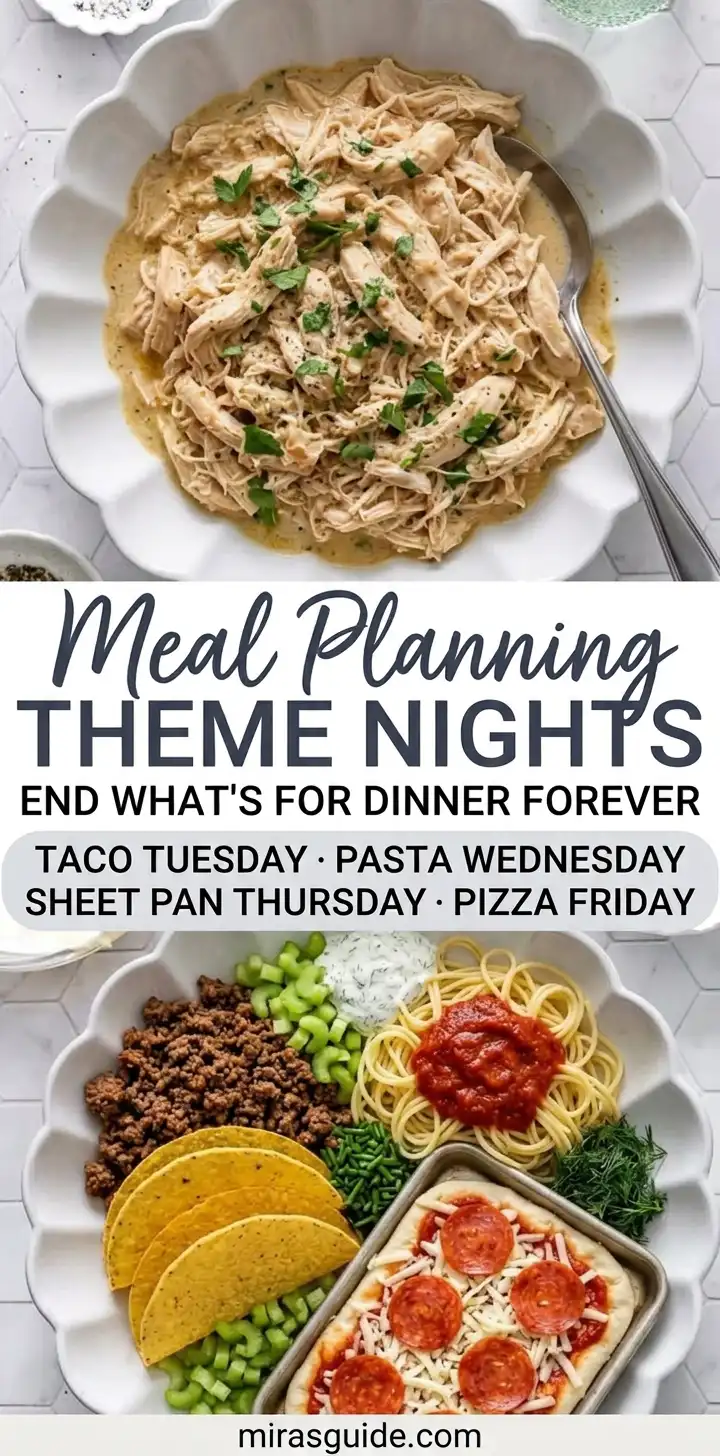
Meal planning theme nights are the single simplest hack for anyone who’s ever stood in front of the fridge at 6 pm asking, “so… what’s for dinner?” Because that question — repeated 365 times a year — is what breaks most meal planning routines.
This guide is the honest, family-tested framework for building a 7-night theme rotation that turns every weeknight into a semi-automatic dinner decision. No decision fatigue. No fancy recipe research.
Don’t Want to Plan Every Dinner Yourself?
28 Days of Dinners Planned for You gives you 28 days of dinners, grocery lists and prep guidance already organized for you.
Just a simple pattern (Taco Tuesday, Pasta Wednesday, Sheet Pan Thursday, and 4 more) that lets your brain rest and your kitchen still deliver real food. If Sunday meal prep intimidates you, theme nights are your gateway drug.
⚠️ Disclaimer: This meal plan is for general informational purposes only. Always consult your doctor before starting any new diet, especially if you have a medical condition, are pregnant, or nursing.
Why Theme Nights Work When Nothing Else Does 🧭
Regular meal planning fails because it demands too many decisions per week. Theme nights slash that decision load by 80%. Here’s why they stick:
- 🧠 1 decision, not 7 — you decide “tacos tonight,” not “chicken? beef? Mexican? Asian? soup?”
- 🛒 Predictable grocery list — you buy the same theme ingredients every week
- 👨👩👧👦 Family knows what to expect — kids ask for “spaghetti day” instead of complaining
- ⚡ Fast decisions = faster cooking — 20 min from decision to plate
- 💸 Consistent grocery spend — no impulse buys, no wasted proteins
- 🔁 Repetition breeds mastery — by month 3 you can execute Pasta Wednesday in your sleep
The good news: theme nights are the entry point for the rest of your meal planning system. Master these, and Sunday prep, budget planning, and family-favorite rotations fall into place.
The 4 Rules of Theme Night Meal Planning 🎯
Before the actual rotation, these rules run everything:
🎯 Rule 1: Pick 7 Themes You Can Execute in 30 Minutes
The whole point is speed. If your Taco Tuesday takes 90 minutes, it’s not a theme — it’s a chore. Every theme should be doable in under 30 min once you’re set up.
🎯 Rule 2: Keep One Theme Flexible for Real Life
Not every weeknight goes to plan. Reserve one night — usually Friday or Sunday — as a “flex night.” Leftovers, takeout, breakfast for dinner, whatever the week needs.
🎯 Rule 3: Repeat the Rotation for at Least 6 Weeks
Don’t judge theme nights after week 1. It takes 3–6 weeks for the family to buy in, for grocery patterns to lock in, and for you to actually feel the mental relief.
🎯 Rule 4: Each Theme Should Have 3–5 Variations
Taco Tuesday isn’t the same taco every week. Rotate between ground beef → shredded chicken → fish → black bean → pulled pork. Enough variety to prevent burnout, enough repetition to prevent decision fatigue.
The 5-Step Theme Night Setup System 🗓️
Here’s exactly how to build your family’s theme night rotation.
Step 1: Pick Your 7 Themes 📝
Choose from these winners (or invent your own):
- 🌮 Taco / Burrito Bowl Night
- 🍝 Pasta Night
- 🥘 Slow Cooker / Instant Pot Night
- 🍕 Pizza / Flatbread Night
- 🍳 Breakfast for Dinner (BFD)
- 🥗 Big Salad / Grain Bowl Night
- 🍔 Sheet Pan / Grill Night
- 🍜 Soup / Chili Night
- 🥡 Takeout / Leftovers Night
- 🍚 Stir-Fry Night
Choose the 7 that fit your family. Assign each to a day.
Step 2: Write Your Rotation on a Visible Board 📌
Whiteboard on the fridge. Chalk sign. Sharpie on a magnetic sheet. Doesn’t matter — write it where everyone sees it every day:
- Mon: Slow Cooker Night
- Tue: Taco Tuesday
- Wed: Pasta Night
- Thu: Sheet Pan Night
- Fri: Pizza Night
- Sat: Family Favorite / Grill
- Sun: Leftovers + Prep for the Week
Step 3: Build 3 Variations for Each Theme 📚
For each theme, list 3–5 variations:
Taco Tuesday variations: – Ground beef tacos with lettuce + cheese – Slow cooker chicken tacos – Fish tacos with slaw – Black bean + sweet potato tacos – Pulled pork tacos with pineapple
Cycle through — never repeats the same variation twice in a row.
Step 4: Standardize the Grocery List 🛒
Once themes are set, your grocery list becomes 90% predictable:
- Tacos: tortillas, cheese, salsa, avocado, protein-of-the-week
- Pasta: pasta box, jar sauce, protein-of-the-week, frozen vegetable
- Slow cooker: chicken thighs, potatoes, carrots, salsa or curry sauce
- Sheet pan: 1 protein, 2 vegetables, 1 starch
- Pizza: dough or flatbreads, sauce, cheese, toppings
You never wonder “what should I buy this week?” again.
Step 5: Batch-Prep Once a Week for Theme Support 🥩
Sunday afternoon, spend 30 min prepping theme staples:
- Batch-cook 1 protein (chicken thighs) → covers Taco Tue + Salad Wed
- Batch-cook 1 grain (rice or quinoa) → covers 3+ nights
- Wash + chop 3 vegetables → speeds every theme
That’s it. Theme nights + 30 min Sunday prep = your whole week.
A Sample Week: Theme Night Meal Plan 📋
Here’s a real week executed on the theme rotation:
Monday — Slow Cooker Night (5 min AM, 0 min PM)
- Slow cooker chicken thighs + salsa + black beans + corn (dumped in AM)
- Reheat + serve over rice + shredded cheese + avocado
- Family rating: 9/10
Tuesday — Taco Tuesday (15 min)
- Same slow cooker chicken reused, warmed with additional spices
- Warm tortillas, cheese, salsa, avocado, sour cream, lettuce
- Family builds their own; adults do burrito bowls
- Family rating: 10/10
Wednesday — Pasta Night (22 min)
- Whole-wheat pasta + jar marinara + ground turkey browned
- Frozen broccoli steamed on the side
- Parmesan + garlic bread
- Family rating: 9/10
Thursday — Sheet Pan Night (25 min)
- Salmon + sweet potato cubes + broccoli on one pan
- 20 min at 425°F
- Lemon + olive oil drizzle
- Family rating: 8/10 (kid: “salmon again?”)
Friday — Pizza Night (25 min)
- Whole-wheat flatbreads + sauce + shredded cheese + pepperoni or veggies
- 12 min in the oven
- Side salad or cut vegetables
- Family rating: 11/10 (universal Friday win)
Saturday — Family Favorite (30–45 min)
- Burgers on the grill + roasted potato wedges + salad
- Or whatever the family voted for
- Family rating: fluctuates
Sunday — Leftovers + Reset (10 min + 30 min prep)
- Whatever’s left: leftover pasta, leftover chicken, leftover pizza
- Then 30 min prep for the next week (bake chicken, chop veggies)
- Family rating: efficient
Managing Common Theme Night Challenges 🎯
“My family says they’re bored of pasta”
- Rotate variations weekly (spaghetti → mac & cheese → pesto pasta → carbonara → pasta salad)
- Change the shape (spaghetti → rigatoni → farfalle)
- Add a “wildcard” theme every 3 weeks (soup night, stir-fry night)
“I hate one of the themes I picked”
- Swap it. Theme nights aren’t law.
- Try new themes for 3 weeks, drop the ones that don’t work
- Common swap: BFD → soup night if breakfast for dinner doesn’t fly
“Themes feel too rigid — I want variety”
- Themes give the structure, variations give the variety
- Pasta Night can be spaghetti this week, ramen next, cold pasta salad the week after
- The framework is the same, the meal is different
“We eat late because of activities”
- Slow cooker night on the busiest activity day
- Sheet pan on the second busiest
- BFD or takeout on the third
- Your busiest days should always be the fastest themes
“The kids sabotage me on their non-favorite themes”
- Involve them in choosing the rotation
- Let each kid pick 1 theme for the week
- One-bite rule: try the theme’s variation, decide next week
- Kids often outgrow food battles once themes normalize
The Theme Night Pantry Base 📦
Stock these — your theme-night foundation:
Refrigerator: – Shredded cheese, sour cream, salsa jars – Rotisserie chicken, eggs, ground beef/turkey (frozen) – Tortillas, sourdough, flatbreads – Baby carrots, cucumbers, salad greens – Butter, milk, yogurt
Freezer: – Frozen vegetables (broccoli, peas, cauliflower rice) – Frozen shrimp, salmon, chicken breasts – Frozen pizza dough or flatbreads – Frozen berries – Backup family-favorite frozen meal
Pantry: – Pasta (multiple shapes), rice, quinoa – Canned tomatoes, jar pasta sauce – Canned beans (black, kidney, chickpea) – Broth cartons, coconut milk – Taco seasoning, curry paste, jerk seasoning – Olive oil, soy sauce, salsa
FAQ
How is this different from just meal planning?
Theme nights are a subset of meal planning — the decision-elimination layer. Regular meal planning still asks “what am I making this week?” Theme nights answer that question upfront and permanently. Instead of choosing 7 recipes a week, you choose 7 categories once and rotate variations forever.
What are the most common theme night mistakes?
Picking too many themes, or themes that take too long. If Sunday is “gourmet Italian night” and it takes 90 minutes, it will collapse by week 3. Every theme should be under 30 minutes. Simple is more sustainable than fancy.
Do theme nights save money?
Yes — usually $30–60/week. Predictable groceries = fewer impulse buys, fewer wasted proteins, fewer takeout nights. Most families report the biggest savings come from the “we would have ordered takeout” nights that now have a plan.
How do I get my family on board?
Let them help build the rotation. Ask each family member to pick 1 theme they love and 1 variation they want tried. Give it 3 weeks — buy-in usually happens once kids start asking for “pasta night!” on their own.
How does this fit with the rest of my meal planning?
Theme nights are the foundation everything else builds on. Our beginner meal planning guide covers the full weekly system, with theme nights as one option. Our Sunday meal prep plan covers the 30-minute Sunday prep that supports theme nights. Our meal planning rotation walks through the broader concept of recipe cycles that keep the plan alive long-term.
Your Next Step 👉
Pick ONE thing this week. My honest suggestion:
- Choose 7 themes. Write them on the fridge tonight. Just decide.
- This week, follow the rotation exactly. Even if it feels awkward.
- List 3 variations for each theme. So next week isn’t identical.
- Do a 30-min Sunday prep (1 protein, 1 grain, 3 vegetables). Theme execution gets 3x faster.
That’s your first week of theme night meal planning.
Once themes stick, layer on the rest. Our Sunday meal prep plan walks through the 30-minute Sunday prep that turbo-charges theme execution. Our meal planning rotation covers the bigger picture of long-term recipe cycles. And our beginner meal planning guide covers foundational planning skills that theme nights slot into.
Meal planning theme nights aren’t about limiting variety — they’re about ending the daily dinner debate. Do that, and every weeknight gets 30 minutes and one mental load lighter.

Stop wondering what’s for dinner
This article covers tonight. 28 Days of Dinners Planned for You covers the next 27—decided, shopped and prepped.
- ✓ 28 dinner recipes for real weeknights
- ✓ 4 weekly grocery lists, done for you
- ✓ Simple prep guidance for smoother evenings
- ✓ Leftover strategy & emergency dinners



Pingback: Meal Planning Rotation: The 4-Week System That Lasts
Pingback: Costco Dinner Meal Plan: The Weeknight Framework