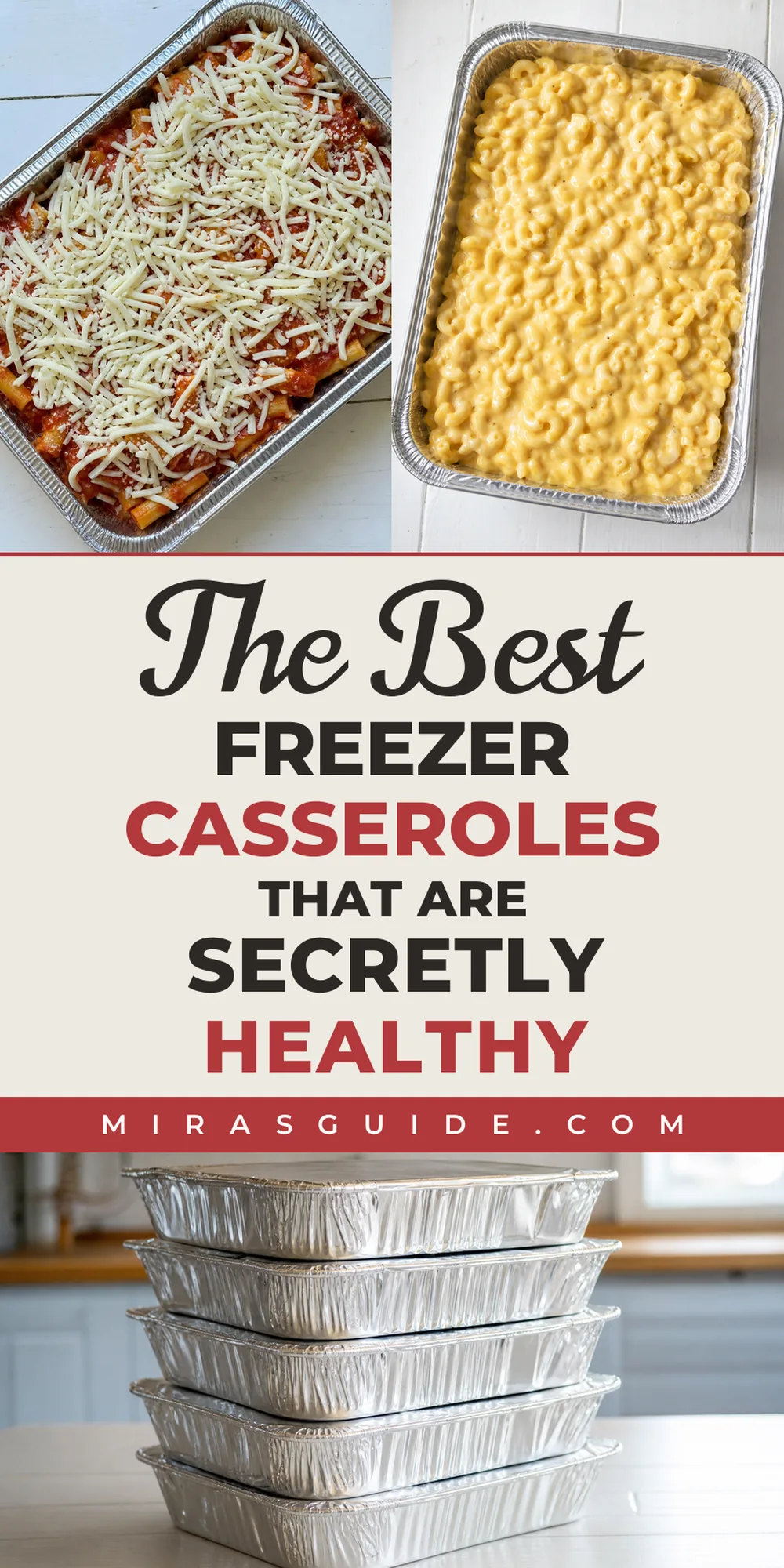
Healthy freezer casseroles usually fail for the same two reasons: they’re built on heavy cream sauces that split when they freeze, or they’re lightened so aggressively that the texture turns watery and bland. These ten solve both problems — each one is engineered for the freezer with the right sauce-to-solid ratio, and each is lighter than a traditional version without tasting like a compromise.
Why These Ten Work 🥘
- Built for the freezer, not adapted to it — no cream sauces that break, no raw potatoes that go grainy.
- Vegetables are structural, not decorative — added in quantities that carry the dish rather than garnish it.
- Lean protein, real portions — chicken breast, ground turkey, beans, and lentils.
- Lightened honestly — Greek yogurt and cottage cheese instead of cream, extra vegetables instead of filler.
- Ten casseroles, all 9×13 — 8–12 servings each, about 20 minutes of assembly apiece.
Recipe at a Glance
Assembly: 20 minutes per casserole
Bake: 35–45 minutes (or freeze unbaked)
Yield: 10 casseroles, 8–12 servings each
Freezer life: 3 months for best quality
Difficulty: Easy
Method: Freeze-unbaked casserole assembly
The Casserole Engineering Rules 🛒
Ten casseroles that reheat like they were just made.
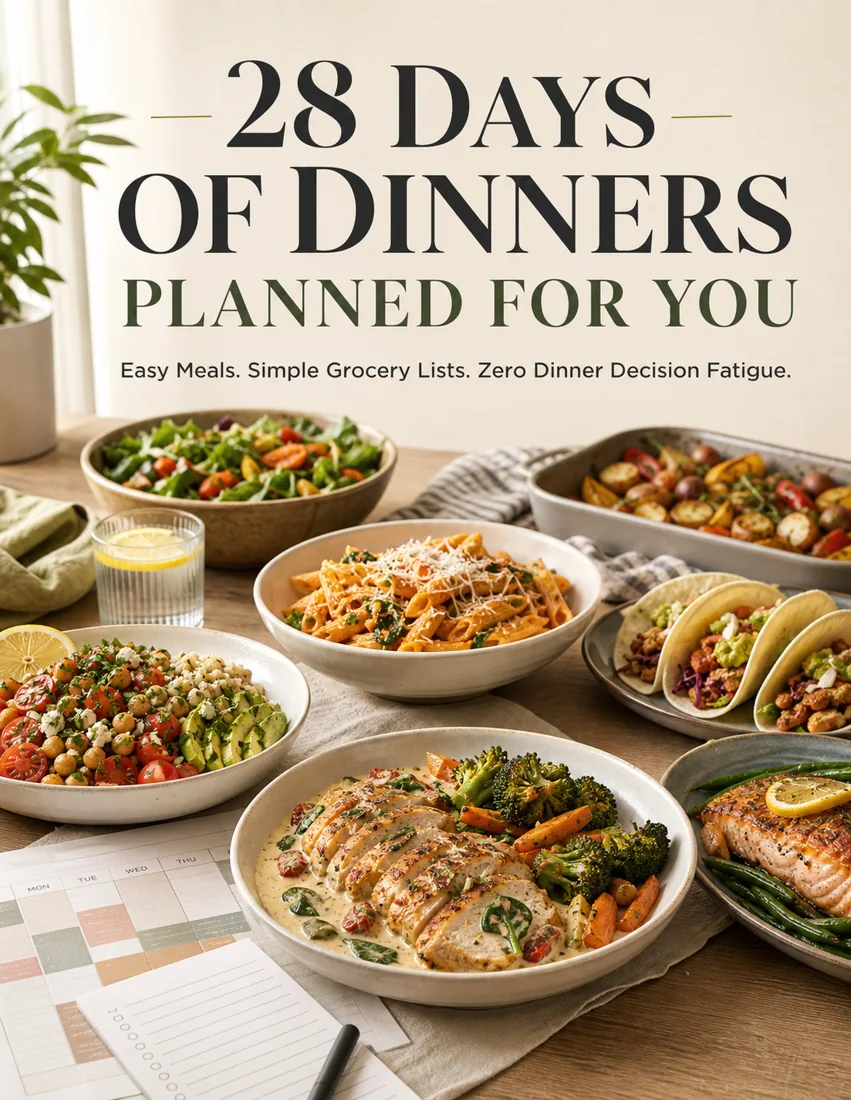
28 Days of Dinners Planned for You hands you a month of weeknight dinners with the shopping list already written—no more 5pm decisions.
Rule 1: The sauce-to-solid ratio must be about 1:3
A casserole needs enough sauce to bind everything and coat it, but not so much that it turns to soup when the vegetables release their water during baking. If you can see visible liquid pooling before it goes in the oven, there’s too much. Thick sauces — ones that hold a ribbon on a spoon — freeze and reheat far better than thin ones.
Rule 2: Never freeze raw pasta or rice in a casserole
Both keep absorbing liquid in the freezer and the oven, and both turn to paste. Two options that work: par-cook pasta to well under al dente (about 4 minutes for regular pasta) so it finishes in the oven, or fully cook it and accept a slightly softer result. Rice should always be cooked before it goes in.
Rule 3: Cream sauces break — use these instead
Heavy cream, milk, and sour cream separate into grainy fat and water when frozen. That’s why so many creamy casseroles are disappointing after freezing. The fixes that genuinely work:
- Greek yogurt — stirred into the filling after cooking, it thickens without splitting
- Cottage cheese blended smooth — behaves like ricotta, higher in protein, and freezes well
- A slurry of cornstarch and milk — thickens without the fat separation problem
- Pureed vegetables — blended cauliflower or squash adds body and creaminess with no dairy at all
Rule 4: Cook vegetables before they go in
Raw vegetables release water in the oven and dilute the sauce. Sautéing or roasting them first drives off that moisture and concentrates flavor. This applies especially to mushrooms, zucchini, and spinach — the three worst offenders in a casserole.
Rule 5: Don’t freeze the topping
Crisp toppings — breadcrumbs, crushed chips, toasted nuts — go soft in the freezer no matter how well you wrap them. Add them on the day you bake, not before freezing.
Freeze unbaked, not baked. An unbaked casserole holds up dramatically better than a baked-then-frozen one, because the pasta and grains haven’t already absorbed their liquid and the sauce hasn’t already broken. Assemble it in a foil pan, wrap it tightly, and bake it from frozen or thawed when you need it.
Use foil pans for freezing, and reuse the good ones. A disposable foil 9×13 costs very little and can go from freezer to oven without a transfer step. Glass works but is heavier and can crack under thermal shock if moved straight from freezer to hot oven.
Under-season slightly less than you’d think. Freezing mutes seasoning, and the vegetables’ water dilutes what’s there. Season the sauce a touch more boldly than tastes right on the spoon.
Equipment
- 10 disposable 9×13 foil pans (or reusable ones)
- Heavy-duty foil for a tight double wrap
- Marker and masking tape — baking instructions go on the lid
- Large skillet for precooking vegetables and browning meat
The 10 Casseroles 👩🍳
1. Chicken broccoli and quinoa bake
Cooked quinoa, shredded chicken breast, steamed broccoli, and a sauce of Greek yogurt, chicken broth, garlic, and a little sharp cheddar. Bake: 375°F for 35 minutes. Why it’s lighter: quinoa replaces pasta and Greek yogurt replaces cream — roughly half the fat of a traditional version with more protein.
2. Turkey and vegetable lasagna
Lean ground turkey, crushed tomatoes, zucchini ribbons layered with lasagna noodles, ricotta blended with cottage cheese, and a modest amount of mozzarella. Bake: 375°F for 45 minutes. Why it’s lighter: zucchini layers replace half the noodles, and blended cottage cheese cuts the ricotta fat.
3. Lentil and vegetable shepherd’s pie
Brown lentils simmered with carrots, celery, and tomato paste under a mashed potato and cauliflower topping. Bake: 400°F for 30 minutes. Why it’s lighter: lentils replace ground lamb, and half the potato is cauliflower.
4. Chicken and wild rice bake
Cooked wild rice blend, chicken breast, mushrooms, celery, and a cornstarch-thickened broth sauce with a light crumb topping added fresh. Bake: 375°F for 40 minutes. Why it’s lighter: the sauce is thickened with cornstarch rather than a butter-and-flour roux, and the crumb topping goes on at bake time.
5. Spinach and feta egg bake
Eggs, egg whites, sautéed spinach, feta, onion, and cottage cheese. Bake: 350°F for 40 minutes. Why it’s lighter: egg whites bulk up the protein without adding fat. Excellent as breakfast or dinner.
6. Black bean and sweet potato enchilada bake
Corn tortillas, black beans, roasted sweet potato, enchilada sauce, and a moderate amount of cheese. Bake: 375°F for 35 minutes. Why it’s lighter: beans replace most of the cheese that normally carries an enchilada bake.
7. Tuna and vegetable noodle bake
Whole wheat noodles par-cooked, tuna, peas, mushrooms, and a sauce of blended cottage cheese, milk, and Dijon. Bake: 375°F for 35 minutes. Why it’s lighter: the classic version uses a butter-flour-milk sauce plus cheese; blended cottage cheese does the same job with far less fat and more protein.
8. Stuffed pepper casserole
Cooked rice, browned ground turkey, diced bell peppers, crushed tomatoes, Italian seasoning, topped with a thin layer of mozzarella. Bake: 375°F for 40 minutes. Why it’s lighter: it’s a stuffed pepper in casserole form — half the cheese, twice the peppers.
9. Cauliflower and chickpea curry bake
Roasted cauliflower, chickpeas, and spinach in a curry-coconut sauce, topped with a small amount of toasted panko added at bake time. Bake: 400°F for 30 minutes. Why it’s lighter: no dairy at all — coconut milk provides the richness, and it doesn’t split when frozen.
10. Chicken parmesan quinoa bake
Cooked quinoa, chicken breast, marinara, and a light layer of mozzarella and Parmesan, with a fresh breadcrumb topping added before baking. Bake: 375°F for 35 minutes. Why it’s lighter: quinoa replaces breaded cutlets and the breadcrumb coating, cutting both carbs and frying oil entirely.
Freezing instructions for all ten
Assemble in a foil pan, cool completely if any component was hot, then wrap tightly in plastic followed by heavy-duty foil. Write the casserole name, the oven temperature, the bake time, and the date on the foil. Freeze flat, stacked no more than three high.
Why the Technique Works
Freezing damages emulsions. A cream sauce is a suspension of fat droplets held in water by proteins and emulsifiers, and when it freezes, ice crystals form and push those droplets together. On thawing, they coalesce instead of re-dispersing, which is what produces the grainy, separated texture people blame on reheating. Greek yogurt and blended cottage cheese resist this because their structure comes from a protein gel rather than a free-fat emulsion — the protein network holds water in place and doesn’t collapse when ice forms inside it. That’s why the swap isn’t just a calorie trade; it’s a functional fix. Similarly, cornstarch-thickened sauces survive freezing better than flour-thickened ones because cornstarch gelatinizes into a more stable structure that doesn’t retrograde into a watery mess the way wheat starch can. The other half of the puzzle is water control: precooking vegetables removes the water they’d otherwise release in the oven and dilute the sauce from the inside.
Cooking Tips & Expert Advice
- Freeze unbaked. It’s the single biggest quality upgrade available to a casserole.
- Par-cook pasta to well under al dente. About 4 minutes. It finishes in the oven instead of turning mushy.
- Sauté mushrooms, zucchini, and spinach first. They’re the three biggest water-releasers in casserole cooking.
- Add crisp toppings at bake time, never before freezing.
- Cool completely before wrapping. Warm casseroles trap steam, which becomes ice crystals and freezer burn.
- Bake from frozen at the same temperature, adding 25–35 minutes. Cover with foil for the first half so the top doesn’t burn before the center is hot.
- Use a thermometer the first time. The center should reach 165°F for anything with poultry.
- Write instructions on the foil — temperature, time, and whether it’s frozen or thawed. Anyone should be able to bake it without asking.
Variations & Substitutions
- Vegetarian: casseroles 3, 5, 6, and 9 are already meatless; swap chicken for chickpeas in 1 and 4.
- Dairy-free: casseroles 3, 6, and 9 are naturally dairy-free. Use coconut milk or pureed cauliflower in place of yogurt sauces.
- Gluten-free: use GF noodles, GF oats, and corn tortillas; check the enchilada sauce and broth.
- Individual portions: assemble in ramekins or a muffin tin for single servings that reheat in 90 seconds.
- Lower carb: swap quinoa and rice for cauliflower rice, and double the non-starchy vegetables.
- Higher protein: add an extra cup of shredded chicken or a can of beans to any casserole; increase the sauce slightly to compensate.
- Family-size doubling: most of these scale cleanly to two 9×13 pans, or one deep lasagna pan with a longer bake.
Serving Suggestions
Serve straight from the pan with a simple side salad or steamed green beans — the casseroles already contain vegetables, so the side is about freshness and texture rather than nutrition. Each one is a complete meal on its own, which is the point of a casserole.
Storage, Freezing & Reheating
Freeze unbaked, tightly wrapped, for up to 3 months at 0°F for quality. Bake from frozen at the temperature listed, covered with foil for the first half, adding 25–35 minutes to the stated time. Baked leftovers keep 4 days refrigerated; reheat individual portions in the microwave until steaming hot, 165°F for anything with poultry. Don’t refreeze a thawed casserole that was already baked.
Troubleshooting
Why is my casserole watery? Vegetables went in raw and released their water, or the sauce was too thin to begin with. Sauté vegetables first and thicken sauces to a ribbon consistency.
Why did the sauce separate after freezing? It was cream-, milk-, or sour-cream-based. Switch to Greek yogurt, blended cottage cheese, or a cornstarch slurry.
Why did the pasta turn to mush? It was fully cooked before freezing, or frozen cooked rather than unbaked. Par-cook to about 4 minutes and freeze before baking.
Why is the topping soggy? It was added before freezing. Crisp toppings go on at bake time, always.
Why did the center stay cold while the edges burned? It was baked from frozen without foil. Cover for the first half of the bake so heat penetrates evenly.
❓ FAQ
Is it better to freeze baked or unbaked? Unbaked, without question. The pasta hasn’t absorbed its liquid yet, the sauce hasn’t broken, and the texture is much closer to freshly made.
Can I bake these from frozen? Yes — same temperature, covered with foil for the first half, adding 25–35 minutes. Check the center reaches 165°F for poultry dishes.
How long do they keep? Three months at 0°F for quality. They stay safe longer, but flavors fade and textures soften.
Can I use glass pans instead of foil? Yes, for baking at home. For freezing, foil is lighter, stacks better, and can go freezer-to-oven without thermal shock risk.
Can I make these smaller? Yes — 8×8 pans for half-size, or ramekins for single servings. Reduce bake time by about 10 minutes.
Are these actually healthy? They’re lighter than conventional casseroles: more vegetables, leaner protein, and dairy swaps that cut fat. They’re still casseroles, so treat the calorie counts as estimates and adjust portions to your needs.
Nutrition, Allergens & Dietary
Per serving, these generally land between 300 and 450 calories with 18–28g of protein and 4–8g of fiber depending on portion size and additions. Allergens vary by recipe: dairy appears in 1, 2, 4, 5, 6, 7, 8, and 10; gluten in the noodles and breadcrumbs in 2, 4, 7, and 10; eggs in 5; fish in 7. Casseroles 3, 6, and 9 are dairy-free, and 3 and 9 are vegan. Nutrition figures are estimates.
Final Thoughts
The two decisions that determine whether a freezer casserole turns out well both happen before it goes in the pan: what thickens your sauce, and whether the vegetables are cooked first. Get those right and freeze it unbaked, and you get a casserole that comes out of the oven tasting like it was made that afternoon — which is exactly what a well-engineered freezer meal should do.
Once these run out, what’s for dinner next month?
Ten casseroles buys you a month of dinners. 28 Days of Dinners buys you the month after.
- ✓ 28 weeknight dinners, already chosen
- ✓ One shopping list per week
- ✓ Balanced, everyday ingredients
- ✓ Short weeknight cook times