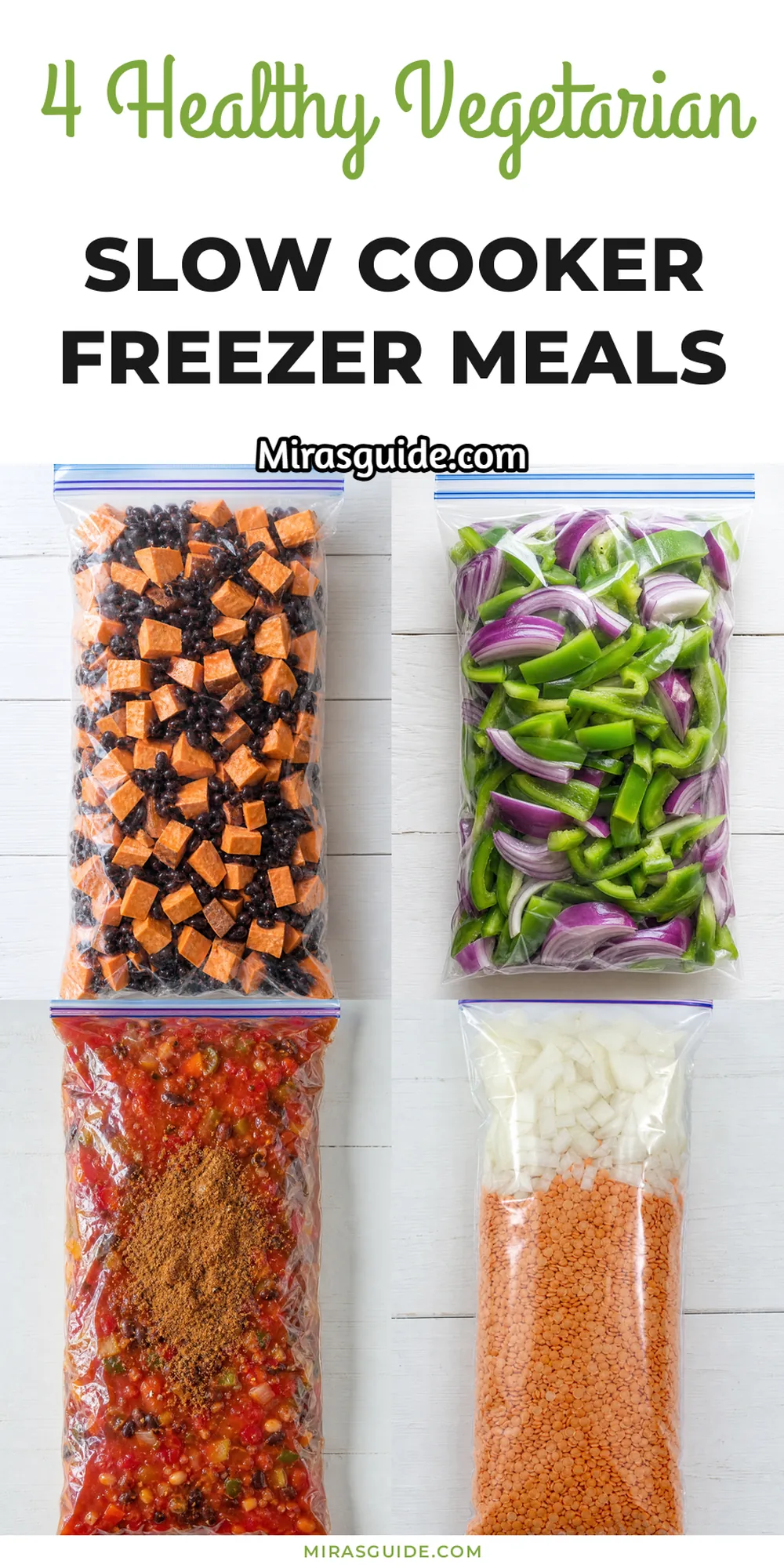
Vegetarian slow cooker freezer meals are four recipes worth making well rather than fifteen worth making fast. Each one is built to survive both the freezer and six hours of slow cooking without turning to mush — which is the real problem with vegetarian slow-cooker food, since vegetables have no connective tissue to hold them together and beans go from tender to paste faster than anyone expects.
Why Just Four, Done Properly 🌿
- Four recipes, four bags each — sixteen dinners from one 45-minute session.
- No mush — vegetables added in the right order and at the right time, not dumped together.
- Actually filling — each one has 15g+ of protein from beans, lentils, or tofu, not just vegetables in sauce.
- No browning, no stovetop — the entire prep is chopping and opening cans.
- Pantry-stable shopping list — cans, dried goods, and frozen vegetables, no fresh-meat timing pressure.
Recipe at a Glance
Assembly: 45 minutes for 16 bags
Yield: 16 meals, 4 servings each
Freezer life: 3 months for best quality
Cook time: 5–7 hours on low
Difficulty: Very easy
Method: Vegetarian freezer bag assembly
Before You Start: The Vegetarian Slow Cooker Problem 🛒
Four meals, sixteen bags, zero guesswork.
28 Days of Dinners Planned for You hands you a month of weeknight dinners with the shopping list already written—no more 5pm decisions.
Vegetables don’t hold their shape the way meat does
A beef stew can sit for eight hours because collagen needs time to break down. Vegetables have nothing to break down — they go from firm to soft to disintegrated on a schedule of their own. That’s why every recipe below sorts vegetables into two groups:
- Sturdy (in the bag): onions, carrots, celery, sweet potato, butternut squash, cauliflower, mushrooms, canned tomatoes. These survive hours of heat.
- Delicate (added at the end): spinach, kale, peas, zucchini, bell peppers, broccoli. Fifteen to twenty minutes, maximum.
Vegetable broth is doing more work than you think
In a meat stew, the meat provides the savory depth. Remove it and the broth has to carry everything. Most store-bought vegetable broth is thin, sweet, and tastes vaguely of carrot. Fix it cheaply: add a tablespoon of tomato paste, a tablespoon of nutritional yeast, a splash of soy sauce or tamari, and a few dried mushrooms to each bag. That combination creates the glutamates that make food taste substantial, and it costs almost nothing.
Beans need acid added late
Tomatoes, lemon, and vinegar slow the softening of beans during cooking. If you’re using canned beans this barely matters — they’re already soft. If you use dried beans, cook them fully first or add acidic ingredients only in the last hour.
Use canned beans, not dried, for freezer bags. Canned beans are already cooked, so they can’t end up underdone, and they hold up better through freezing. Dried beans in a slow cooker can take 6–8 hours even after soaking and are inconsistent across altitudes and water hardness.
Nutritional yeast and tomato paste are your umami. A tablespoon of each per bag turns a thin vegetable broth into something that tastes like it cooked all day.
Skip dairy in the bags. Cream and milk split in the freezer and again in a slow cooker. Coconut milk is a stable substitute; if you want yogurt or sour cream, stir it in after the slow cooker is off.
Equipment
- 16 freezer-safe gallon bags
- Marker and masking tape
- Two sheet pans for freezing flat
- Large cutting board — there’s a lot of chopping, and a big board is faster than a small one
The Four Meals 👩🍳
1. Red lentil coconut curry (4 bags)
Per bag: 1 cup red lentils, 1 can full-fat coconut milk, 1 cup vegetable broth, 1 cup sweet potato cubes, 1 cup cauliflower florets, 1 onion diced, 1 tablespoon curry powder, 1 tablespoon tomato paste, 1 tablespoon nutritional yeast, 1 teaspoon minced ginger, 1 tablespoon garlic, ½ teaspoon salt.
Cook: 5 hours on low. Finish: stir in 2 cups baby spinach and a squeeze of lime.
Why it works: Red lentils break down completely, thickening the curry into something creamy without any dairy. They also carry protein — about 12g per cooked cup — which is what makes this a dinner rather than a side.
2. Three-bean chili (4 bags)
Per bag: 1 can kidney beans, 1 can black beans, 1 can pinto beans (all drained), 1 can crushed tomatoes, 1 cup corn, 1 bell pepper diced, 1 onion diced, 2 tablespoons chili powder, 1 tablespoon cumin, 1 tablespoon tomato paste, 1 teaspoon smoked paprika, 1 tablespoon garlic, ½ cup vegetable broth.
Cook: 6 hours on low. Finish: lime juice, and top with avocado or vegan sour cream.
Why it works: Three kinds of beans give three different textures, so it doesn’t read as a single mushy mass. The smoked paprika does the work that bacon or ground beef normally would.
3. Chickpea and sweet potato stew (4 bags)
Per bag: 2 cans chickpeas drained, 2 cups sweet potato cubes, 1 can diced tomatoes, 1 cup vegetable broth, 1 onion diced, 2 cups kale (frozen in the bag is fine), 1 tablespoon Moroccan spice blend (cumin, coriander, cinnamon, ginger), 1 tablespoon tomato paste, 1 tablespoon garlic, ½ teaspoon salt.
Cook: 5 hours on low. Finish: a tablespoon of lemon juice and a spoon of tahini stirred through.
Why it works: Sweet potato holds its shape far better than white potato after freezing, and its sweetness balances the cumin and cinnamon. The tahini at the end adds richness and a slight bitterness that makes the whole thing taste finished.
4. Mushroom barley stew (4 bags)
Per bag: 1 lb sliced mushrooms, 1 cup pearl barley, 4 cups vegetable broth, 2 carrots sliced, 2 celery stalks sliced, 1 onion diced, 1 tablespoon dried thyme, 2 tablespoons tamari, 1 tablespoon tomato paste, 1 tablespoon nutritional yeast, 1 tablespoon garlic, 1 bay leaf.
Cook: 6 hours on low. Finish: remove the bay leaf and stir in a splash of tamari.
Why it works: Barley releases starch as it cooks, thickening the broth into a gravy on its own — no thickener needed. Mushrooms plus tamari plus nutritional yeast is the closest a vegetarian stew gets to a beef-and-barley flavor profile.
Assembly order for all four
Canned or sturdy vegetables first, then grains or legumes, then liquid to about a third of the way up the contents, then tomato paste and seasonings on top. Press flat, squeeze out the air, seal, and freeze flat on a sheet pan.
Why the Technique Works
Slow cookers and vegetarian food have a mismatch that’s worth understanding: a slow cooker’s whole value is breaking down tough connective tissue over hours, and plants don’t have connective tissue. What they have is pectin in cell walls, which softens much faster and then keeps going. That’s why the same six hours that makes beef chuck tender turns carrots to paste and broccoli to nothing. The solution isn’t a shorter cook time — it’s sorting your vegetables by structural durability and treating them differently. Sturdy roots and brassicas go in the bag; tender greens and quick-cooking vegetables go in at the end. Meanwhile, the barley and red lentils in these recipes are doing a second job: their starch leaches into the cooking liquid and thickens it naturally, so these stews reach a gravy consistency without a single tablespoon of flour or cornstarch.
Cooking Tips & Expert Advice
- Fix your broth. Tomato paste, nutritional yeast, tamari, and dried mushrooms turn watery vegetable broth into something with real depth. It’s the single biggest upgrade to vegetarian slow cooking.
- Sort vegetables by durability. Sturdy in the bag, delicate at the end. This is the difference between a stew and a purée.
- Add acid at the end. Lemon, lime, or vinegar restores brightness that hours of heat destroys.
- Keep the liquid to a third of the way up. Vegetables release a lot of water and nothing evaporates in a slow cooker.
- Stir tahini or nut butter in at the end for richness without dairy — a tablespoon transforms a thin stew.
- Toast the spices in oil first if you have three extra minutes. Blooming cumin, curry powder, or chili powder in a little oil before it hits the bag makes a noticeable difference that survives freezing.
- Label with cook time. All four are 5–6 hours, but writing it on the bag means no one has to look it up.
Variations & Substitutions
- Vegan: all four are already vegan as written.
- Gluten-free: swap the barley for 1 cup of quinoa or 1½ cups of cooked brown rice, and use tamari. Note that pearl barley contains gluten and cannot be substituted one-for-one with a GF grain without changing the thickening behavior — add 1 tablespoon of cornstarch at the end instead.
- Higher protein: add 1 cup of cooked quinoa or a can of extra beans per bag.
- Lower carb: drop the barley and reduce sweet potato; add extra cauliflower and mushrooms.
- Soy-free: replace tamari with coconut aminos.
- Instant Pot: cook from frozen for 22 minutes under pressure with an extra ½ cup of liquid; add greens after the pressure releases.
Serving Suggestions
Serve the curry and chickpea stew over rice or with naan; the chili with cornbread or in a bowl with avocado; the barley stew with crusty bread or over mashed potatoes. Each is a complete meal on its own, but a simple green salad alongside makes them feel like a proper dinner rather than a bowl of stew.
Storage, Freezing & Reheating
Freeze flat up to 3 months at 0°F for quality. Thaw overnight in the refrigerator. Reheat gently on the stovetop or in the microwave — these thicken in the fridge, so add a splash of broth or water as you reheat. Leftovers keep 4 days refrigerated. Don’t reheat in a slow cooker from cold; it takes too long and the vegetables overcook a second time.
Troubleshooting
Why did my vegetables turn to mush? Everything went in at once. Put delicate vegetables in during the last 20 minutes, not in the freezer bag.
Why does it taste watery and bland? Store-bought vegetable broth alone isn’t enough. Add tomato paste, nutritional yeast, tamari, and dried mushrooms to build depth.
Why did my stew come out dry? The grains absorbed the liquid. Barley and lentils keep drinking as they cook. Add an extra half cup of broth per bag next time, and loosen with water when reheating.
Why did the beans break apart? They cooked too long or were stirred too much. Let it cook undisturbed and stir only at the end.
Why is it too sweet? Some vegetable broths and sweet potatoes are naturally sweet. Counter it with acid — a full tablespoon of lemon juice or vinegar at the end, not a squeeze.
❓ FAQ
Are these filling enough as a main course? Yes — the lentils, chickpeas, beans, and barley provide 12–18g of protein per serving, which is what makes them a dinner rather than a side dish.
Can I use frozen vegetables? Absolutely, and it saves significant time. Add them frozen to the bag. They’re pre-blanched, so they hold up better in a slow cooker than raw delicate vegetables would.
Do I need to thaw before cooking? Best practice, yes. From frozen it works but takes about 2 extra hours and cooks unevenly, with mushy edges and a cold center.
Can I make these on the stovetop instead? Yes. Simmer 30–40 minutes, or 25 in a pressure cooker. The flavor is slightly fresher and the vegetables firmer.
Why only four recipes? Because four recipes done properly — sixteen dinners — beats twelve recipes you don’t want to eat twice. Once these are in the rotation, add more.
Can I freeze these in jars instead of bags? Yes, for single portions. Leave 2 inches of headspace and use wide-mouth jars so they don’t crack as the contents expand.
Nutrition, Allergens & Dietary
Per serving, these land between 300 and 430 calories with 12–18g of protein and 10–16g of fiber depending on portion size. All four are vegetarian and vegan as written. Meals 1, 2, and 4 contain soy (tamari); meal 4 contains gluten from barley. Coconut is present in meal 1. The barley stew is the only one that isn’t gluten-free. Nutrition is an estimate.
Final Thoughts
Vegetarian slow cooking fails for one predictable reason: people treat vegetables like meat and cook them for hours. Sort them by how much heat they can take, put only the sturdy ones in the bag, and build your broth so it carries the flavor meat would have provided. Do those two things and these four recipes come out tasting deliberate every time.
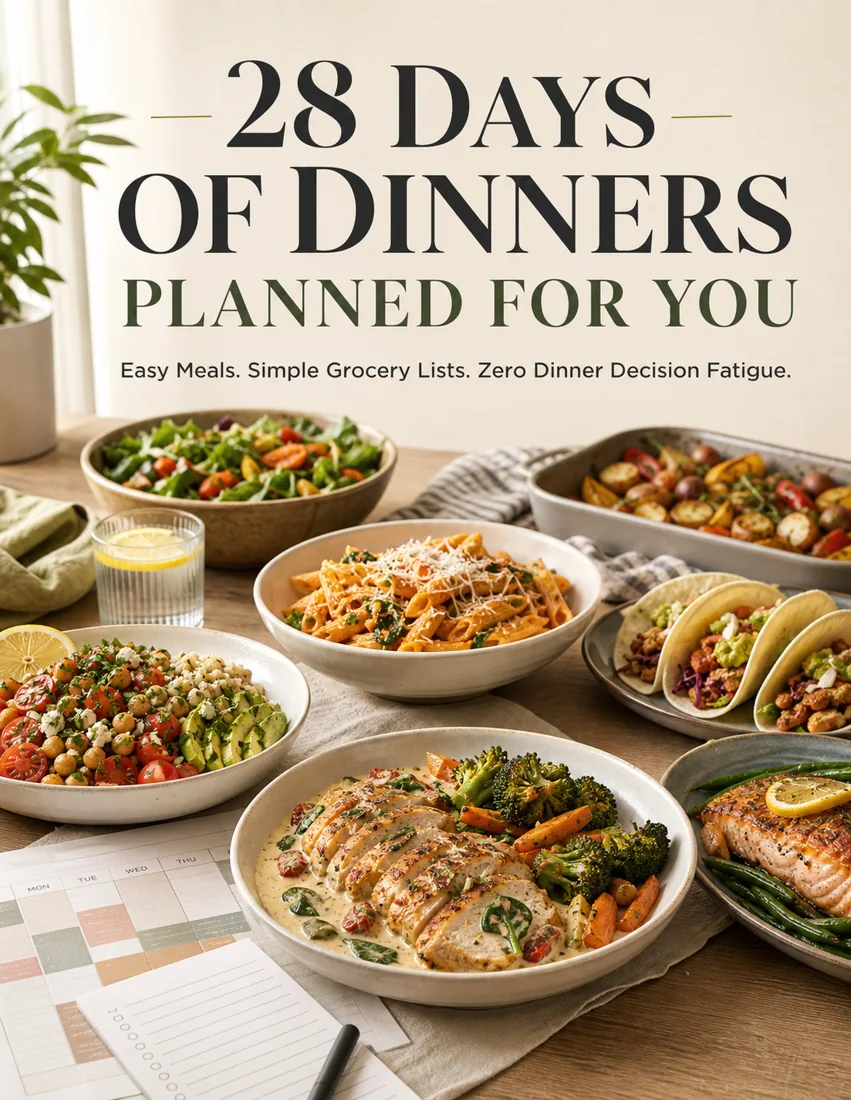
Once these run out, what’s for dinner next month?
Sixteen bags is about six weeks of dinners. 28 Days of Dinners covers the rest of the month.
- ✓ 28 weeknight dinners, already chosen
- ✓ Shopping lists done for you
- ✓ Slow cooker friendly
- ✓ Everyday grocery-store ingredients